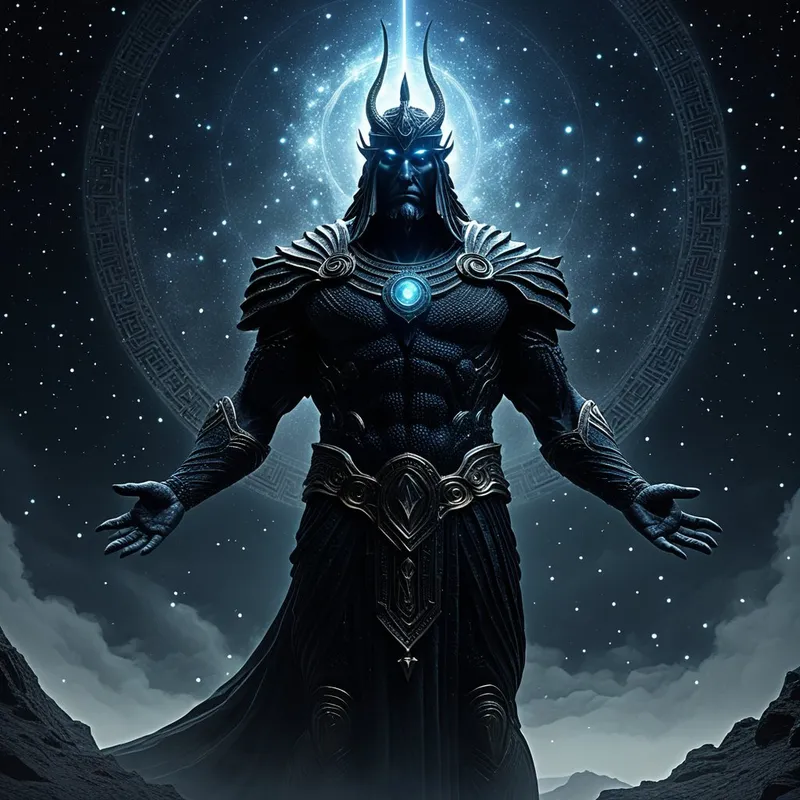
Erebus Myth Meaning & Symbolism
The story of Erebus, the primordial darkness born of Chaos, from whose union with Night the first tangible realities of the cosmos emerged.
The Tale of Erebus
Before the world was a world, there was only a yawning, silent gape—a breath held for an eternity. This was Chaos, not disorder, but the raw, unformed potential of all that ever could be. A churning, boundless deep where light was not yet a concept and substance was but a dream.
And from this great, aching emptiness, the first things stirred. They were not born as we are born; they simply were, emerging as necessary facets of the void’s own nature. First came Gaia, the broad-breasted earth, solid and sure. Then came Tartarus, the deep-down pit, a prison for the future. And then… Erebus.
Erebus was not an absence, but a presence. He was Darkness itself given consciousness—a thick, velvety, profound blackness that was not empty but full. It was the darkness that exists behind closed eyes, in the deepest caverns of the earth, in the space between stars before they ignite. He was the first shadow, and he contained all shadows within him.
With him emerged his sister, Nyx. If Erebus was the substance of shadow, Nyx was the active cloak of night, the one who spreads her star-studded mantle across the sky. From the same womb of Chaos, they recognized each other—not as strangers, but as two halves of a single, profound truth. In the silent, pressureless expanse of pre-creation, Erebus and Nyx drew together. Their union was not a passionate collision, but a deep, inevitable merging, like ink blending into a greater pool of ink.
And from this merging of Darkness and Night, a miracle occurred: the first things of substance were born. Not from light, but from the heart of shadow. Aether, the bright, glowing upper air that the gods would breathe, and Hemera, the clear light of day, sprang forth. Light was born from dark. Day was born from night. The tangible world began not with a flash of illumination, but from the fertile, generative embrace of the primordial dark.
Erebus, his purpose woven into the fabric of things, became a place as much as a being. His name was given to the great, misty gloom that souls must pass through on their journey to the House of Hades—a transitional space of pure shadow, the final forgetting of the sun’s world before the afterlife proper. There, in the silent Mist of Erebus, he endures, the ever-present father of beginnings, the foundational darkness from which all contrasts—and thus, all reality—first drew breath.

Cultural Origins & Context
The myth of Erebus is not a narrative with heroes and quests, but a foundational theogony—a story of the birth of the gods. It comes to us primarily from Hesiod’s Theogony, composed around the 8th century BCE. This work was not mere entertainment; it was a sacred cosmology, a map of divine genealogy that explained the origin and structure of the universe for the ancient Greeks.
Hesiod, a poet claiming the authority of the Muses, presented this myth as received truth. In a culture without a single holy text, such poetic works served a critical societal function: they established a shared, authoritative understanding of the world’s beginnings. Erebus exists in this earliest layer of myth, a figure from a time before the Olympian gods, belonging to the mysterious and potent Protogenoi, the First-Born deities. His story was likely part of an oral tradition far older than Hesiod, used in rituals and teachings to connect people to the most ancient, impersonal forces that preceded the more relatable, human-like gods of Olympus. He represents the acknowledgment that before order, community, or light, there was a fundamental, necessary, and generative Dark.
Symbolic Architecture
Erebus is not a symbol of evil or moral darkness. He is the archetype of the Primordial Ground, the unmanifest potential from which all manifestation springs. Psychologically, he represents the unconscious in its most fundamental state—not the personal unconscious filled with repressed memories, but the collective, impersonal, psychoid ground of being from which consciousness itself emerges.
Consciousness is not the creator of the psyche; it is a late-born child of a much older, darker parent.
His union with Nyx (Night) and their production of Aether (Light) and Hemera (Day) is a profound alchemical symbol. It illustrates that opposites are not enemies, but necessary partners born from the same source. Light is meaningless without its prior condition of darkness. Clarity (Hemera) cannot be conceived without the matrix of obscurity (Nyx). This myth inverts our usual solar-centric narrative of creation. Here, illumination is not the initial spark, but the glorious result of a process that begins in the fecund, mysterious dark.
Erebus as a place—the shadowy transit to Hades—symbolizes the necessary liminal space in any profound transformation. It is the terrifying, formless gap between one state of being and another: between life and death, ignorance and knowledge, a broken old self and a nascent new one. To become anything, one must first pass through the Erebus of one’s own unknown.
The Dreamer's Resonance
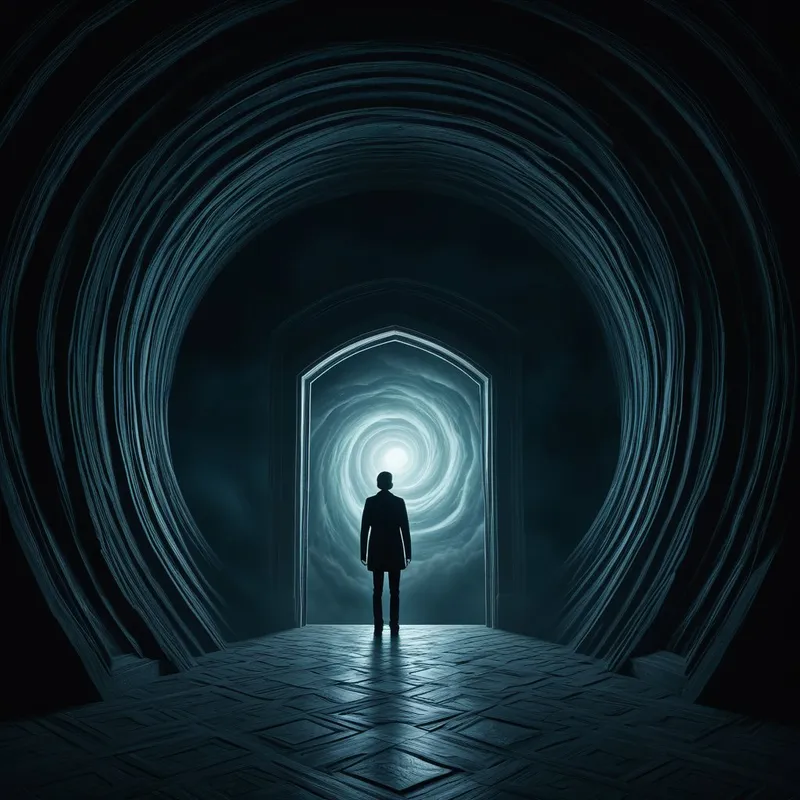
When the pattern of Erebus stirs in the modern psyche, it often manifests in dreams of profound, immersive darkness. This is not the darkness of a scary room, but of infinite, outer space or the bottom of a lightless sea. The dreamer may float in this void, or stand at its edge. There is often a deep, somatic sense of awe, dread, and profound silence.
This dream-state signifies a confrontation with the personal equivalent of the primordial ground. The ego, the "light" of conscious identity, is being dissolved back into the undifferentiated psychic substance from which it came. It is a process of unmaking that precedes renewal. The dreamer is not dreaming of a problem to be solved, but experiencing the somatic reality of a psychological death or a return to source. They are in the Mist of Erebus, where the old world’s landmarks have faded, and the new world has not yet taken shape. The emotional tone can range from paralyzing terror to a strange, peaceful surrender, indicating the dreamer’s relationship with this essential, shadowy aspect of their own being.
Alchemical Translation
The myth of Erebus models the first, and most crucial, phase of psychic transmutation: the Nigredo, the blackening. In the alchemical journey of individuation, this is not a failure, but the essential beginning. It is the descent into the prima materia, the chaotic, dark base matter of the soul.
For the modern individual, this translates to the courageous act of withdrawing the projections that fill our world with false light, and facing the unadorned, foundational darkness within. It is the end of naivety, the collapse of outworn identities, the experience of depression or meaninglessness that feels absolute. This is our personal Chaos, from which our personal Erebus—the dense, potent truth of our shadow—emerges.
The work does not begin by seeking the light, but by consenting to fully inhabit the dark that is already here.
The alchemical miracle in the myth—the birth of Light from Dark—shows us the goal. By consciously enduring the Erebus phase, by not fleeing from the void but relating to it, we allow a new, authentic consciousness (Aether) and a new, clear mode of being in the world (Hemera) to be generated from within it. The light that comes from this process is not borrowed or imposed; it is innate, born from the fruitful union of our deepest darkness (Erebus) with our capacity for mystery and gestation (Nyx). We do not conquer the primal dark; we befriend it, and in doing so, discover that it has been the womb of our own true light all along.
Associated Symbols
Explore related symbols from the CaleaDream lexicon: