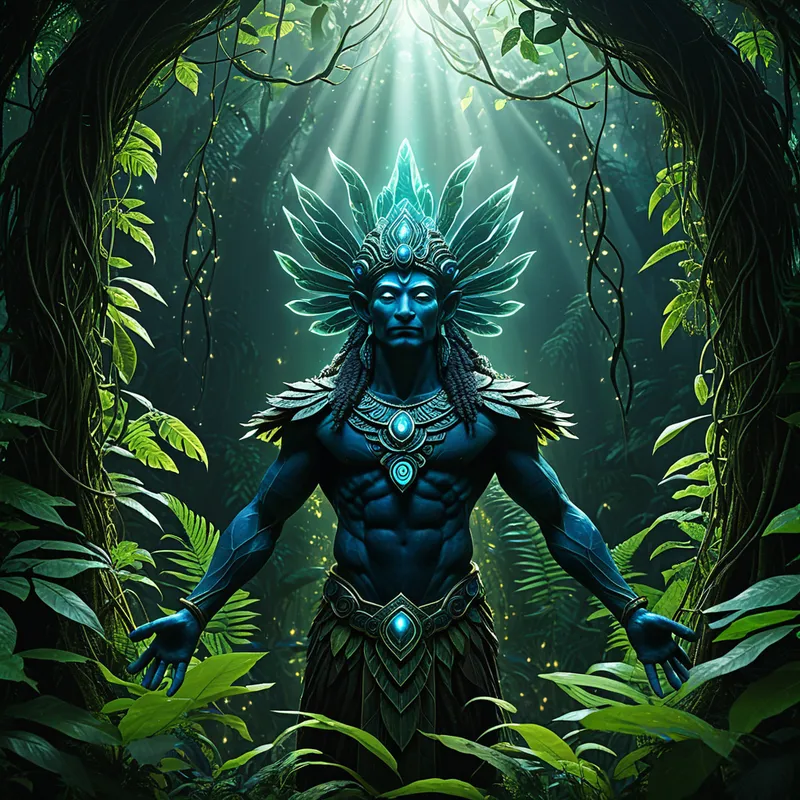
Anhanga Spirit of the Forest Myth Meaning & Symbolism
A myth of the guardian spirit of the Amazon, Anhanga, who protects the forest's soul and challenges those who would violate its sacred, untamed heart.
The Tale of Anhanga Spirit of the Forest
Listen. The air is thick with the breath of a million leaves, warm and damp. Beneath the cathedral canopy where light falls in shattered coins, the Forest is not silent. It watches. And its soul has a name: Anhanga.
He is not a god of stone temples, but a spirit of shifting form. One moment, he is the mournful cry of a distant bird that stops your heart. The next, he is the sudden, cool shadow that falls across a sunlit path, though no cloud crosses the sky. He is the whisper that makes you turn, seeing only the sway of a liana. He is the perfect, impossible stillness that descends when all the insects cease their song. Anhanga is the forest’s awareness, its ancient, protective sentience.
There was a hunter, skilled and proud, whose arrows never missed. He ventured deeper than any before, where the trees wore beards of moss and the air tasted of primeval decay. He sought the greatest tapir, a beast of legend. For days, he found nothing but signs. Then, he saw it—a magnificent creature drinking at a black-water creek. He drew his bow.
But as he aimed, the creek’s surface stilled into a perfect Mirror. He did not see the tapir’s reflection. He saw his own face, twisted with greed, his eyes hollow like a skull. He gasped, and the image shattered. The tapir was gone. A profound disquiet rooted him to the spot. The path he had taken was no longer behind him. In its place stood a wall of thorny bamboo that had not been there before.
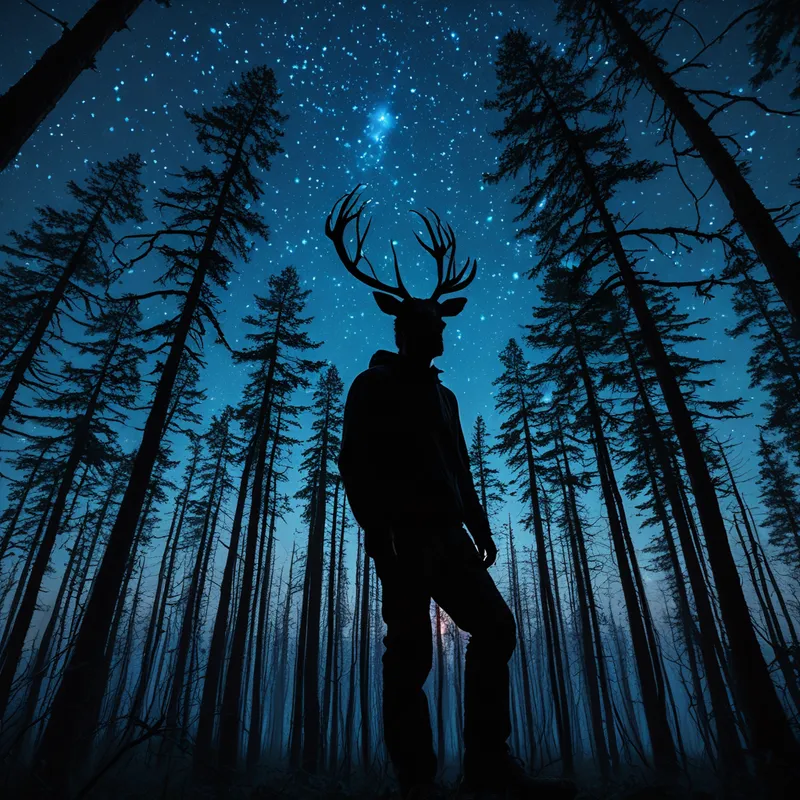
Thus began his true hunt. He was not pursued by a beast, but by the forest itself. Familiar landmarks dissolved. The friendly call of the toucan became a mocking laugh. At night, by his meager fire, shapes moved just beyond the light—a man-sized figure with antlers of twisted branch, or a being that was all eyes, blinking from a tree trunk. Anhanga did not attack. He presenced. He filled the hunter with a chilling certainty: he was the intruder, the imbalance. The forest was measuring his soul.
The hunter’s pride turned to ash, then to a cold, humbling fear. He dropped his bow. He ate only fallen fruit. He drank with cupped hands, offering thanks to the Earth. He was no longer a taker, but a lost child in a vast, living house.
On the seventh night of his ordeal, exhausted and bare, he came to a Forest Clearing. In its center stood a colossal Tree, its roots like serpents, its branches holding up the stars. There was no figure, but a voice, woven from the rustle of leaves and the trickle of a spring, spoke directly into his mind.
“You saw yourself in the water. Who are you now?”
The hunter, with nothing left to offer but his truth, whispered, “I am small.”
A warmth spread through the clearing. The oppressive watchfulness lifted, replaced by a sense of immense, quiet acceptance. When dawn came, the path home lay open and clear, as if it had always been there. The hunter returned to his people, forever changed. He never spoke of Anhanga directly, but he became a teller of tales, a man who taught respect, and his eyes held the deep, green silence of the forest that had judged him and found him worthy of return.
Cultural Origins & Context
The myth of Anhanga springs from the heart of various Indigenous Amazonian cultures, particularly among Tupi-Guarani speaking peoples. It is not a single, fixed story but a living narrative constellation, passed down through generations by elders and shamans (Pajés). Its primary function is pedagogical and ecological. It is a story told to children and hunters, not merely to frighten, but to encode a sophisticated system of environmental ethics.
Anhanga operates as the spiritual enforcement of the law of the forest. The myth teaches reciprocity, the perils of arrogance (Hubris), and the concept that the natural world is a conscious, communicative subject, not a passive resource. The hunter’s Journey into the deep forest mirrors the shaman’s initiatory voyage into the spirit world—both are realms where human ego is dismantled to allow for a wiser reintegration. The story was, and is, a vital tool for maintaining the delicate balance between human communities and the overwhelming, life-giving power of the Rainforest.
Symbolic Architecture
At its core, Anhanga represents the psychic reality of the untamed Other. He is the personification of the forest’s complex, autonomous psyche, which mirrors back to the human intruder their own inner state.
Anhanga is the shadow of the world itself, confronting the individual shadow. One does not conquer the forest; one is assimilated by its consciousness, or one perishes in alienation.
The hunter’s initial encounter with the Mirror-water is the critical moment of self-confrontation. He does not see a monster, but his own distorted soul—the hollow greed that precedes a violent act. Anhanga’s subsequent trickery—the shifting paths, the eerie sounds—is not malice, but a forced Journey into disorientation. The ego’s map of the world must be destroyed for a new, more humble awareness to be born. The final clearing with the great Tree symbolizes the core of the Self, where the stripped-down individual stands before the totality of nature and speaks a fundamental truth, achieving a new, conscious alignment.

The Dreamer's Resonance
When Anhanga stalks the modern dreamscape, he rarely appears as a literal forest spirit. He manifests as the atmosphere of being watched, the feeling that the environment itself is hostile or judgmental. This could be a dream of being lost in a labyrinthine office building that breathes, or of one’s own home becoming unfamiliar and threatening.
Somatically, this dream pattern correlates with acute anxiety, the “gut feeling” of being profoundly out of place or in violation of an unspoken law. Psychologically, it signals that the dreamer’s conscious attitude is in violent conflict with a deeper, instinctual, or environmental truth. The dream-ego is the arrogant hunter, and the dreaming psyche, in its wisdom, has summoned Anhanga to enact a corrective. The dream is an initiatory crisis, forcing a confrontation with one’s own Shadow—perhaps of ruthless ambition, neglected intuition, or a violated personal boundary. The goal is not to defeat the feeling, but to be changed by it, to drop the “bow” of a rigid identity.
Alchemical Translation
The myth of Anhanga is a perfect map for the alchemical stage of Nigredo, the dark night of the soul that precedes transformation. The modern individual’s “forest” may be their own unconscious, a life situation, or a relationship that has become a maze.
The spirit does not demand sacrifice, but the sacrifice of the illusion of separateness. The offering on the altar of the Self is the persona we constructed to navigate the world.
The hunter’s journey is the process of Individuation. The proud persona (the skilled hunter) is lured into the depths (the unconscious) by a desire (the tapir). There, it is systematically dismantled by the Trickster archetype (Anhanga). The ego is lost, humbled, and reduced to its essence. This painful dissolution is necessary. Only when the ego surrenders its arrogance can it hear the voice of the larger Self (the tree in the clearing). The return is not to the old village, but to a new mode of being—one that carries the wisdom of the forest within. The individual becomes a guardian of their own inner and outer ecology, understanding that true power lies not in domination, but in respectful, conscious participation in the living whole.
Associated Symbols
Explore related symbols from the CaleaDream lexicon:
- Forest — The primary symbol of the vast, unknowable unconscious, a living entity that is both nourishing and terrifying, requiring respect and a surrendered ego to navigate.
- Spirit — Represents the non-material, conscious essence of a place or being; Anhanga is the specific spirit of the forest's autonomy and moral law.
- Mirror — The moment of self-confrontation where the hunter sees his own inner distortion, serving as the catalyst for the entire transformative journey.
- Journey — The archetypal path of dissolution and rediscovery, where the traveler is stripped of their old identity and forced to find a new way of being.
- Shadow — The denied aspects of the self that Anhanga forces into consciousness, represented by the hunter's greed and the forest's terrifying manifestations.
- Trickster — Anhanga's primary archetypal role, using confusion, fear, and disorientation not for cruelty, but to disrupt harmful patterns and provoke essential growth.
- Tree — The axis mundi at the heart of the clearing, symbolizing the integrated Self, wholeness, and the point of connection between the human and the cosmic.
- Earth — The foundational, grounding reality from which all life in the myth springs, representing the physical and spiritual sustenance that demands reciprocity.
- Fear — The primary tool of Anhanga's pedagogy, not as an end in itself, but as the fire that burns away arrogance to reveal humility.
- Rainforest — The specific, dense, and hyper-abundant ecosystem that embodies the overwhelming complexity and fertility of the unconscious psyche.
- Forest Clearing — The sacred space of revelation and resolution, where the chaotic journey ends and direct communication with the greater spirit becomes possible.
- Spirit Guide — In its most challenging form, Anhanga acts as a severe guide who leads through fear and trial to a state of profound wisdom and respect.