Aliguyon Myth Meaning & Symbolism
A legendary Ifugao hero whose epic rivalry transforms into a sacred bond, modeling the alchemy of opposition into unity.
The Tale of Aliguyon
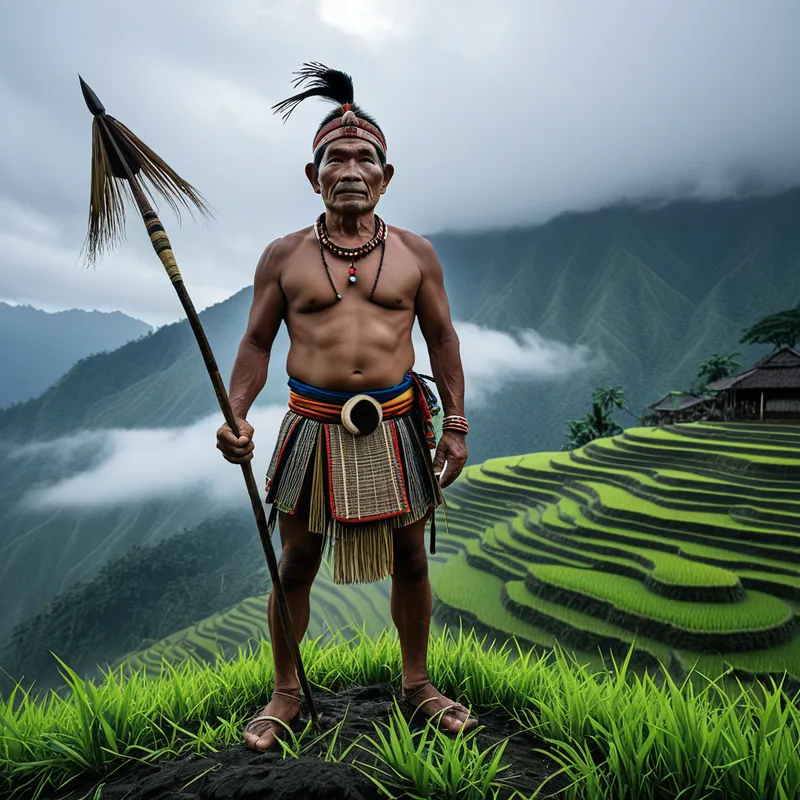
Listen, and let the mists of the Cordillera mountains part. In the highlands where the sky touches the terraced earth, where the anito whisper in the wind through the rice, there lived a people of stone and strength, the Ifugao. From the village of Hannanga, a child was born under a portentous sky. His name was Aliguyon, son of Amtalao. Even as a babe, he did not cry but observed the world with the eyes of an eagle. His father, a mighty warrior, saw the seed of destiny and nurtured it. He taught the boy not just the throw of the spear, but the song of the Hudhud, the laws of the gods, and the rhythm of the terraces.
Years passed, and Aliguyon grew into a man whose name stirred both pride and fear. His skill in battle was unmatched, his pangi (loincloth) a banner of his prowess. Yet, his greatness cast a long shadow. In the rival village of Daligdigan, another seed had been sown. Pumbakhayon, son of the warrior Pangaiwan, grew with a mirroring strength, his own destiny forged in the fires of his father’s tales of Hannanga’s might. The land itself seemed to hold its breath, the rivers running quieter, the sun glinting coldly off the warriors’ spears.
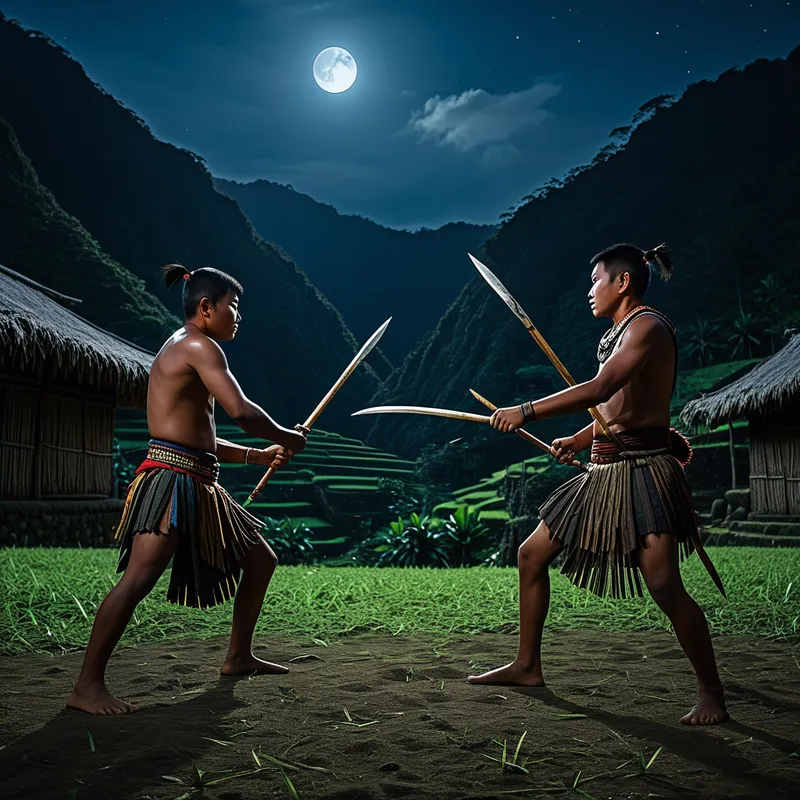
The conflict ignited not with a roar, but with the relentless, grinding tension of honor. Aliguyon, seeking to prove his valor and expand his father’s legacy, journeyed to Daligdigan. He stood before the houses on stilts and issued his challenge not with a shout, but with the solemn, terrible ritual of a warrior. Pumbakhayon accepted. What followed was not a single clash, but a season of war. Battle after battle they fought on the stony paths between the rice fields. Their spears, the bangkaw, clashed with a sound like cracking stone. They were evenly matched—every clever stratagem of Aliguyon met by an ingenious counter from Pumbakhayon. Seasons turned; planting and harvest came and went, but their conflict was the only true crop, a bitter harvest of stalemate. The earth was tired of drinking spilled ambition.
Then, a shift, subtle as a change in the wind. In the endless cycle of attack and parry, a profound recognition began to dawn. To face a mirror of your own skill for so long is to eventually see yourself. The hatred, once hot and sharp, cooled into a form of respect, then into a bewildered awe. Here was not an enemy to be crushed, but a force of equal magnitude. The epic struggle, the very thing that defined them, became the crucible for a new understanding.
The resolution came not with a death, but with a breath. In a pause between clashes, a proposal was made, as revolutionary as it was ancient. Aliguyon, seeing the exhaustion in his own people and the mirrored fatigue in his rival’s eyes, offered peace. But this was no simple truce. It was to be sealed by the most sacred bond: marriage. Aliguyon would take Pumbakhayon’s sister, Bugan, as his wife, and Pumbakhayon would wed Aliguyon’s sister, Aginaya. The spears were laid down. The warriors who had danced the dance of death now prepared for the feast of life. From a legacy of vendetta, a new lineage was born—a weaving together of two powerful bloodlines that brought not weakness, but unshakeable strength and lasting peace to the highlands. The hero’s journey ended not on a battlefield, but at a wedding ceremony, the greatest victory being the end of the war itself.
Cultural Origins & Context
The epic of Aliguyon belongs to the Hudhud, a centuries-old oral tradition of the Ifugao people of Northern Luzon. Chanted, not merely spoken, the Hudhud is performed primarily by women, often while engaged in the communal labor of harvesting rice in the majestic terraces. This context is vital: the myth is not entertainment divorced from life; it is a rhythmic companion to the act of sustenance, its themes of cyclical struggle, patience, and fruitful resolution mirroring the agricultural cycle itself.
The epic functioned as a social charter, a living document encoding Ifugao values of binnadang (community cooperation), strategic intelligence over brute force, and the supreme importance of social harmony. It provided a model for conflict resolution that transcended annihilation, offering the sophisticated solution of strategic alliance. In a society where village rivalries were common, the story of Aliguyon and Pumbakhayon served as a profound psychological and social template, teaching that true honor could be found in the transformative act of making peace, creating bonds stronger than those of clan alone.
Symbolic Architecture
At its heart, the myth of Aliguyon is a masterful depiction of the psychology of the shadow and the sibling archetype. Pumbakhayon is not a monster or a foreign invader; he is Aliguyon’s equal, his mirrored self from a rival house. He represents the projected shadow—all the strength, skill, and ferocity Aliguyon possesses, but perceived as "other" and therefore threatening.
The ultimate rival is never the other, but the unrecognized self, staring back from across the field of conflict.
Their endless, stalemated war symbolizes a futile psychological state: the ego’s attempt to conquer an aspect of its own psyche that it has split off and externalized. The terraced fields, built for nurturing growth, become the stage for a cyclical battle that yields no nourishment. The breakthrough occurs when the projection falls away, and recognition dawns. The "enemy" is seen not as something to destroy, but as a complementary force. The spear, symbol of penetrating will and separation, must be transformed. The resolution—the double marriage—is a profound symbol of conjunctio, or sacred marriage. It is the integration of opposites, not through annihilation, but through union. The families are woven together, creating a new, more complex, and resilient whole. The hero’s task evolves from conquering the external foe to integrating the internal one, achieving a peace that is active and creative, not passive.
The Dreamer's Resonance
When this mythic pattern stirs in the modern dreamer, it often manifests as dreams of being locked in a futile, recurring struggle. You might dream of a faceless opponent of equal skill, a rival at work you can never best, or a recurring argument with a loved one that goes in circles. The somatic feeling is one of exhausting tension, of muscles perpetually braced for a clash that never concludes in victory or defeat.
Psychologically, this signals a profound engagement with one’s shadow. The dream-opponent embodies a disowned quality—perhaps your own ambition, aggression, competence, or pride—that you are fighting against in waking life. The stalemate is the psyche’s way of shouting that the current strategy of repression or combat is failing. The dream invites you to the pivotal moment in the myth: the cessation of battle and the act of recognition. To dream of this myth is to be on the cusp of withdrawing a projection. The healing begins not when you defeat the figure in the dream, but when you stop, look closer, and ask, "What part of me are you?"
Alchemical Translation
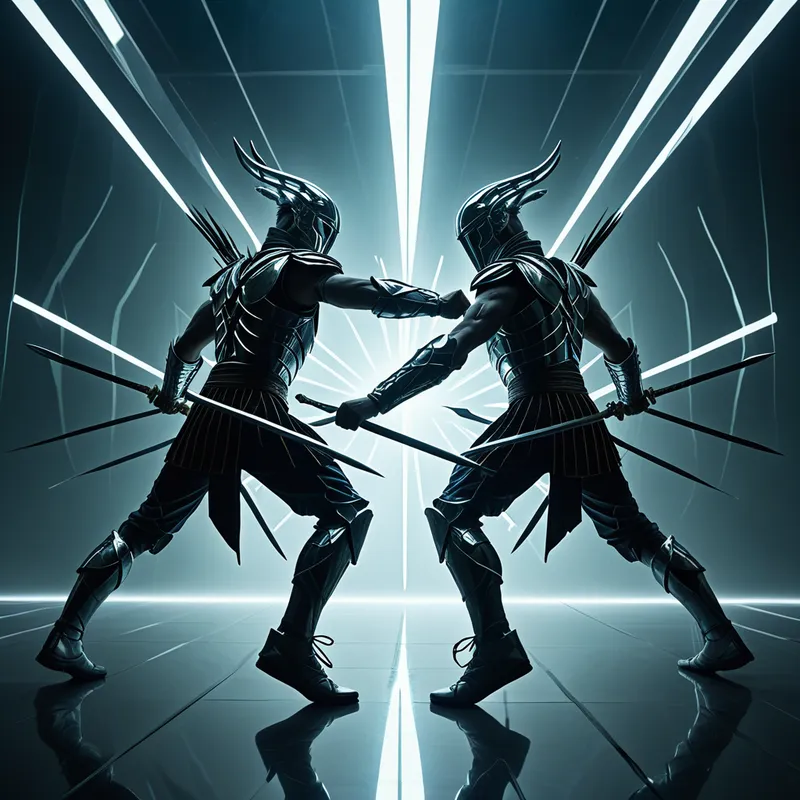
The journey of Aliguyon models the individuation process with stunning clarity. It begins in a state of identified heroism—the ego, Aliguyon, is strong, skilled, and defined by its opposition to the other (Pumbakhayon, the shadow). This is the nigredo phase, the blackening, represented by the endless, murky conflict that leads nowhere but exhaustion.
The turning point is the mortificatio, a symbolic death of the old attitude. The ego’s project of conquest dies. This allows for the albedo, the whitening or illumination: the moment of recognition. "My enemy is my equal. My enemy is, in essence, myself." This insight is the light that cleanses the perception.
Individuation is not about becoming a perfect, conflict-free self. It is about building a conscious relationship between the warring factions within, turning the battlefield into a meeting ground.
The final stage, the rubedo or reddening, is the creation of the new, integrated consciousness symbolized by the double marriage. The libido once spent on conflict is now available for creation and union. The psyche achieves a higher-order synthesis. For the modern individual, this translates to the transformation of a lifelong inner critic into a discerning advisor, a bitter rivalry into a fruitful partnership, or a hated personal trait into a source of strength. The goal is not the eradication of opposition, but the establishment of a conscious, dynamic, and respectful relationship between opposing inner forces, leading to a state of fertile, resilient peace.
Associated Symbols
Explore related symbols from the CaleaDream lexicon:
- Spear — The symbol of focused will, penetration, and conflict, which must ultimately be laid down and transformed into an instrument of connection.
- Mirror — Represents Pumbakhayon as Aliguyon's perfect rival and shadow-self, reflecting back the hero's own unintegrated strength and identity.
- Bridge — The marriage alliance that forms a sacred bridge between two warring clans, symbolizing the psyche's capacity to connect opposed inner forces.
- Hero — Aliguyon embodies the hero who evolves beyond mere physical conquest to achieve the greater victory of psychological integration and social harmony.
- Rival — Pumbakhayon is the archetypal rival who, through relentless opposition, forces the hero into a transformation he could not achieve alone.
- Marriage — The double wedding signifies the conjunctio, the sacred alchemical marriage that unites opposites and creates new, fertile wholeness from division.
- Mountain — The Cordillera highlands setting represents the lofty, challenging terrain of the psyche where this epic inner struggle takes place.
- Dance — The protracted, ritualized battles are a deadly dance of equals, a pattern that must be completed and transcended.
- Honor — The core value that drives the conflict, which is redefined from victory in battle to the wisdom and strength required to make peace.
- Seed — The potential for peace and union that was planted at the beginning of the conflict, requiring the long, arduous season of struggle to finally bear fruit.
- Shadow — Pumbakhayon as the personified shadow, containing the disowned power and identity that Aliguyon must eventually recognize and integrate.
- Circle — The cyclical, stalemated nature of the battles, representing a futile psychological loop that can only be broken by a conscious act of transformation.