Alenushka and Her Brother Myth Meaning & Symbolism
A sister's love endures her brother's transformation into a goat, a witch's treachery, and a watery grave, culminating in a miraculous return to human form.
The Tale of Alenushka and Her Brother
Listen, and let the old forest tell you a tale. It begins not with joy, but with a hollowing grief. An orphaned brother and sister, Alenushka and her little brother, Ivanushka, were left alone in the wide world. The sun beat down upon them as they walked, seeking a new home, their footsteps the only sound in the vast, whispering steppe.
Their path led to a field of tall grass, and there, Ivanushka’s throat closed with a terrible thirst. He saw the hoof prints of cattle filled with rainwater. “Sister, let me drink from this track,” he pleaded. But Alenushka, her voice soft with a knowing fear, warned, “Do not drink, little brother. If you do, you will become a bull-calf.” He obeyed. They walked on.
The thirst grew. They came to a horse’s hoof print, glistening with water. “Sister, I must drink.” Again, her warning came, a gentle prophecy: “Do not drink, dear heart. If you do, you will become a foal.” His lips cracked, but he obeyed.
But then they reached the banks of a wide, swift river. And beside it, the prints of a goat. The thirst was a fire in Ivanushka’s soul. The water called with a silver song he could no longer resist. “I will drink,” he said, “even if I become a goat.” He bent his head to the cool, clear water.
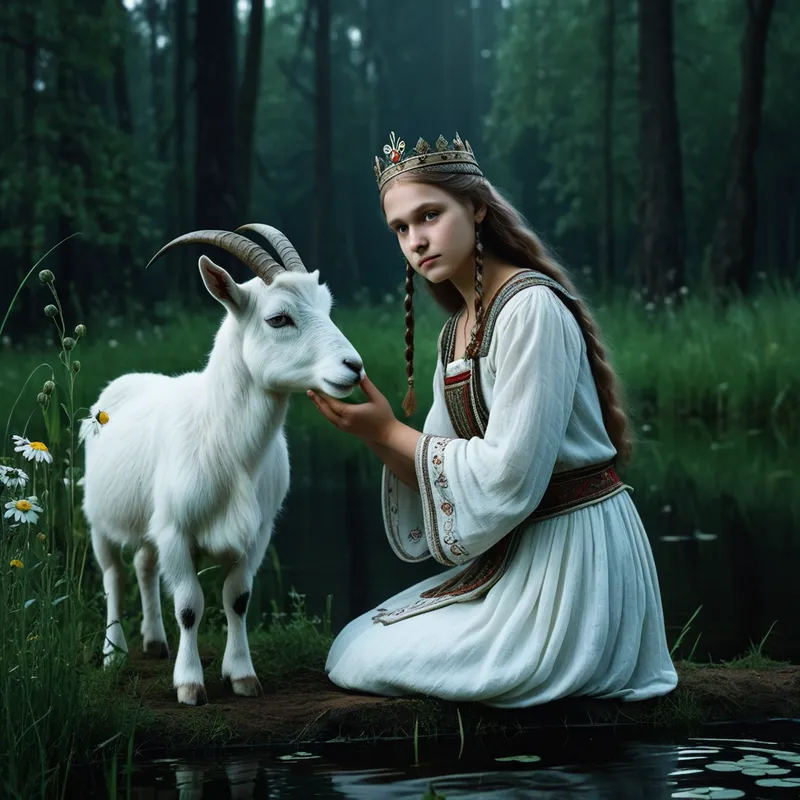
As the river’s gift touched his lips, a shudder passed through him. His form shimmered, twisted, and shrank. Where a boy stood, now stood a little white goat, with soft fur and eyes full of a human sorrow. Alenushka wept, but she did not flee. She took a silken cord, tied it around his neck, and led him onward. “You are my brother still,” she whispered. “I will care for you.”
They found a cottage in the deep woods and made a life. Alenushka would go to the village to spin and sing, and the little goat would play in the meadow, waiting for her return. But the world has ears for beauty and eyes for envy. A merchant, passing by, heard Alenushka’s song and saw her grace. He wished to marry her. And a witch, a creature of bitter marrow and green envy, heard of this and desired the merchant for herself.
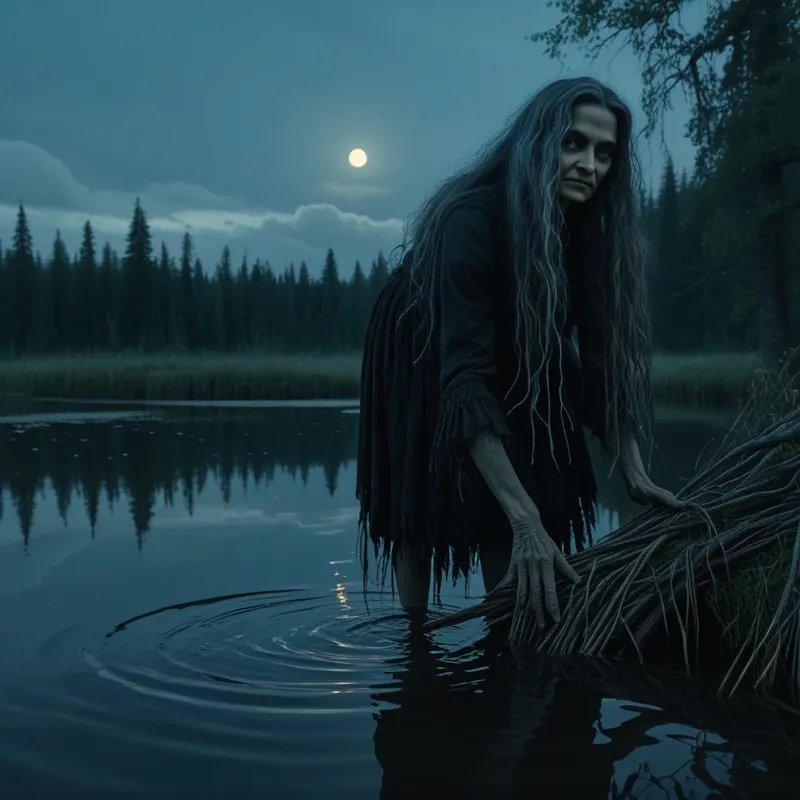
One day, as Alenushka went to the river, the witch appeared, her voice honeyed with poison. “Let me comb your lovely hair,” she crooned. And as Alenushka sat trustingly by the water’s edge, the witch wove a heavy stone into her braids and pushed her into the deep, dark pool. The waters swallowed Alenushka whole.
The witch then took on Alenushka’s form, her magic a poor copy of true beauty, and returned to the cottage. The little goat knew. He knew in the beat of his animal heart that this was not his sister. He would not eat, would not drink, but ran to the riverbank and cried out in a voice that was both bleat and lament: “Alenushka, my sister! Rise up from the deep waters!”
The false bride, the witch, grew furious. She demanded the merchant have the goat slaughtered. Reluctantly, the merchant agreed. As they led the little goat to the river’s edge, his cries grew more desperate. “Alenushka, my sister! They are taking me to my death!”
And from the depths of the river, a voice answered. It was faint, a bubble of sound breaking the surface. The merchant, hearing this miracle, ordered the river to be swept with silk nets. They cast the nets, and from the dark water, they pulled not a body, but Alenushka herself, alive, her hair flowing like river weed, her eyes clear. The stone fell from her braids and sank forever.
The witch’s disguise melted like wax in a flame, revealing her true, wretched form. Justice was swift. And as Alenushka embraced her brother, the little goat, a second miracle unfolded. His white fur shimmered, his form stretched and straightened. The goat was gone, and in his place stood Ivanushka, her human brother, returned by the power of a love that even the river could not drown.
Cultural Origins & Context
This tale, known across many Slavic regions with slight variations, belongs to the vast oral tradition of Eastern Slavs. It was not a story for books, but for the pech-side, told by grandmothers (babushka) during the long winter nights. Its primary function was didactic, embedding core cultural values: the sacred duty of familial care, the peril of disobedience, and the ultimate triumph of purity and steadfast love over deception and evil.
The figure of the witch represents the ever-present danger of the untamed forest and the envious, destructive forces that threaten the fragile order of the home. The story also reflects an animistic worldview, where bodies of water are sentient, capable of both taking and giving life, and where transformation between human and animal states is a constant possibility, governed by simple, profound rules. It served as a psychic map for children, teaching them about the consequences of actions (the thirst and transformation) and the unwavering loyalty required within the family unit, the primary defense against a chaotic world.
Symbolic Architecture
At its heart, this is a myth of the soul’s fragmentation and its arduous journey toward reintegration. Ivanushka’s transformation is not a punishment, but a direct result of consuming an instinctual, untamed element—the water from an animal’s print. He drinks from the source of the Animal, and thus becomes it. His human consciousness is submerged beneath an animal nature.
The brother becomes the embodied instinct, while the sister becomes the carrier of conscious memory and loving connection.
Alenushka’s role is that of the Anima as caregiver and preserver of spirit. She does not abandon the animalized brother but tethers him to the human world with a “silken cord”—a symbol of the subtle, enduring bonds of love and relationship that can survive even the most radical psychic change. The witch represents the Shadow—specifically, the envious, murderous aspect that seeks to destroy the loving connection (Anima) and replace it with a false, hollow facade for selfish gain.
The river is the Unconscious itself. Alenushka’s drowning is a descent into these depths, a necessary “death” where her conscious identity is submerged. Her preservation and eventual retrieval signify that the core of the soul cannot be destroyed by the Shadow; it merely awaits recognition and rescue. The brother’s cries are the instinct’s plea for the soul’s return. Only when the conscious connection (Alenushka) is restored from the deep can the instinctual side (Ivanushka) be restored to its proper, integrated human form.
The Dreamer's Resonance
When this myth stirs in modern dreams, it often signals a profound process of psychic re-balancing. To dream of a loved one turning into an animal suggests we are witnessing a part of ourselves or a relationship becoming dominated by raw, untamed instinct—perhaps unchecked hunger (thirst), rage, or fear. The dreamer may be in Alenushka’s position, feeling the burden of caretaking for a part of their own psyche or a relationship that has become “bestial” and less than human in its expression.
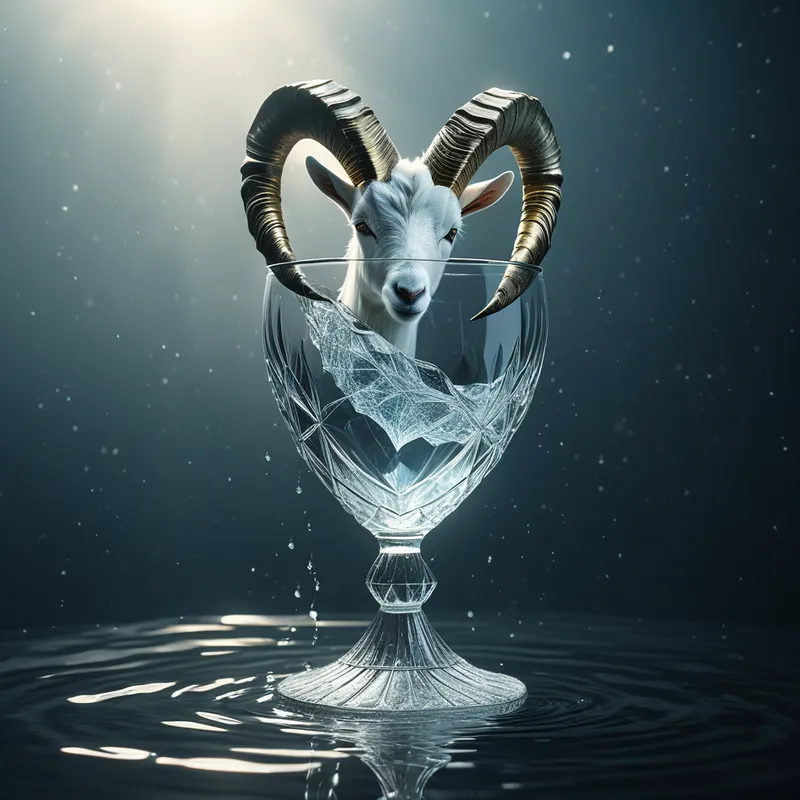
Dreams of drowning, particularly while being weighed down (the stone), point to a feeling of the conscious ego being overwhelmed and pulled into the unconscious by a heavy, unresolved complex—often one related to guilt, shame, or a deep sadness (Grief). The witch in a dream is a clear manifestation of a toxic, deceptive complex that has “taken over the house,” masquerading as the true self while causing inner havoc. The dream’s resolution—the retrieval from water and the restoration of form—is the psyche’s innate movement toward healing, indicating that the dreamer is ready to “net” and reclaim a lost, soulful quality that has been submerged.
Alchemical Translation
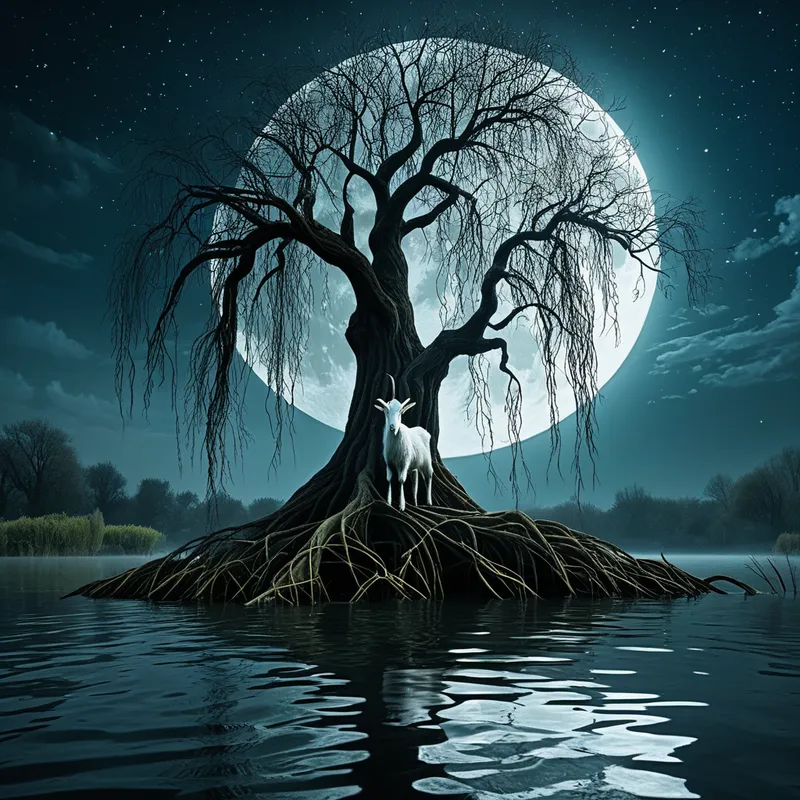
The myth of Alenushka and Her Brother is a perfect allegory for the alchemical and Jungian process of Individuation. The initial state is one of orphanhood—a psyche feeling disconnected from its parental, guiding structures. The journey begins with a Nigredo, a descent into darkness: Ivanushka’s fall into animal nature and Alenushka’s drowning. This is the necessary dissolution of the old, naive state.
The silken cord is the filum Ariadnis, the thread that connects consciousness to the transforming essence, preventing total disintegration.
The witch’s reign represents the chaotic, deceptive inflation of the ego (the false bride) that often occurs mid-process. The true work, the Albedo, is the purification that occurs in the watery depths. Alenushka is not corrupted by the river; she is preserved within it, her love intact. Her retrieval is the “washing” or lifting of this purified essence back into the light of consciousness.
Finally, the simultaneous restoration of both siblings marks the Rubedo. The human brother is not restored until the sister is saved. This illustrates the core alchemical truth: the transcendent function, the birth of the integrated Self, is born from the sacred marriage (coniunctio) of the conscious principle (the caring, enduring Anima) and the redeemed instinctual principle (the transformed animal nature). They are two halves of one whole soul, and individuation is the story of their separation, trial, and glorious reunion.
Associated Symbols
Explore related symbols from the CaleaDream lexicon:
- Water — The primal element of the unconscious, emotion, and potential; it is both the agent of transformation (turning the brother) and the medium of purification and rebirth (preserving the sister).
- Goat — The instinctual, animal self that results from consuming untamed nature; it represents a descent into a simpler, driven state, but one still capable of loyalty and connection.
- River — The flowing, dynamic boundary between worlds (conscious/unconscious, life/death); it is the site of critical transformation, sacrifice, and ultimate retrieval.
- Sister — The archetypal caregiver and anima figure, representing the soul's capacity for unwavering love, memory, and the thread that binds us to our humanity.
- Witch — The embodiment of the envious, destructive shadow that seeks to sever soul-connections and usurp identity through deception and violence.
- Stone — The weight of a complex, a burden of guilt or grief that pulls the conscious self down into the depths of the unconscious, requiring a conscious effort to release.
- Forest — The liminal, untamed realm of the psyche where magic (transformation) is possible and where the orphaned parts of the self must journey to find a home.
- Brother — The instinctual, younger masculine aspect of the self, prone to impulsive actions that lead to a loss of higher form, requiring redemption through relationship.
- Sacrifice — The necessary surrender, both of Alenushka's life and Ivanushka's humanity, which creates the conditions for a more profound, earned wholeness.
- Rebirth — The core promise of the myth, achieved not through avoidance of suffering, but by passing through the watery grave and emerging restored, together.
- Love — The silken cord and the saving cry; the transcendent force that navigates the depths, recognizes truth from falsehood, and makes restoration possible.
- Journey — The fundamental structure of the tale, representing the soul's obligatory passage from a state of lack (orphanhood) through trials to a state of completed, relational wholeness.