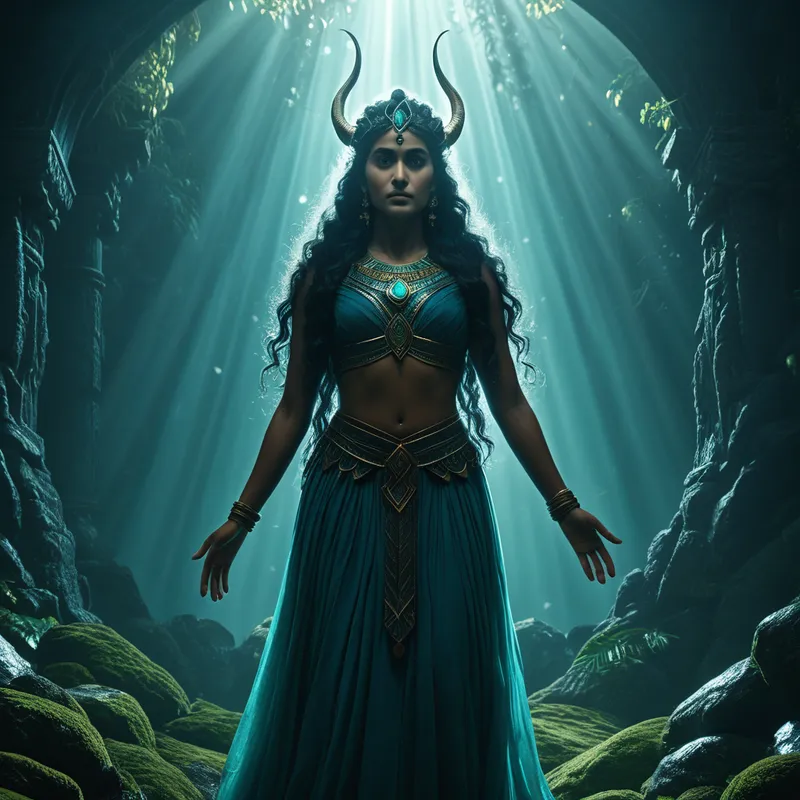
Al-Miraj the Horned Rabbit
A mythical horned rabbit from Arabian folklore, blending gentle and fierce traits to symbolize paradox and hidden wisdom in ancient tales.
The Tale of Al-Miraj the Horned Rabbit
In the shimmering silence between the desert’s breath and the star’s descent, a tale is whispered of a creature that should not be. It begins not with a roar, but with a tremor in the sand, a subtle disturbance in the order of things. From the labyrinthine depths of its warren, where the earth holds its secrets close, it emerges: Al-Miraj. At first glance, it is but a rabbit, soft-furred and swift, a creature of timidity and flight, its nose twitching to the rhythms of the hidden world. But lift your gaze, and the world tilts. Upon its brow, curving with a terrible elegance, rests a single, spiraling horn.
This is not the horn of a stag, announcing virile challenge, nor the twisted spike of a desert demon. It is a paradox made flesh, a silent question poised above a creature of answerless flight. The stories say Al-Miraj was born from a union of opposites—perhaps from a beam of the moon, cool and silver, piercing the fever-dream of a sun-baked dune. Others murmur it was a gift, or a curse, from the jinn, those capricious architects of the unseen, who delight in weaving contradiction into the fabric of reality.
Its life is a solitary pilgrimage across the margins. It drinks from oasis pools under the judgmental eye of the horned oryx, who sees in it a mockery of its own proud armament. It flees the shadow of the hunting hawk, its horn useless for the sky-battle, yet it is said that the horn holds a different power. When cornered, when the chase reaches its inevitable, brutal end, Al-Miraj does not simply submit. It turns. And in that turning, the horn, which seemed a decorative absurdity, becomes a locus of fierce, concentrated will. It is a weapon of last resort, a denial of the passive fate assigned to its kind. The creature of burrows becomes, for a blinding moment, a creature of points and defiance. It does not seek combat, but embodies the truth that even the gentlest soul houses a latent, sharp-edged truth that can, and will, defend its right to exist.
Cultural Origins & Context
Al-Miraj springs from the rich, layered soil of classical Arabic lore and <abbr title="A genre of literature concerning the 'wonders' of creation, often describing fantastical creatures and distant lands."">aja'ib literature (wonders of creation). It belongs not to the grand cosmological myths of gods and chaos, but to the zoological tapestry of the miraculous. Medieval scholars and storytellers, compiling encyclopedias of marvels, placed it alongside the phoenix and the <abbr title="A giant bird or eagle of immense size and power in Middle Eastern mythology."">roc. Its primary habitat was the page of the illuminated manuscript and the breath of the night-time storyteller, often situated on a mysterious island (sometimes associated with Alexander the Great’s journeys) where natural law was delightfully suspended.
This context is crucial. The Arabian intellectual tradition, particularly during the Islamic Golden Age, was deeply engaged with classifying and understanding the world. Philosophy, theology, natural science, and poetry were in constant dialogue. A creature like Al-Miraj was not merely a fantasy; it was a thought-experiment, a natural philosophical puzzle. It challenged categorization. Was it a predator or prey? A symbol of cowardice or courage? Its existence in lore served as a testament to the boundless creativity of the Divine, a reminder that the universe contains possibilities that defy human logic and expectation. It lived in the mental landscape as a proof against arrogance, a permanent question mark scribbled in the margin of the known world.
Symbolic Architecture
Al-Miraj is a living emblem of paradox, and from this central tension, all its symbolic power flows. It is a dialectic made flesh, where thesis and antithesis are forced to share a single body.
The horn, weapon of the forward charge, is grafted onto the rabbit, archetype of the backward retreat. This is not a balance, but a cohabitation of extremes, suggesting that wisdom often resides in the capacity to hold contradictory truths in a state of creative, unresolved tension.
Its symbolism operates on multiple levels. On the social plane, it represents the unexpected hero, the individual who possesses a hidden strength that belies their apparent meekness. Psychologically, it maps the inner conflict between our vulnerable, fearful selves (the rabbit that seeks shelter) and our assertive, defensive egos (the horn that stands its ground). It is the anxiety that turns to righteous anger, the gentle heart that finds a steely core when principles are threatened.
Most profoundly, Al-Miraj symbolizes a specific kind of wisdom—not the loud, declaratory wisdom of the prophet, but the hidden, paradoxical wisdom of the <abbr title="A wise old man or sage figure, often a hermit, who possesses deep spiritual insight."">sage. The sage understands that true strength incorporates softness, that retreat can be a strategic advance, and that the most potent truths are often those that seem illogical to the binary mind. The creature’s solitary nature underscores this: this wisdom is not found in the herd, but on the lonely path of integrating one’s own contradictions.
The Dreamer's Resonance
To encounter Al-Miraj in the dreamscape is to be presented with a riddle from the depths of the psyche. Its appearance is rarely neutral; it signals a moment of internal paradox reaching a critical point. Dreaming of the horned rabbit may ask: Where in your life are you being meek when you need to be pointed? Where are you being aggressively defensive when you need to retreat and burrow into introspection?
The creature may appear fleeing, its horn catching the moonlight—a call to acknowledge a unique talent or perspective (the horn) that you are hiding out of fear or a sense of incongruity (the rabbit nature). Conversely, to dream of it turning, horn lowered, might indicate a brewing confrontation. The psyche is preparing to defend a vulnerable part of the self, to finally assert a boundary with a potency that may surprise the dreamer’s waking self.
It embodies the “shadow integration” of the gentle and the fierce. For one who identifies solely with kindness, Al-Miraj heralds the necessary arrival of healthy assertiveness. For one perpetually armored and combative, it whispers of the soft, quick, vulnerable life that is being sacrificed at the altar of strength. The dream Al-Miraj is a psychopomp guiding the soul toward wholeness, not through the elimination of contradiction, but through its conscious, lived embodiment.
Alchemical Translation
In the alchemical vessel of the soul, Al-Miraj represents the coniunctio oppositorum—the sacred marriage of opposites. The rabbit, associated with the moon, silver, and the feminine principle of receptivity and fertility, is fused with the horn, a symbol of solar power, penetration, and masculine assertion. This is not a battle for dominance, but a paradoxical fusion that creates a third, transcendent thing.
The alchemical process is one of dissolution and coagulation. Al-Miraj is the living coagula, the fixed image that emerges when the volatile spirit (the horn’s piercing intent) and the fixed body (the rabbit’s earthly nature) are united. It is the emblem of the Philosopher’s Stone not as a physical object, but as a state of being: the individual who has integrated their latent, opposing potentials.
The creature’s habitat—often a mystical island—parallels the alchemist’s sealed vessel, a protected space where impossible transformations can occur. The journey to find Al-Miraj is the opus itself, the search for the hidden, paradoxical truth within. Its horn is the lapis, the touchstone that can transmute base fear into golden courage, not by erasing the fear, but by arming it with purpose. In this light, Al-Miraj is the ultimate symbol of individuation: the Self that is both sanctuary and sword, both burrow and beacon.
Associated Symbols
Explore related symbols from the CaleaDream lexicon:
- Rabbit — A symbol of fertility, intuition, and timidity, representing a quick, receptive consciousness vulnerable to the outer world.
- Horn — An emblem of spiritual authority, defense, and piercing insight, a projection of power and alertness into the environment.
- Paradox — The state of holding two seemingly contradictory truths simultaneously, the fertile ground where logic ends and deeper understanding begins.
- Moon — The celestial body governing cycles, the unconscious, reflection, and the hidden, receptive aspects of nature mirrored in the rabbit’s essence.
- Burrowing Rabbit — The act of delving into the subconscious, seeking hidden safety, and creating labyrinths of inner thought and memory.
- Shadow — The rejected, hidden, or unconscious part of the psyche, which Al-Miraj embodies by combining traits society deems incompatible.
- Dream — The realm where paradoxical beings like Al-Miraj find their true home, bridging the conscious and unconscious with symbolic language.
- Cave — A natural sanctuary and place of deep introspection, analogous to the rabbit’s warren, where hidden truths and transformations are incubated.
- Mask — A representation of the persona or the concealed true self; Al-Miraj wears the "mask" of a rabbit while bearing the "truth" of the horn.
- Journey — The quest to reconcile inner opposites, often a solitary pilgrimage to find the mystical island where one’s paradoxical nature is revealed and accepted.