
Akashic Records Myth Meaning & Symbolism
The cosmic library of all time, where every thought, word, and deed is eternally inscribed, revealing the soul's journey through infinite cycles.
The Tale of Akashic Records
In the beginning, before the first breath of Brahma, there was a sound. Not a sound that shattered silence, but the silence itself, vibrating. This vibration was Aum, and as it echoed through the unformed void, it left a trace. Not on stone or water, but on the very substance of space itself—Akasha.
And so, the first library was born. Not with walls or shelves, but as an infinite, living memory. Every ripple of that first sound, every potential form it contained, was etched into the Akasha. When Brahma opened his eyes and began to weave the tapestry of worlds, each thread—every star’s birth, every mountain’s rise, every drop of rain’s fall—was simultaneously a story written in light upon this cosmic parchment.
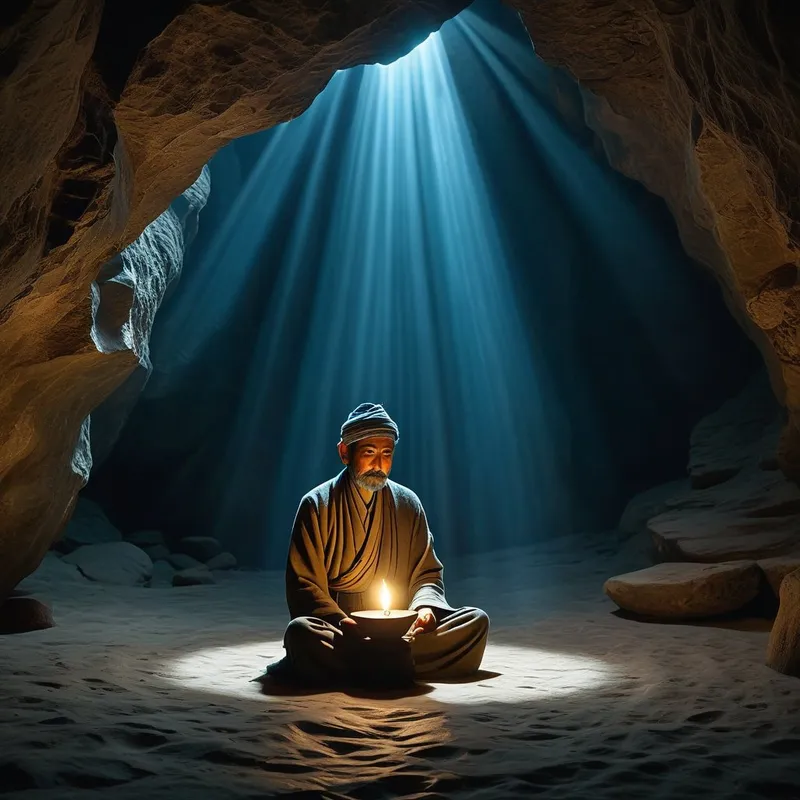
The great sages, the Rishis, sitting in the high, cold caves of the Himalayas, were the first librarians. They stilled the clamor of their own hearts until their inner silence matched the primordial vibration. In that profound stillness, they could listen. Not with ears, but with the soul. And they heard it—the faint, eternal hum of the Records. They saw the past not as a linear tale, but as a living landscape. They witnessed the great battle of Kurukshetra not as a historical event, but as a perpetual drama of dharma and adharma playing out in the soul of every being. They read the love of Radha and Krishna as the eternal song of the individual soul yearning for the divine.
To access this was no small feat. It required a descent into the deepest well of the self, past the swirling storms of desire and the frozen layers of fear. The seeker had to become so empty, so transparent, that they became a flawless mirror for the cosmos. Then, and only then, would the Akasha reveal its secrets—not as answers given, but as truths remembered. The greatest realization was always the same: the record you sought to read was, in the end, your own signature, written across eternity with every thought, word, and deed.
Cultural Origins & Context
The concept of the Akashic Records is woven from the oldest threads of Hindu philosophical thought, primarily within the school of Samkhya and the esoteric practices of Yoga. It is not the plot of a single, canonical epic like the Mahabharata, but rather a metaphysical principle that permeates the understanding of reality. The term finds its roots in the Vedas and is elaborated in later texts like the Yoga Sutras of Patanjali and various Puranas.
It was transmitted orally from guru to disciple as part of secret, advanced teachings (upadesha). Its societal function was dual. For the philosophical elite, it provided a model for a deterministic yet meaningful cosmos, where the law of karma was impeccably documented. For the broader culture, it served as a profound moral metaphor: you are always writing your own story in a book that never closes, witnessed by the universe itself. This idea gave weight to everyday actions and nurtured the belief that self-knowledge was the ultimate knowledge, as to know the self was to touch the record of all selves.
Symbolic Architecture
The Akashic Records represent the ultimate symbolic architecture of memory, consciousness, and cosmic order. Akasha is not mere empty space; it is the womb of potential, the subtle medium that holds the imprint of all manifestation. The "Records" are not books but the inherent memory of existence itself.
The soul does not learn, it remembers. The journey is not toward acquisition, but toward recollection of one's own eternal signature in the cosmic text.
Psychologically, this myth symbolizes the collective unconscious—not as a passive repository, but as an active, intelligent field that records every psychic event. The individual ego, with its limited, linear memory, is but a single page pulled from an infinite volume. The struggle of the sage to access the Records mirrors our own inner struggle to move beyond personal history and trauma (our personal "karmic record") to touch the transpersonal ground of being. The deity-figure often associated with its guardianship, like Brahma or Saraswati, represents the archetype of the cosmic knower, the consciousness that can hold the totality without being fragmented by it.
The Dreamer's Resonance
When this myth pattern stirs in the modern psyche, it often manifests in dreams of vast archives, endless libraries, or complex data streams. The dreamer may find themselves in a labyrinth of hallways lined with books whose titles shift, or before a computer screen displaying the code of their own life. There is a somatic quality of both awe and anxiety—the awe of infinite possibility, the anxiety of total exposure.
This dream signals a profound psychological process: the ego's confrontation with the sheer volume and weight of the personal and ancestral unconscious. It is the psyche's way of announcing, "A reckoning is at hand." The dreamer may be on the verge of integrating forgotten memories, recognizing deep behavioral patterns (karmic loops), or feeling called to a purpose that seems to originate from beyond their personal biography. The frustration of being unable to "read" the text in the dream mirrors the frustration of sensing a meaning just beyond conscious grasp, urging a deeper, more intuitive form of knowing.

Alchemical Translation
The alchemical process modeled by this myth is the transmutation of leaden, fate-bound identity into the gold of conscious, creative authorship. The initial state is one of being written—living out scripts of conditioning, trauma, and unconscious impulse. The Records, in this stage, are a prison of predetermined narrative.
The nigredo, or blackening, is the painful realization of this bondage. The seeker's arduous meditation is the albedo, the whitening or purification, where the noise of the ego is stilled. As the inner mirror is polished, the individual consciousness begins to align with the cosmic consciousness (Brahman). This is the citrinitas, the yellowing or awakening.
Individuation is not writing a new story, but becoming conscious of the pen in your hand while the eternal story writes itself through you.
The final transmutation, the rubedo or reddening, is not erasing the Records, but achieving a paradoxical state: you see your life as a perfect, necessary entry in the cosmic ledger, yet you are simultaneously free to inscribe the next moment with conscious choice. You move from being a character in a script to a co-author with the divine. The myth teaches that liberation (moksha) is not escape from the Records, but the enlightened understanding that you are, and always have been, both the archive and the archivist.
Associated Symbols
Explore related symbols from the CaleaDream lexicon: