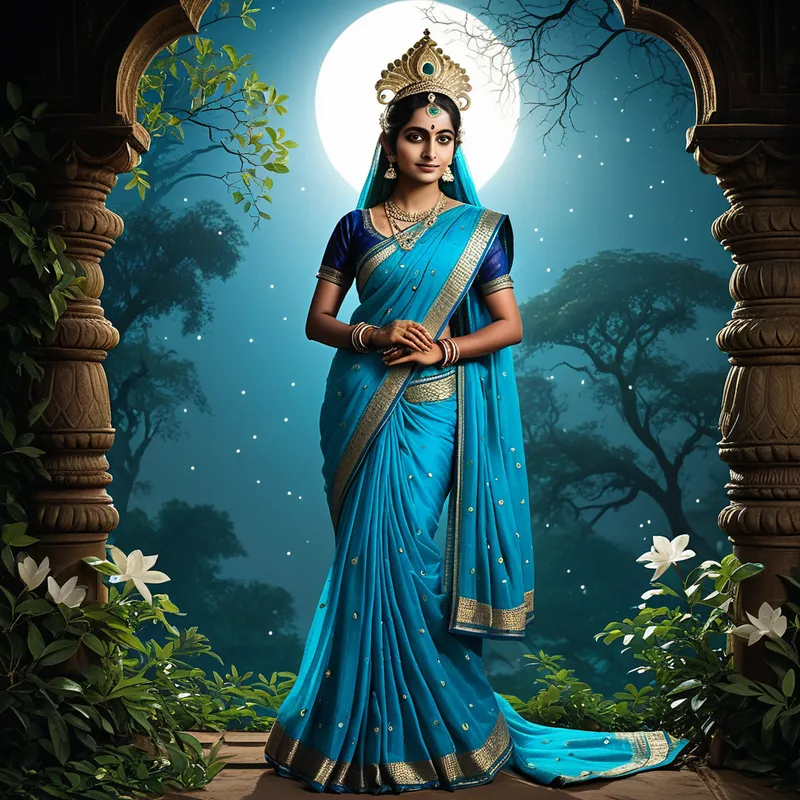
Radha Myth Meaning & Symbolism
The story of Radha, the gopi whose unconditional love for Krishna symbolizes the human soul's ecstatic, painful, and eternal longing for the divine.
The Tale of Radha
Listen. In the land of Braj, where the Yamuna river flows like a ribbon of silver under a sky heavy with stars, there was a love that shook the cosmos. It was not a love born of law or lineage, but of a flute’s call in the twilight.
In the village of Vrindavan, the air was thick with the scent of wild jasmine and ripe mangoes. Here, among the cowherd folk, the gopis, moved Radha. She was not a queen by earthly measure, but her grace was such that the peacocks would fall silent to watch her pass. And then, there was he—Krishna, whose skin was the color of a monsoon cloud, whose eyes held the mischief of a thousand universes, and whose flute held a magic that could stop time.
When Krishna played, the very trees would bend to listen. The river would slow its current. And Radha’s soul would leave her body, drawn by an invisible, irresistible thread. Their love was the landscape itself—it was the secret meetings in the bowers of kadamba trees, the stolen glances across crowded festival grounds, the ecstatic dance under the full moon of Rasa Lila, where one Krishna became many, dancing with each gopi as if she were the only one.
But a divine love in a mortal world is woven with the thread of separation, viraha. The conflict was not of betrayal, but of destiny. Krishna, the divine prince, had a cosmic duty that called him away from the forests of Vrindavan to the courts of Mathura. The call to war, to kingship, to his role as a savior, sounded.
The rising action was the agony of parting. Radha did not cling; her love was too vast for that. But in the moment of his leaving, the world drained of color. The flute’s song became a memory that ached in her bones. The resolution was not a reunion in this lifetime. It was a transformation. Radha remained in Vrindavan, but her consciousness merged with the essence of Krishna’s flute. She became the listening, the longing, the love that persists in absence. In some tellings, in the final heartbeat of the cosmos, they unite as one inseparable reality—Radha-Krishna. But in the earthly tale, her triumph was to make the longing itself a form of perfect, eternal union.
Cultural Origins & Context
The figure of Radha blossoms most fully not in the ancient epics, but in the fertile soil of medieval Bhakti poetry, particularly from the 12th century onward. While hinted at in texts like the Bhagavata Purana, it was poet-saints like Jayadeva who gave her a central, unparalleled voice. In his Gita Govinda, Radha’s emotional landscape—her passion, jealousy, anguish, and ecstasy—became the map for the soul’s journey to God.
This myth was carried on the breath of singers and the pages of poets, from Chaitanya Mahaprabhu, who saw himself as a combined manifestation of Radha and Krishna’s love, to the rustic folk songs of Braj. Its societal function was revolutionary. It democratized divinity. Radha was not born divine; she was a gopi, a simple cowherd girl. Her authority came not from ritual or scripture, but from the raw, human intensity of her love. This provided a powerful, emotionally accessible path to the divine for common people, bypassing priestly hierarchies and establishing a direct, personal relationship with God through the metaphor of passionate, all-consuming love.
Symbolic Architecture
Psychologically, the myth of Radha and Krishna represents the fundamental duality and ultimate non-duality of the human experience. Krishna symbolizes the Self—the divine, cosmic consciousness that is playful, creative, and ultimately beyond full grasp. Radha symbolizes the individual human soul, the jivatma, whose entire purpose and fulfillment is found in yearning for that Self.
The beloved is not an other to be possessed, but the mirror in which the lover recognizes her own deepest, divine nature.
Their separation, viraha, is not a tragedy but the essential condition for love’s depth. It represents the soul’s experience of alienation from its own source, the existential longing that fuels all spiritual seeking. The flute is the call of the Self, an enchantment that awakens the soul from its worldly slumber. Radha’s unwavering devotion, even in absence, symbolizes the ego’s surrender. She does not seek to become Krishna, but to love him so completely that her identity dissolves into that love. In this, the myth models a profound truth: the path to wholeness is not through acquisition of the divine, but through the total offering of the self.
The Dreamer's Resonance
When this myth pattern surfaces in modern dreams, it rarely appears as literal figures. Instead, one may dream of a hauntingly beautiful melody with no source, a feeling of intense, joyful connection suddenly severed, or a landscape—a forest or river—that feels like “home” but is perpetually out of reach. The dreamer might find themselves searching for someone whose face they cannot see, or waiting at a crossroads for a meeting that never occurs.
Somatically, this can correlate with a feeling of tightness in the chest—not the panic of anxiety, but the deep ache of longing. Psychologically, it signals a process where a previously integrated aspect of the personality (a passion, a creative drive, a sense of spiritual connection) has become distant or compartmentalized due to life’s demands, trauma, or societal conditioning. The dream is the psyche’s flute, sounding the call to remember that lost connection. The pain of the dream is the viraha, the necessary friction that indicates a vital part of the Self is calling for reintegration. It is the soul’s homesickness.

Alchemical Translation
The alchemical process modeled here is the transmutation of personal, often romantic, longing into spiritual aspiration—the turning of leaden human desire into the gold of divine love. For the modern individual navigating individuation, the myth offers a stark map.
The first stage is Enchantment: hearing the flute. This is the eruption of the irrational, the numinous, into a ordered life—falling in love, a consuming creative inspiration, or a sudden spiritual awakening. The ego is captivated.
The second, and most crucial, stage is Separation & Longing (Viraha). The beloved (the ideal, the inspiration, the state of grace) inevitably recedes. The worldly life, duties, and one’s own neuroses create distance. The alchemical work here is to refine the longing itself. Instead of lapsing into bitterness or despair, one must learn to make the longing a devotional practice. This is the opus—sitting in the fire of absence and consciously offering that pain as a testament to the reality of the connection.
The crucible of the heart is fired not by union, but by the faithful memory of union.
The final transmutation is Identity Through Devotion. Radha does not get Krishna back on her terms. Instead, her entire being becomes an altar to him. In psychological terms, the ego’s desire to “have” the Self is surrendered. In its place arises a new identity structured around love, service, and remembrance of that higher principle. The individual no longer seeks wholeness as an external object; they embody the search, and in that embodiment, become whole. The lover and the beloved, the seeker and the sought, are revealed to have never been two. The separation was the illusion that made the love, and thus the ultimate union, possible.
Associated Symbols
Explore related symbols from the CaleaDream lexicon: