Aipaloovik Evil Sea Spirit Myth Meaning & Symbolism
An Inuit myth of a monstrous sea spirit who devours souls, embodying the primal chaos that must be faced to restore cosmic and psychological order.
The Tale of Aipaloovik Evil Sea Spirit
Listen. Listen to the silence that comes before the wind, to the stillness that lies beneath the ice. This is a story from the time when the world was younger, and the line between the breathing and the spirit was thin as a seal’s bladder. It is the tale of the hunger beneath the waves, the hunger with a name: Aipaloovik.
In the endless night of the long winter, when the sun was a memory and the moon a cold, watchful eye, the people grew uneasy. The seals grew scarce, slipping away into holes that led nowhere. The caribou herds turned their backs on the hunters. A deep, gnawing cold settled in the bones, a cold that no fire of driftwood or blubber could thaw. The angakkuit, the shamans, listened to their drums. In the steady thump-thump-thump, they heard a new rhythm: a slow, sucking pull, like the tide drawing away from the land, never to return. They whispered of a presence in the far, black waters to the north, a thing that was not of the good spirits of sea and sky.
It was a spirit of pure appetite, a maw without a body, a will without a soul. Aipaloovik. It did not hunt for food, but for the very essence of life—the inua, the soul-stuff of all living things. It called with a silence that was louder than any storm, a psychic lure that drew the lonely, the despairing, the lost out onto the thin ice. They would walk, entranced, towards the dark horizon, until the ice gave way and the black water swallowed them whole. Their bodies were never found, for Aipaloovik consumed them utterly, spirit and flesh, leaving only a deeper chill in the world.
The people huddled in their snow houses, their lamps burning low. Children cried without sound. The community’s song was fading. It was then that the greatest of the angakkuit knew he must journey. He prepared with rituals of purification, fasting until he saw the webs of life glowing between all things. He took his drum, made of stretched walrus stomach, and his amulets of carved bone. He told his people he would seek the source of the hunger.
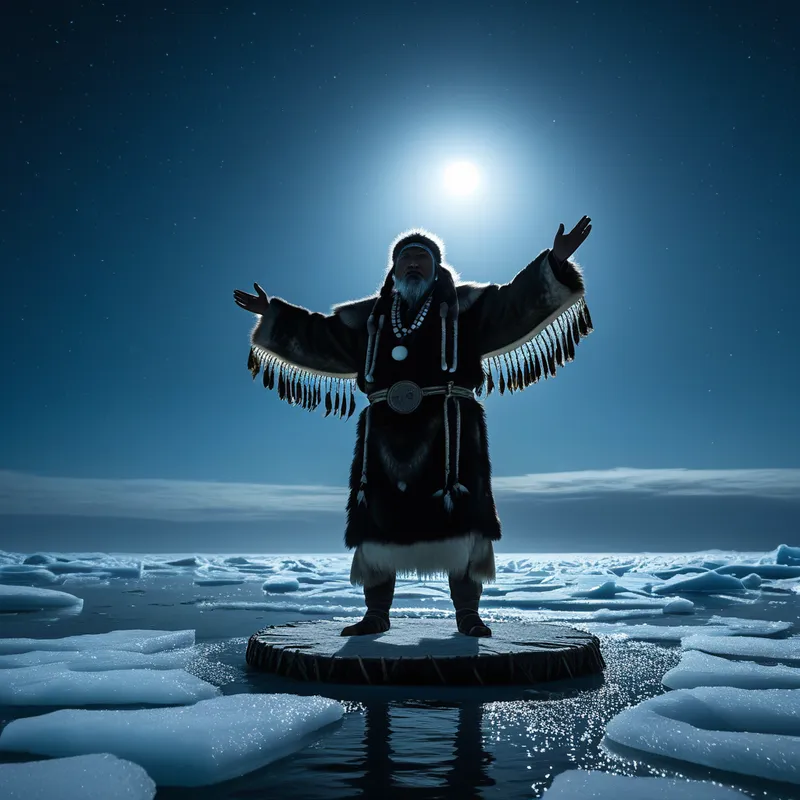
He traveled by dogsled and then by foot, north, always north, towards the place where the ice met the forever-night. The air grew so still he could hear the blood moving in his own ears. Finally, on the shore of a sea so dark it seemed a hole in the world, he stopped. He built no shelter. He lit no fire. He sat on the ice, took his drum, and began to sing. His song was not a challenge, but a calling. A lure for the lurker. He sang of life, of the taste of fresh fat, the sound of children laughing, the warmth of the summer sun—all the things the spirit had forgotten.
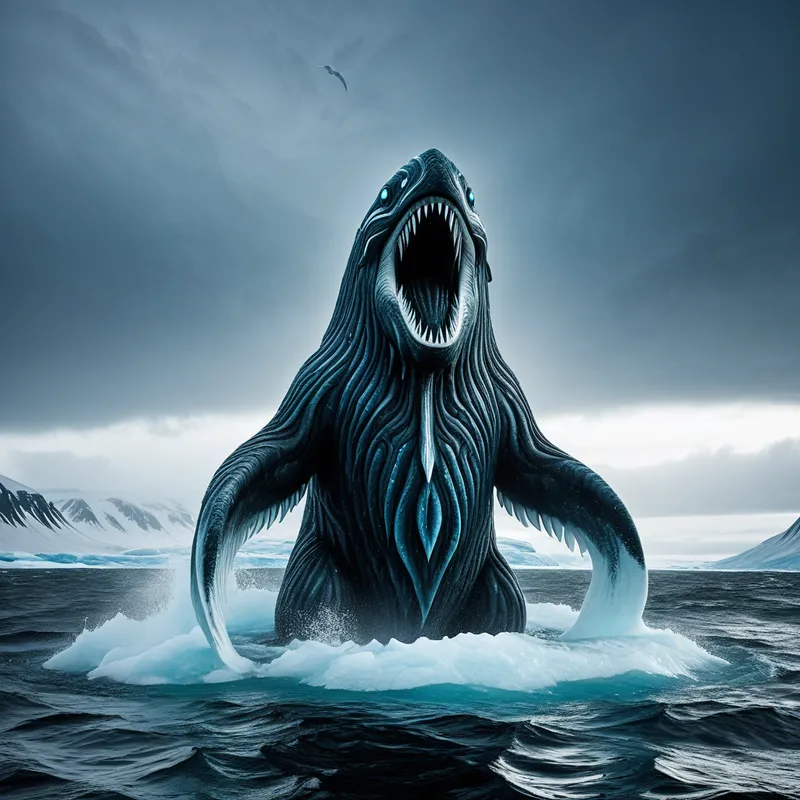
The water did not ripple. It shivered. From the profound depths, a shape began to rise. It was not one thing, but a nightmare of all things: the sleek, terrible bulk of a whale, the claws of a bear, the haunting, empty eyes of a drowned man. It was Aipaloovik, and its mouth was a cavern of darkness. The hunger poured forth, a wave of despair that sought to extinguish the shaman’s song.
The angakkuq did not flee. He drummed harder, his song becoming a rope of sound, a net of memory and names. He named every person lost to the spirit. He named the seals and the caribou. He named the ice and the stars. He wove them into his song and cast this net of being into the gaping maw. The spirit thrashed, repelled not by force, but by the sheer, indigestible weight of life, of connection, of meaning it had tried to consume. The battle was not of claws and teeth, but of essence against void.
For three days and nights, the shaman sang, his voice growing raw, his spirit bleeding into the drumbeat. He offered not his fear, but his remembrance. Finally, as the first faint glow of the returning sun touched the horizon, a great shudder passed through Aipaloovik. With a sound like a glacier calving, it sank back, not defeated, but sated—not by flesh, but by the story of it. The psychic pull ceased. The waters grew calm. The angakkuq, exhausted to the very root of his soul, turned and began the long journey home. The balance was restored. The hunger was quieted, for now. The people could live again, with the knowledge that some darkness must be fed with light, not fought with shadows.
Cultural Origins & Context
The myth of Aipaloovik originates from the Inuit peoples across the Arctic, particularly those of Greenland and the Canadian North. This narrative was not mere entertainment; it was a vital survival doctrine transmitted orally by elders and shamans (angakkuit) around the communal qulliq (oil lamp) during the long, confining winters. The story functioned as a profound piece of ecological and psychological technology.
In a world where the sea was both provider and grave, the line between respect and terror was thin. Aipaloovik personified the capricious, soul-devouring aspect of the Arctic environment—the sudden storm, the treacherous ice, the inexplicable scarcity of game that could doom a community. The myth explained these events not as random misfortunes, but as the work of a specific, intelligible force. More importantly, it prescribed the remedy: not brute force, but spiritual intervention. It reinforced the critical role of the angakkuq as the community’s mediator with the unseen forces, the one who could journey into the psychic landscape and renegotiate the terms of survival. The story taught that some threats are metaphysical and require metaphysical solutions—ritual, song, and the courageous offering of meaning into the maw of meaninglessness.
Symbolic Architecture
At its core, Aipaloovik is an archetypal symbol of the formless, devouring Shadow on a cosmic scale. It is not evil with human malice, but a primal, psychic entropy—a force that consumes structure, relationship, and warmth, leaving only cold isolation. It represents the undifferentiated chaos that exists prior to and in opposition to the created world of names, roles, and connections (the community).
The true monster is not that which seeks to kill you, but that which seeks to unmake the story of you, to dissolve your name back into the silent, hungry void from which it came.
The angakkuq represents the conscious ego or the mediating function of the psyche. His journey is the heroic descent into the unconscious to confront the source of a collective psychic poison. His weapons—song, drum, memory—are the tools of consciousness itself: language, rhythm, and the power of narrative. He does not destroy Aipaloovik; he transforms its relationship to the community by feeding it the very thing it lacks and therefore craves: conscious meaning. This is a profound psychological truth: we cannot simply eradicate our deepest fears or voids; we must learn to relate to them, to introduce light into their structure, thereby changing their nature from devourer to acknowledged part of the whole.
The Dreamer's Resonance
When the pattern of Aipaloovik stirs in modern dreams, it often manifests not as a literal monster, but as an atmosphere of profound, sucking dread. The dreamer may find themselves on an endless, dark shore, feeling an irresistible pull toward a black ocean. They may dream of a loved one walking silently into the sea, or of a gaping hole or pit that threatens to consume everything. Somatic sensations include a crushing weight on the chest, a feeling of icy cold in the limbs, or a terrifying paralysis.
Psychologically, this signals an encounter with a core, formless anxiety—the fear of dissolution, of losing one's identity, of being consumed by depression, grief, or a life crisis that has no clear shape. It is the psyche's signal that a foundational, soul-level hunger is active, one that ordinary "food" (achievements, distractions, possessions) cannot satisfy. The dream is a call for the modern angakkuq within to awaken: to stop fleeing the void, and to turn toward it with the tools of conscious attention and meaning-making.
Alchemical Translation
The myth of Aipaloovik is a precise map for the alchemical process of individuation, specifically the stage of nigredo—the blackening, the descent into the primal matter of the soul. The evil sea spirit is the massa confusa, the chaotic, undifferentiated state of the unconscious that threatens to swallow the conscious personality.
The alchemical work is not to flee the black water, but to learn the song that can be sung only on its shore, the song that transforms the devourer into the digested.
The modern individual's "journey north" is the courageous decision to confront the source of their existential hunger or despair, often in solitude. The "drum and song" are the disciplined practices of introspection, therapy, art, or journaling—the rhythmic, focused application of consciousness to the formless fear. The "offering of names" is the act of articulation: giving precise language to vague anxieties, remembering one's history and connections, reaffirming one's values and identity in the face of the void.
The triumph is not annihilation of the dark, but integration. By consciously "feeding" the chaotic spirit with acknowledgment and meaning, we perform a psychic transmutation. The devouring hunger becomes a contained force, a part of our inner ecology rather than its destroyer. The energy that was spent on fear and avoidance is liberated, leading to a rebirth of purpose and vitality—the return of the sun in the myth. We restore balance within our own internal cosmos, having learned that our deepest wounds can only be healed by the medicine of our own conscious, story-making spirit.
Associated Symbols
Explore related symbols from the CaleaDream lexicon:
- Ocean — The vast, unconscious psyche from which the formless terror of Aipaloovik emerges, representing both the source of life and the potential for soul-dissolving chaos.
- Shadow — Aipaloovik is the archetypal Shadow made manifest, the embodiment of the primal, devouring chaos that exists in opposition to the ordered world of the conscious self and community.
- Ritual — The angakkuq's drumming and singing represent the sacred ritual, the structured act of consciousness that is the only effective tool for engaging with and transforming formless psychic terror.
- Spirit — The myth revolves around engagement with the spirit world, depicting the necessary and dangerous dialogue between human consciousness and the autonomous, powerful entities of the unseen.
- Fear — Aipaloovik is not just an object of fear, but the very embodiment of existential, formless dread—the fear of annihilation, meaninglessness, and the dissolution of the self.
- Journey — The angakkuq's trek north is the essential heroic journey into the unknown depths of the self, a solitary voyage to confront the source of collective suffering.
- Sacrifice — The shaman sacrifices his comfort, safety, and personal energy, offering not a physical object but the profound sacrifice of his focused consciousness to heal the communal psyche.
- Dream — The entire encounter exists in a liminal, dream-like state between worlds, modeling how our deepest psychological work often occurs in such trance-like, non-ordinary states of awareness.
- Death — Aipaloovik brings a psychic and spiritual death, the consumption of the soul-stuff; the myth is about confronting this type of death to prevent it from claiming the entire community.
- Rebirth — The quieting of Aipaloovik and the return of the sun symbolize the rebirth of hope, order, and vitality that follows the conscious integration of a terrifying psychic content.
- Hero — The angakkuq embodies the Hero archetype, not through physical combat, but through the supreme courage required to face a metaphysical enemy with spiritual tools.