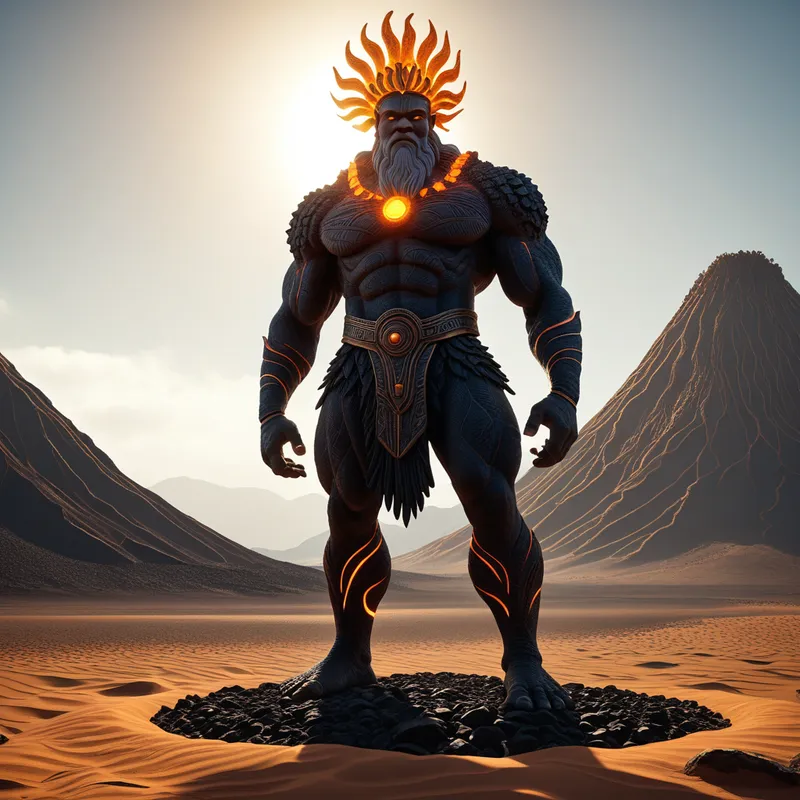
Aganju Myth Meaning & Symbolism
The myth of Aganju, the Yoruba god of the desert and volcano, whose fiery union with the river goddess Yemoja births the god of culture and civilization.
The Tale of Aganju
Hear now the tale of the foundation of the world, when the elements were not yet wed, and the earth was a lonely sovereign.
In the beginning, there was the Olorun, the vast and luminous sky, and below him, the Ilè, the ground of all being. And upon this ground stood a king. His name was Aganju. He was not a king of cities or of people, but of the very substance of the world. His body was the mountain, his bones the great rocks, his blood the slow, fiery magma that slept beneath the crust. His domain was the vast, silent desert, the scorched plain, the immovable cliff. He was stability itself, absolute, austere, and utterly alone. The wind could not move him. The sun beat upon his broad shoulders and he did not flinch. He was the anchor of existence, but an anchor knows only the deep, dark hold; it does not know the voyage.
Across this barren kingdom flowed a single, impossible thread of life: a river. But this was no ordinary river. This was Yemoja, the mother of waters. Where Aganju was stillness, she was motion. Where he was fire trapped in stone, she was cool, nourishing flow. She sang as she moved, a melody of connection and fertility, weaving through the cracks of his domain, seeking, always seeking, a way to the great ocean of her becoming. Yet, before Aganju’s territory, even her waters hesitated. His land was a wall. It drank her streams and gave back only dust.
A great tension built in the world—a psychic heat. The people and the other orisas felt it. The earth was potent but barren; the waters were fertile but had no vessel. Aganju, in his solitary majesty, was complete, yet the world was incomplete. A prophecy hummed in the air: only a union of these absolute opposites could birth a new order.
The moment of meeting was not gentle. It was a cataclysm of essence. Yemoja, driven by the imperative of life, did not go around the mountain. She flowed to it. She presented herself not as a supplicant, but as a complementary force. Aganju, the unmovable, felt the persistent, cool touch of her waters at his base. It was an affront to his solitude, a demand for relationship. The earth trembled. From his peak, smoke began to curl—not the smoke of destruction, but the steam of encounter. His volcanic heart, so long dormant, stirred.
He did not bend to her. He encompassed her. In a mythic act that shook the foundations of Ayé, the solid earth opened. Aganju allowed his fiery, rigid form to create a vessel. Yemoja, the flowing, formless one, entered that vessel. It was the marriage of container and content, of fierce stability and graceful adaptation. The desert did not become a swamp; the river did not evaporate in fire. Instead, from their profound and tumultuous union, a new force was born.
His name was Orunmila. He was not a warrior or a elemental power. He was the god of wisdom, of divination, of the Ikin. He carried the calm, reflective intelligence of his mother’s deep waters and the unwavering, foundational truth of his father’s earth. He brought order, language, art, and law. He was civilization itself, born not from conquest, but from the sacred, alchemical marriage of the wild earth and the nurturing waters. The stability of Aganju found its purpose not in isolation, but in providing the ground upon which the river of culture could finally flow and flourish.

Cultural Origins & Context
The myth of Aganju is woven into the very fabric of Isese, the Yoruba traditional religion. It is not merely a story of gods, but a cosmological map and a social charter. Passed down through generations of Babalawos and custodians of oral tradition, the narrative is embedded within the vast poetic corpus of the Odu Ifá. Here, myths are not fixed texts but living verses (ese) invoked during divination to illuminate a client’s situation.
Societally, the myth functioned on multiple levels. Cosmologically, it explained the origin of fundamental principles: the solidity of the land, the necessity of rivers for life, and the divine origin of human culture and order (Àṣẹ). Politically, it modeled kingship. Aganju is the archetypal ruler—firm, unwavering, and providing stability. His union with Yemoja reflects the ideal ruler’s need to be wedded to the life-giving, nurturing forces of the community (often symbolized by the queen or the earth itself). The myth taught that true power and civilization (Itutu) emerge not from brute force alone, but from the fertile synthesis of strength and compassion, structure and flow.
Symbolic Architecture
At its core, the myth of Aganju is a profound allegory of psychic wholeness. Aganju represents the principle of the Ego in its most developed, stable form. He is the mountain of the Self—the achieved identity, the will, the capacity to stand firm and say “I am.” He symbolizes the bones of the psyche, the necessary structures and defenses that give us form.
The unyielding earth is not the enemy of life; it is the prerequisite for the river’s course. Without the mountain, the water has nowhere to go but into the formless sea.
Yemoja represents the Anima or the deep, unconscious flow of life, emotion, intuition, and connection. She is what the structured ego often fears: the fluid, overwhelming, nourishing, yet potentially dissolving waters of the unconscious. The conflict is not between good and evil, but between two absolute and necessary modes of being: conscious stability and unconscious fluidity.
Their union is the central alchemical act. It is the Hieros Gamos (Sacred Marriage) within the individual psyche. Aganju’s “eruption” is not a loss of control, but the ego’s courageous opening to the depths it has long fortified itself against. He makes a vessel of himself. Yemoja’s “entry” is the unconscious content being welcomed and contained by consciousness. The child of this union, Orunmila, symbolizes the transcendent function—the new, reconciling perspective that arises when conscious and unconscious communicate. He is reflective wisdom, cultural creativity, and the ability to navigate life with both firmness and adaptability.

The Dreamer's Resonance
When the pattern of Aganju stirs in the modern dreamer, it often manifests as a profound somatic and psychological crossroads. One may dream of standing on incredibly solid, parched ground while watching a distant, unreachable river or ocean. There is a feeling of immense personal strength coupled with deep existential thirst. Alternatively, the dream may feature volcanic imagery—not of destructive explosions, but of a slow, radiant heat building underfoot, or of fertile, mineral-rich lava slowly cooling into new, strange landforms.
Psychologically, this signals a process where the ego’s long-held structures—careers, identities, beliefs—have become too rigid, too isolating. The dreamer may feel competent but barren, strong but disconnected from the flow of their own emotions, creativity, or relationships. The “Yemoja” aspect of their psyche is pressing at the boundaries, demanding recognition. The process is one of controlled eruption: allowing the firm walls of the persona to become permeable, to risk feeling the cool, unsettling, yet life-giving waters of the neglected inner world. It is the body’s wisdom signaling that stability has served its purpose and must now become a vessel for something new to be born.

Alchemical Translation
The myth of Aganju provides a masterful model for the Jungian process of individuation—the psychic transmutation of the self into a more complete being. The initial state is one of conscious fortification. We build our Aganju-mountain: a strong ego, a defined personality, a sense of control. This is necessary and good. But individuation requires this mountain to discover it is not an island.
The first alchemical stage is Recognizing the Barrenness. The feeling that, despite all our achievements, something essential is missing. This is the psychic heat, the tension.
The second stage is The Approach of the Opposite. Instead of seeking more control (building the mountain higher), we must turn toward what we have excluded—our fluid emotions, our wild creativity, our deep vulnerabilities (the river). This is an act of immense courage for the ego.
The alchemical vessel is forged in the moment the ego consents to be changed by what it contains.
The third and crucial stage is Sacred Union, Not Conquest. The ego does not drown in the unconscious, nor does it dam the river. It performs the ultimate act of strength: it transforms its nature from a fortress into a crucible. It holds the tension of the opposites. This is the volcanic opening, the conscious suffering of the conflict.
The final stage is the Birth of the Third. From this contained union emerges a new psychic authority—the inner Orunmila. This is not the old, rigid ego, but a wise, discerning consciousness that can consult the depths (divination) and bring forth creative, civilizing solutions to life’s problems. The individual gains the stability of the earth and the adaptability of the waters. They become truly grounded, not in rigidity, but in a dynamic, fertile wholeness.
Associated Symbols
Explore related symbols from the CaleaDream lexicon:
- Mountain — Represents Aganju’s unyielding stability, the ego’s fortress, and the immense, solitary strength that must be risked for transformation to occur.
- River — Symbolizes Yemoja’s life-giving flow, the unconscious stream of emotion, intuition, and creative potential that seeks to fertilize the barren structures of the conscious mind.
- Fire — Embodies the volcanic heart of Aganju, the latent psychic energy, passion, and transformative heat that builds under pressure and must be consciously integrated.
- Earth — The foundational principle of solidity, reality, and groundedness that Aganju rules over; the necessary container for all life and psychic content.
- Union — The central alchemical act of the myth; the sacred marriage of opposites (stable/fluid, conscious/unconscious) that births a new state of being.
- God — Represents the archetypal principle of order, sovereignty, and foundational power that Aganju embodies in its most primal, elemental form.
- Goddess — Represents the archetypal principle of nurturing, fluidity, and generative life that Yemoja embodies, which complements and completes the divine masculine.
- Stone — Symbolizes the core, unchangeable essence of Aganju; the hardened will and the potential vessel that must be carved open by relationship.
- Order — The civilizing principle born as Orunmila; the wisdom, structure, and culture that emerge from the harmonious integration of chaos and stability.
- Root — The deep, anchoring connection to the foundational earth and to ancestral strength that Aganju provides, which must be maintained even during psychic upheaval.
- Vessel — The crucial symbolic form; the transformed ego-structure that learns to contain rather than repel the contents of the unconscious, enabling alchemical change.
- Light — The illuminating wisdom of Orunmila that emerges from the union, representing consciousness that can now reflect upon both itself and its depths.