Menorah Myth Meaning & Symbolism
The myth of the divinely revealed Menorah, a golden lampstand whose sevenfold light illuminates the sacred space and symbolizes wisdom's enduring flame.
The Tale of Menorah
Listen. In the vast, whispering silence of the desert, a mountain smokes. Not with the fire of volcanoes, but with the presence of the Unnameable. The air itself is heavy, charged, a thin veil between the grit of the wilderness and the heart of the cosmos. Below, a people camp—a nation born from the womb of slavery, their spirits still echoing with the crack of whips and the taste of mortar. They are free, yet unformed, a chaotic sea of memory and hope held in a basin of sand.
To their leader, Moses, a voice speaks from the heart of the smoking cloud. It is not a sound for ears, but a pattern impressed upon the soul. A vision of light. Not a torch, not a star, but a crafted thing of beauty and terrifying precision: a Menorah.
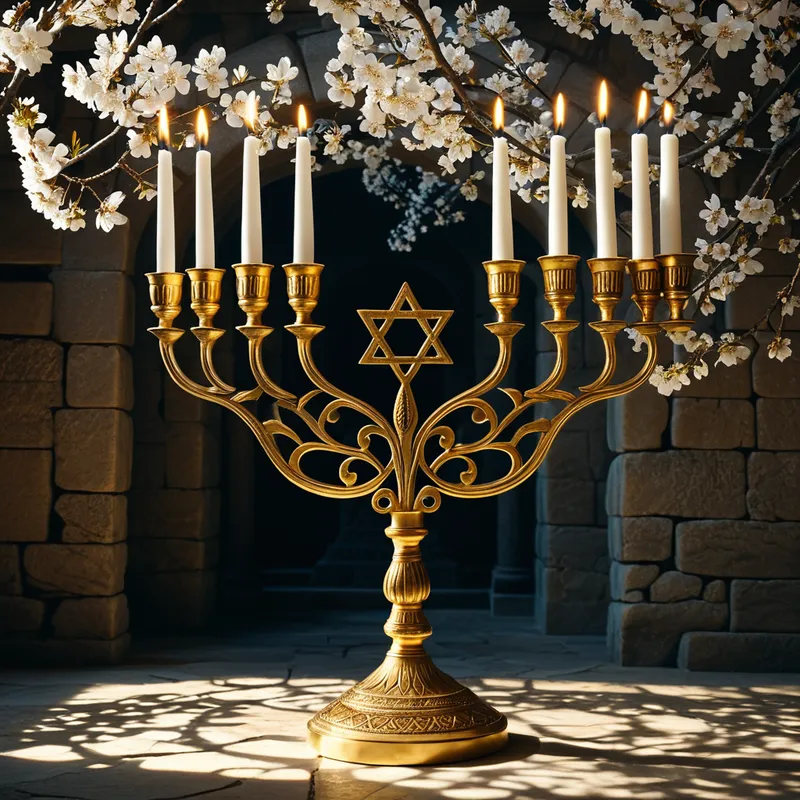
The voice describes it, measure by sacred measure. It is to be forged from a single talent of pure, hammered gold—no casting, no joining of separate pieces. From its central stem, six branches shall emerge, three curving to the left, three to the right, like the limbs of an almond tree caught in a moment of perfect, symmetrical growth. On each branch, three cups shaped like almond blossoms, with knobs and flowers. Seven lamps in total, their wicks to be trimmed, their purest olive oil to be poured, so that their flames face the central light, which faces the Table of Showbread.
But who can shape such a thing? The vision is clear, but the hands are human. The task falls to Bezalel, son of Uri, in whose heart the divine has placed wisdom, understanding, and knowledge in all manner of craftsmanship. He takes the heavy, luminous ingot. The forge is lit. The hammer rises and falls, not in random blows, but in a rhythm of obedience. He does not invent; he unveils. He coaxes the form from within the gold, following the pattern shown on the mountain. Every petal, every curve, every knob is a word in a silent prayer of making.
Finally, it is done. The Menorah is carried into the inner darkness of the newly raised Tabernacle, the Tent of Meeting. The air is thick with the scent of incense and animal hide. The Ark rests in the profound darkness of the Holy of Holies. Here, in the outer chamber called the Holy Place, the Menorah is placed opposite the Table, a sentinel of light. The first high priest, Aaron, approaches with trembling hands. He fills the seven lamps with the clear, beaten oil. He lights the wicks.
A soft whoosh, and then—illumination. Not the harsh sun of the desert, but a warm, steady, living glow. The hammered gold drinks the light and gives it back, multiplied. The almond blossoms seem to bloom anew in the flicker. The shadows retreat, not banished, but ordered, falling in respectful lines behind the sacred furniture. This light does not scream; it abides. It burns through the night, a silent witness against the outer darkness, a promise that the pattern revealed in the chaos of the mountain can indeed be made manifest in the world by human hands, guided by a divine blueprint. The work is complete. The light is lit. And the long vigil of history begins.
Cultural Origins & Context
The myth of the Menorah is not a narrative of gods battling monsters, but a foundational story of sacred technology and covenantal order. Its origins are embedded in the Book of Exodus, a text central to both Jewish and Christian scriptural canons. It was passed down not by bards around a fire, but by priests and scribes, its details preserved with meticulous care as part of the constitutional blueprint for a nascent nation’s relationship with the divine.
Its primary societal function was threefold. First, it was constitutional: the Menorah was a central furnishing of the Tabernacle (and later, the Temples in Jerusalem), making the myth an integral part of the legal and ritual architecture of ancient Israel. Second, it was pedagogical: the detailed instructions (Exodus 25:31-40) served as a perpetual lesson in the marriage of divine inspiration (ruach Elohim) and skilled human execution (chokhmah). It taught that holiness could be fabricated, that the spiritual was to be embodied in material form through disciplined artistry. Third, it was identitarian: the ever-burning light became a core symbol of the people themselves—a nation meant to be a "light unto the nations" (Isaiah 42:6), enduring through exile and darkness, its form and purpose preserved.
Symbolic Architecture
The Menorah is a compact universe of symbolic meaning. Its form is a masterclass in sacred geometry and psychological archetypes.
At its most fundamental, it is the symbol of illuminated consciousness. The single piece of hammered gold represents the unified, integrated Self, forged through the repeated blows of experience (the opus of life) into a coherent whole. The six branches extending from the central stem symbolize the diverse faculties of the psyche—thought, feeling, sensation, intuition, and more—all rooted in and oriented toward the central axis of the transcendent function, the seventh light.
The central light is not merely one among seven; it is the source from which the others derive their orientation and meaning. It is the still point in the turning world of the psyche.
The almond tree motif is profoundly significant. The almond (shaqed in Hebrew) is the first tree to blossom in the late winter in the Levant, a sudden eruption of life and beauty from dormant wood. It is a symbol of vigilant promise and swift fulfillment. The Menorah, therefore, is not static decoration; it is a tree of life in perpetual, luminous bloom, representing wisdom that flowers from the wood of human experience, watched over by a vigilant consciousness (the priestly trimming of the wicks).
The requirement for pure, beaten olive oil adds another layer: illumination requires preparation, effort, and the crushing of raw substance to release its latent energy. Light is not free; it is the product of a sacrificial, alchemical process.
The Dreamer's Resonance
When the Menorah appears in a modern dream, it rarely manifests as a museum artifact. It appears as an inner structure seeking recognition. To dream of lighting the Menorah suggests the dreamer is attempting to consciously order and illuminate disparate aspects of their inner life, to bring a sacred discipline to their psychic energy. There is often a feeling of solemn responsibility, of being entrusted with a fragile, precious flame.
To dream of a broken or malformed Menorah may point to a sense of fragmentation—a Self that feels assembled from disparate, poorly joined parts, rather than forged from a single, resilient substance. The dreamer may feel their talents or energies (the branches) are misaligned, not serving a central, unifying purpose.
Dreaming of being in a dark space with only the Menorah’s light can symbolize a period of introspection where one’s inner wisdom (the lumen naturae, or light of nature) is the sole guide through a confusing or shadowy phase of life. The somatic sensation is often one of focused calm amidst anxiety, a small, warm center in a vast, cool darkness.
Alchemical Translation
The myth of the Menorah models the alchemical process of individuation with stunning clarity. The prima materia is the raw, undifferentiated talent of gold—the chaotic potential of the un-lived life, heavy with value but without form. The divine pattern shown on the mountain represents the archetypal image of the Self, the latent, complete blueprint of wholeness that exists in the collective unconscious.
The artisan Bezalel embodies the ego in service to the Self. His tools—wisdom, understanding, knowledge—are the cognitive and creative faculties we must employ. The hammering is the relentless work of consciousness: confronting complexes, integrating shadows, enduring suffering, and consciously shaping our experiences. The goal is not to create something new from nothing, but to reveal the form hidden within the mass, to become who we essentially are.
The instruction to make it from one piece is the ultimate alchemical directive: the work of individuation is the creation of psychic integrity. We are not assembling a personality from parts; we are discovering the unitary being beneath the fragments.
The final act—lighting the lamps with prepared oil—symbolizes the ignition of consciousness. This is not the blinding flash of inflation, but the steady, enduring flame of sustained awareness. It requires ongoing maintenance (the opus contra naturam): trimming the wicks of outdated attitudes, replenishing the oil of spiritual practice. The light faces inward, illuminating the inner sanctum, but it also radiates outward, becoming a stabilizing, orienting presence in the world. The Menorah thus becomes a living symbol of the achieved Self: a structured, luminous totality, born from chaos, forged by effort, and dedicated to the perpetual, vigilant maintenance of sacred light.
Associated Symbols
Explore related symbols from the CaleaDream lexicon: