
The Hungry Grass Myth Meaning & Symbolism
A cursed patch of ground, born from a corpse's unquiet spirit, that saps the life from any living soul who dares to walk upon it.
The Tale of The Hungry Grass
Listen now, and tread softly. There are places in this land where the green cloak of Éire grows thin, and the old bones of the world remember their hunger.
It begins not with a bang of thunder, but with a silence. A man falls—not in battle, though his heart was a battlefield. Perhaps a father, broken by the weight of a famine-empty pot. A mother, her soul carried off by a fever that spared her body. A rebel, cut down and left for the crows, his cause unfinished, his rage unspent. They die with a great cry trapped in their throat, a final, furious no to the turning of the world. And when they are laid in the earth, or worse, left upon it, that cry does not dissipate. It soaks downward, a poison of pure negation.
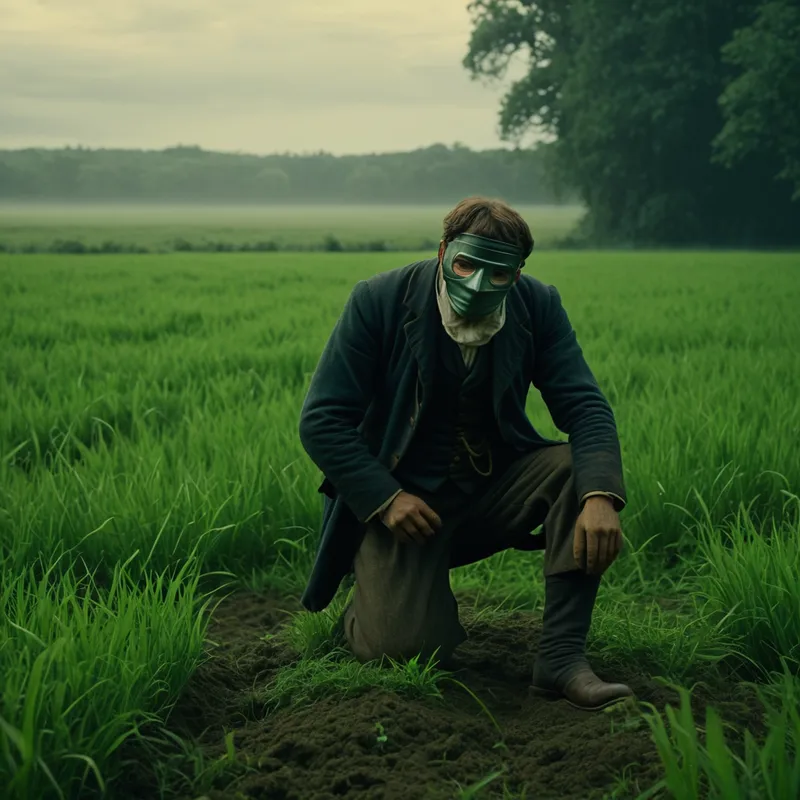
The soil drinks it. The roots of the grass sup upon it. And there, in that spot, the grass forgets its nature. It no longer lives on sun and rain. It develops a taste for the quick, warm spark of the living. It becomes Féar Gortach—the Hungry Grass.
To the eye, it is a trap of perfect innocence. A circle of green, perhaps lusher and more inviting than the grass around it, shimmering in the low sun. A traveler, footsore and mind adrift, thinks it a fine place to rest. A child chases a ball into its embrace. The moment a living foot touches that cursed sod, the cold begins. Not a winter chill, but a drain, a sinking void that pulls from the very marrow. Strength flees the limbs like water down a drain. The knees buckle. A profound, unshakeable lethargy wraps the soul. The world dims. The victim feels the history of that place—the specific, personal anguish of the one who died there—flood into them, a foreign grief replacing their own vitality. They will lie there, pinned by invisible chains, until the life is nearly spent, or until a passerby, wise to the old signs, drags them free and presses food and drink into their hands, forcing the living world back into their body.
The grass itself is never sated. It waits, patient as stone, for the next spark of life to wander too close.
Cultural Origins & Context
The myth of the Hungry Grass is not a tale of ancient gods, but of the very soil and its recent dead. It flourished in the 18th and 19th centuries, particularly in the wake of the Great Famine (An Gorta Mór). This was a folklore born from a landscape scarred by mass, un-mourned death. Bodies were often buried hastily in unconsecrated ground, or worse, left by the roadside. The societal and religious rites that traditionally shepherded a soul to rest collapsed under the scale of the catastrophe.
The story was passed in whispers by the hearth, a practical warning wrapped in profound metaphysics. It was told by seanchaí to children, by farmers to laborers. Its function was twofold: first, a stark, survivalist guideline to avoid certain patches of land. But more deeply, it was an act of cultural psycho-geography. It named the trauma. It said, Here, a person died in despair. This ground is not neutral. It holds memory. The myth transformed anonymous tragedy into located, specific history, creating a map of pain that warned the living to tread with awareness, or to carry sustenance—a literal piece of bread in the pocket—as both physical and symbolic armor against the inherited hunger of the past.
Symbolic Architecture
At its core, the Hungry Grass is a symbol of unintegrated trauma. It represents grief that was not processed, rage that was not expressed, a life narrative that was abruptly severed without resolution. This psychic energy does not vanish; it incorporates itself into the very fabric of a place or a lineage.
The Hungry Grass is the psychological equivalent of a complex that has fallen into the unconscious land, where it operates autonomously, sapping energy from the conscious personality.
The "hunger" is not evil, but a distorted, parasitic form of longing. The unquiet dead longed for life, for resolution. The grass, infected by this longing, seeks to fulfill it by consuming the life of others. Psychologically, this mirrors how unhealed ancestral wounds—patterns of despair, abandonment, or rage—can "hunger" for expression through us, draining our vitality to feed a ghostly narrative that is not our own. The patch of grass is a liminal zone, a thin place between the world of the living and the frozen moment of a traumatic death. To step on it is to unconsciously step into that frozen moment, to be forced to wear another's unresolved fate.

The Dreamer's Resonance
When this myth pattern stirs in the modern dreamscape, it rarely appears as literal grass. The dreamer may find themselves in a familiar place—their childhood home, their office, a regular path in the park—that suddenly exerts a paralyzing, draining pull. They feel their energy seeping away into the floorboards, the carpet, the soil. Often, there is a sense of a specific, localized "spot" of profound negativity.
Somatically, this dream points to a confrontation with a pocket of frozen history within the psyche. The dreamer is standing on, or living within, an emotional reality that belongs to an ancestor or a past version of themselves—a trauma, a resignation, a buried grief. The life-drain is the cost of sustaining this frozen story. The dream is a stark illustration of assimilation in reverse: instead of the ego integrating unconscious material, the unconscious complex is consuming the ego's energy. The healing action implied by the folklore—being dragged off the spot and fed—suggests the dreamer needs to be forcibly removed from this psychic identification and nourished with new, life-affirming "food" (new perspectives, somatic grounding, conscious breath) to break the spell.

Alchemical Translation
The alchemical journey modeled by the Hungry Grass is the nigredo of the soul's inheritance. It is the stage of confronting the prima materia of one's psychic ground, which is often poisoned with the leaden weight of unlived lives.
The triumph is not in destroying the Hungry Grass, but in changing one's relationship to it. The bread in the pocket is the Lapis Philosophorum in potentia—a humble, embodied act of consciousness that transmutes the encounter.
The process begins with the fall—the inevitable moment when we step onto our own psychic "hungry grass," when an ancestral pattern (of fear, lack, or despair) activates and drains us. This is the necessary descent. The alchemical work is, first, to recognize the ground you are standing on. To ask: "Whose hunger is this? Whose unresolved death am I re-enacting?" This is the separatio—distinguishing your own life from the frozen hunger embedded in your field.
Then comes the crucial act: carrying and offering the "bread." Psychologically, this is the conscious, nourishing intention—the act of self-care, the boundary, the spoken truth, the felt grief—that you bring into the hungry place. You do not feed the grass by letting it drain you; you transform the relationship by introducing a foreign element of deliberate sustenance. This act breaks the automatic, parasitic circuit. It acknowledges the hunger without becoming its meal. In time, through repeated conscious engagement, the cursed spot may lose its power. The frozen grief may thaw, not into nothingness, but into compost for new growth. The grass may simply become grass again, and you, the traveler, become wiser for knowing the map of your own interior, and what sustenance you must always carry.
Associated Symbols
Explore related symbols from the CaleaDream lexicon: