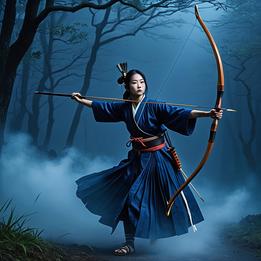
Yumi
A traditional Japanese longbow, historically used by samurai for warfare and archery. It symbolizes discipline, precision, and spiritual connection.
Yumi Dream Meaning
A traditional Japanese longbow, historically used by samurai for warfare and archery. It symbolizes discipline, precision, and spiritual connection.
Interpretive Themes
Cultural Lenses
Jungian Perspective
View Context →The yumi represents the Self's striving for wholeness through disciplined practice. It symbolizes the tension between conscious aim and unconscious forces, with the arrow's flight as individuation.
Freudian Perspective
View Context →A phallic symbol representing masculine power, aggression, and sexual energy. The act of drawing and releasing may symbolize tension and release of libidinal drives or repressed desires.
Gestalt Perspective
View Context →The yumi is an extension of the self in the dreamer's field. It represents how the dreamer aims their energy, with the relationship between archer, bow, and target revealing current life dynamics.
Cognitive Perspective
View Context →Represents mental schemas related to goal-directed behavior, practice, and skill acquisition. The dream processes memories of discipline or anxieties about performance and precision.
Evolutionary Perspective
View Context →Taps into ancient survival mechanisms related to hunting, tool use, and threat assessment. Symbolizes the human capacity for foresight, planning, and coordinated action against challenges.
East Asian Perspective
View Context →In Japanese tradition, the yumi is sacred in Shinto and kyudo, where shooting is a spiritual ritual (sharei) to purify mind and body, embodying harmony, truth, and beauty.
Global/Universal Perspective
View Context →A universal archetype of the bow as a tool of focus, power, and direction. Cross-culturally, it symbolizes the application of force with control toward a distant objective.
South Asian Perspective
View Context →Evokes Arjuna's Gandiva bow from the Mahabharata, representing dharma (duty), skill in action (karma yoga), and the focused mind required for spiritual warfare against inner demons.
Modern Western Perspective
View Context →Often romanticized as an emblem of samurai honor and Zen-like focus. In contemporary culture, it symbolizes niche mastery, mindfulness practices, and aesthetic minimalism.
European Perspective
View Context →Historically, the longbow (like the English yew bow) symbolizes peasant resilience, skilled craftsmanship, and democratic power, as at Agincourt, where it overturned feudal hierarchies.
African Perspective
View Context →In many African traditions, the bow is a hunter's tool linked to initiation, provision, and community protection. It symbolizes precision, patience, and respect for natural balance.
Middle Eastern Perspective
View Context →Recalls the composite bows of Persian and Ottoman cavalry, symbolizing martial prowess, empire, and technological artistry. In poetry, it often represents the curved eyebrow of the beloved.
Want a deeper analysis?
Get a personalized interpretation of your entire dream including this symbol.
Interpret My DreamCommon Appearances & Contexts
| Context | Emotion | Interpretation |
|---|---|---|
| Context Drawing the bow | Emotion determined | Interpretation Preparing for action. |
| Context Holding a yumi | Emotion reverent | Interpretation Connecting to tradition. |
| Context Shooting an arrow | Emotion focused | Interpretation Releasing intention. |
| Context A broken yumi | Emotion devastated | Interpretation Loss of discipline. |
| Context Receiving a yumi | Emotion honored | Interpretation Accepting responsibility. |
| Context Carrying a yumi | Emotion burdened | Interpretation Bearing expectations. |
| Context Watching archery | Emotion inspired | Interpretation Observing mastery. |
| Context Missing a target | Emotion frustrated | Interpretation Lacking focus. |
| Context Polishing a yumi | Emotion calm | Interpretation Cultivating care. |
| Context A glowing yumi | Emotion awed | Interpretation Spiritual awakening. |
| Context Teaching with yumi | Emotion patient | Interpretation Passing knowledge. |
| Context Choosing a yumi | Emotion deliberate | Interpretation Selecting a path. |
Interpret Your Full Dream
Beyond this symbol, every dream carries a unique story. Share your dream for a personalized AI-powered interpretation.