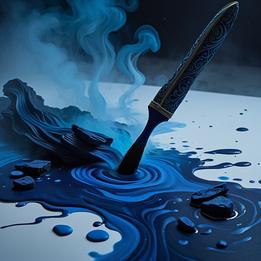
Ink Brush
A traditional tool for calligraphy and painting, symbolizing creative expression, spiritual discipline, and the flow of consciousness onto a blank surface.
Ink Brush Dream Meaning
A traditional tool for calligraphy and painting, symbolizing creative expression, spiritual discipline, and the flow of consciousness onto a blank surface.
Interpretive Themes
Mythological Resonance
Cangjie
ChineseThe mythical four-eyed scribe who, upon observing the tracks of birds and beasts, was inspired to create the first Chinese characters, causing millet to rain from the sky as the heavens celebrated the birth of writing.
Wu Wei
TaoistThe principle of 'effortless action' embodied in the master calligrapher's stroke, where intention and execution become one, and the brush moves as an extension of the spirit, not the hand.
Cultural Lenses
Jungian Perspective
View Context →Archetypal tool of the Self, integrating conscious and unconscious through symbolic expression. Represents the individuation process where inner truths are made visible through creative acts.
Freudian Perspective
View Context →Phallic symbol representing creative or sexual energy. The ink flow may symbolize seminal fluid, with writing/painting as sublimated expression of libidinal drives.
Gestalt Perspective
View Context →Represents the dreamer's ability to make marks on the world. The brush is an extension of self, with its condition reflecting how one approaches self-expression and boundary-setting.
Cognitive Perspective
View Context →Mental tool for organizing thoughts and memories. The brush represents cognitive processes of encoding experiences into retrievable forms through symbolic representation.
Evolutionary Perspective
View Context →Tool-making adaptation for communication and social bonding. Represents human advantage in creating shared symbols, facilitating cooperation and cultural transmission across generations.
East Asian Perspective
View Context →Sacred instrument in Chinese, Japanese, and Korean traditions. Historically used for scholarly pursuits, spiritual cultivation, and artistic expression—embodying the unity of mind, body, and spirit in disciplined practice.
South Asian Perspective
View Context →Associated with Saraswati (goddess of knowledge) and scribal traditions. Used in manuscript illumination and religious texts, representing divine wisdom flowing through human hands.
Middle Eastern Perspective
View Context →Islamic calligraphy tool for transcribing Quranic verses. Represents devotion, with the brush mediating between human skill and divine word in sacred art forms.
European Perspective
View Context →Renaissance artist's tool symbolizing humanist ideals. Associated with individual genius and the elevation of secular art alongside religious themes in Western tradition.
African Perspective
View Context →Used in traditional storytelling through symbols and patterns. Represents communal knowledge transmission, with brushwork encoding cultural memory and ancestral wisdom.
Modern Western Perspective
View Context →Nostalgic symbol of analog creativity in digital age. Represents mindfulness, slow living, and the handmade as counterpoint to mass production and screen-based expression.
Global/Universal Perspective
View Context →Cross-cultural symbol of human mark-making. From cave paintings to contemporary art, represents fundamental human urge to leave traces, communicate, and transform blankness into meaning.
Historical Authorities
Want a deeper analysis?
Get a personalized interpretation of your entire dream including this symbol.
Interpret My DreamThe Oracle's Prediction
Combine multiple symbolsA breakthrough in creative or meditative practice, revealing a new channel for self-expression.
Timeframe
Lunation (~29 Days)
Intensity
Deep
Common Appearances & Contexts
| Context | Emotion | Interpretation |
|---|---|---|
| Context Writing calligraphy | Emotion Calm | Interpretation Seeking inner peace. |
| Context Broken brush | Emotion Frustrated | Interpretation Creative block. |
| Context Ink spilling | Emotion Anxious | Interpretation Loss of control. |
| Context Gifted brush | Emotion Grateful | Interpretation Receiving inspiration. |
| Context Painting landscape | Emotion Joyful | Interpretation Expressing vision. |
| Context Brush floating | Emotion Awe | Interpretation Divine inspiration. |
| Context Brush fighting | Emotion Angry | Interpretation Internal conflict. |
| Context Ancient brush | Emotion Reverent | Interpretation Connecting to past. |
| Context Brush burning | Emotion Fearful | Interpretation Destroying creativity. |
| Context Teaching brushwork | Emotion Proud | Interpretation Sharing knowledge. |
| Context Brush transforming | Emotion Amazed | Interpretation Personal evolution. |
| Context Empty inkwell | Emotion Despair | Interpretation Creative depletion. |
Interpret Your Full Dream
Beyond this symbol, every dream carries a unique story. Share your dream for a personalized AI-powered interpretation.