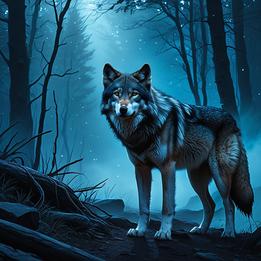
Wolf Guide
A spiritual protector or teacher appearing in dreams, often representing primal wisdom, instinctual guidance, and connection to untamed nature.
Wolf Guide Dream Meaning
A spiritual protector or teacher appearing in dreams, often representing primal wisdom, instinctual guidance, and connection to untamed nature.
Interpretive Themes
Mythological Resonance
Fenrir
NorseThe giant wolf bound by gods, symbolizing untamed forces that must be confronted, yet also a guide to Ragnarok's transformation.
Lupa
RomanThe she-wolf who nursed Romulus and Remus, representing fierce protection and the foundation of civilization from wild origins.
Cultural Lenses
Jungian Perspective
View Context →Represents the Self archetype integrating shadow aspects—the wild, untamed psyche that guides toward wholeness through instinctual wisdom rather than conscious rationality.
Freudian Perspective
View Context →Symbolizes repressed primal instincts and libidinal energy, particularly aggressive or sexual drives seeking expression through a protective, guiding figure in the dream landscape.
Gestalt Perspective
View Context →The dreamer's projected aspect of personal power and natural leadership—exploring what the wolf represents about one's own untapped potential and authentic expression.
Cognitive Perspective
View Context →Mental schema for processing instinctual decision-making and social navigation—the brain's way of simulating guidance through challenging situations using animal metaphor.
Evolutionary Perspective
View Context →Ancient survival mechanism recalling human-wolf coevolution—symbolizing social cooperation, territory protection, and predator awareness encoded in ancestral memory for adaptive advantage.
North American Perspective
View Context →In Native traditions, often a spirit guide teaching balance between community and individuality, with modern context preserving these teachings through oral traditions and ecological awareness.
European Perspective
View Context →Historically feared as demonic in medieval Christianity, now romanticized in folklore as wise forest guardian—modern context shows rehabilitation through conservation and myth revival.
East Asian Perspective
View Context →In Chinese and Japanese traditions, celestial wolf deities like Tianlang protect travelers and represent martial prowess—modern context appears in anime and spiritual practices.
Global/Universal Perspective
View Context →Cross-cultural symbol of wilderness wisdom appearing in shamanic traditions worldwide—modern context represents universal human longing for reconnection with natural world and instinctual knowing.
South Asian Perspective
View Context →In Hindu mythology, wolves appear as vahanas (vehicles) for deities and in Buddhist Jataka tales as teachers—modern context maintains spiritual significance in folk traditions.
Middle Eastern Perspective
View Context →Ancient Mesopotamian cultures saw wolves as symbols of both destruction and protection—modern context influenced by Bedouin traditions of wolf as desert guide and survivor.
African Perspective
View Context →In various traditions, wolf or jackal guides (like Anubis) mediate between worlds—modern context preserves these roles in spiritual practices and oral histories.
Historical Authorities
Want a deeper analysis?
Get a personalized interpretation of your entire dream including this symbol.
Interpret My DreamThe Oracle's Prediction
Combine multiple symbolsYou will discover a new path or leadership role by trusting your instincts.
Timeframe
Lunation (~29 Days)
Intensity
Deep
A loyal partnership or pack-like community will form or strengthen.
Timeframe
Seasonal (~3 Months)
Intensity
Deep
Common Appearances & Contexts
| Context | Emotion | Interpretation |
|---|---|---|
| Context Forest journey | Emotion Curiosity | Interpretation Seeking deeper understanding |
| Context Night wilderness | Emotion Fear | Interpretation Confronting primal fears |
| Context Mountain path | Emotion Determination | Interpretation Perseverance with guidance |
| Context River crossing | Emotion Anxiety | Interpretation Transition with protection |
| Context Pack hunting | Emotion Excitement | Interpretation Collaborative pursuit of goals |
| Context Cave entrance | Emotion Awe | Interpretation Entering subconscious depths |
| Context Moonlit clearing | Emotion Peace | Interpretation Intuitive clarity emerges |
| Context Storm approaching | Emotion Urgency | Interpretation Need for quick guidance |
| Context Teaching cubs | Emotion Nurturing | Interpretation Mentoring others emerges |
| Context Territory marking | Emotion Assertiveness | Interpretation Establishing personal boundaries |
| Context Howling together | Emotion Connection | Interpretation Finding voice in community |
| Context Winter survival | Emotion Resilience | Interpretation Endurance through hardship |
Interpret Your Full Dream
Beyond this symbol, every dream carries a unique story. Share your dream for a personalized AI-powered interpretation.