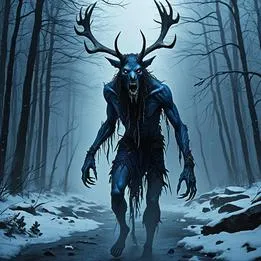
Wendigo Dream Meaning
A malevolent spirit or creature from Algonquian folklore, representing insatiable greed, cannibalism, and the corruption of the human soul through extreme hunger and winter isolation.
Common Appearances & Contexts
| Context | Emotion | Interpretation |
|---|---|---|
| Being pursued | Panic | Running from inner corruption. |
| Eating forbidden food | Guilt | Consuming what harms others. |
| Winter isolation | Despair | Facing survival's moral cost. |
| Transforming into monster | Horror | Fear of losing humanity. |
| Obsessive hoarding | Compulsion | Greed consuming the self. |
| Hearing distant screams | Dread | Awareness of approaching corruption. |
| Frozen landscape | Desolation | Emotional or spiritual barrenness. |
| Breaking cultural taboos | Shame | Violating core moral values. |
| Endless hunger | Desperation | Unsatisfied spiritual craving. |
| Witnessing transformation | Revulsion | Seeing corruption take hold. |
| Ancient forest | Awe | Confronting primal nature. |
| Ritual warning | Anxiety | Heeding moral boundaries. |
Interpretive Themes
Unchecked Consumption
highWarns against material or spiritual gluttony.
Loss of Humanity
highFear of becoming what you despise.
Environmental Destruction
mediumEcological imbalance leads to spiritual decay.
Winter Isolation
mediumSurvival pressures testing moral boundaries.
Taboo Transgression
highCannibalism as ultimate moral boundary.
Cultural Lenses
North American Perspective
View Context →Originates from Algonquian peoples as a winter spirit of cannibalism and greed, historically serving as cautionary tale against starvation-induced moral decay, now often appropriated in horror media while original teachings warn against environmental exploitation.
Jungian Perspective
View Context →Represents the Shadow archetype at its most destructive - the repressed hunger, greed, and primal instincts that, when denied integration, transform into monstrous compulsions consuming the psyche from within.
Freudian Perspective
View Context →Manifestation of the Id's oral fixation and death drive unrestrained by Superego, representing cannibalistic fantasies and regression to primitive survival instincts that civilization attempts to suppress but cannot eliminate.
Gestalt Perspective
View Context →Projection of unacknowledged hunger - not just physical but emotional, spiritual, or material - that the dreamer disowns, creating a monstrous 'other' to carry what they cannot accept in themselves.
Cognitive Perspective
View Context →Cognitive schema for extreme scarcity thinking, where survival anxiety becomes pathological greed, representing maladaptive thought patterns about resource competition and threat magnification in perceived barren environments.
Evolutionary Perspective
View Context →Archetypal warning system against cannibalism and resource hoarding that threatens group survival, encoding deep evolutionary fears about starvation, winter scarcity, and behaviors that destroy social cohesion during extreme hardship.
Modern Western Perspective
View Context →Metaphor for consumerism's insatiable appetite, environmental destruction through overconsumption, and capitalism's dehumanizing greed, transforming indigenous warning into critique of contemporary materialistic culture.
European Perspective
View Context →Parallels to werewolf and vampire myths of transformation through transgression, but with distinct emphasis on winter hardship and cannibalism rather than lunar cycles or blood, reflecting different environmental pressures.
Global/Universal Perspective
View Context →Cross-cultural archetype of the hunger demon or famine spirit appearing in various forms worldwide, representing universal human fear of starvation driving moral collapse and the terrifying transformation through extreme deprivation.
East Asian Perspective
View Context →Resonates with hungry ghost (preta) concepts in Buddhism - spirits cursed with insatiable hunger due to past greed, though Wendigo emphasizes winter isolation and cannibalism rather than karmic punishment alone.
African Perspective
View Context →Echoes shapeshifter myths and famine spirits like the Swahili popobawa, but Wendigo uniquely ties transformation to winter environment and cannibalism rather than sexual predation or general malice.
Latin American Perspective
View Context →Similar to nahual shapeshifter concepts but with emphasis on winter hardship and cannibalism rather than animal transformation for protection or predation, reflecting different ecological and cultural contexts.
Interpret Your Full Dream
Beyond this symbol, every dream carries a unique story. Share your dream for a personalized AI-powered interpretation.