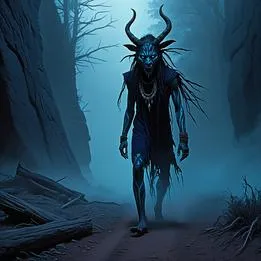
Skinwalker Dream Meaning
A shape-shifting entity from Navajo (Diné) tradition, often associated with malevolent witchcraft, transformation, and violation of natural/spiritual boundaries.
Common Appearances & Contexts
| Context | Emotion | Interpretation |
|---|---|---|
| Being pursued | panic | Feeling hunted by unknown. |
| Seeing transformation | horror | Witnessing violation of nature. |
| Trusted person changes | betrayal | Familiar becomes threatening. |
| In wilderness at night | vulnerability | Exposed to hidden dangers. |
| Losing own form | dissociation | Fear of self-unraveling. |
| Breaking a taboo | guilt | Consequences of transgression. |
| Confronting the entity | dread | Facing corrupted power. |
| Animal behaving unnaturally | unease | Nature feels wrong. |
| Whispering in darkness | paranoia | Unseen malevolent presence. |
| Ritual gone wrong | terror | Spiritual protection failed. |
| Mirror reflection shifts | shock | Self-image distorted. |
| Home invasion | violation | Sanctuary breached. |
Interpretive Themes
Cultural Lenses
North American Perspective
View Context →Specifically Navajo (Diné): A 'yee naaldlooshii', a witch who has gained power to transform into animals through dark rituals, representing ultimate taboo and spiritual corruption. Modern context involves cultural appropriation in media.
Jungian Perspective
View Context →Shadow archetype manifesting as shape-shifter; represents repressed aspects of psyche taking monstrous forms. Integration requires confronting one's capacity for deception and transformation.
Freudian Perspective
View Context →Expression of repressed primal instincts (id) breaking through ego boundaries; transformation symbolizes return to primitive, amoral state. May relate to unconscious fears of regression.
Gestalt Perspective
View Context →Projection of one's own capacity for deception or hidden malice onto external figure. The dreamer may be disowning their ability to transform or adapt in harmful ways.
Cognitive Perspective
View Context →Mental representation of threat detection system misfiring; brain categorizing ambiguous stimuli as extreme danger. May reflect anxiety about unreliable perceptions or social deception.
Evolutionary Perspective
View Context →Activation of predator-detection and coalitional psychology modules; fear of deceptive mimicry by hostile agents. Rooted in survival need to identify threats that disguise themselves.
European Perspective
View Context →Parallels to werewolf legends and witch folklore; shape-shifting as pact with devil or curse. Historically tied to fears of witchcraft and boundary-crossing between human/animal realms.
African Perspective
View Context →Resonates with shapeshifter traditions like the 'bultungin' (were-hyena) of East Africa or witch-animal transformations; often tied to spiritual power, jealousy, and social disruption.
Latin American Perspective
View Context →Echoes in 'nahual' traditions (Mesoamerican shape-shifting sorcerers) and folk tales of brujería; transformation tied to spiritual knowledge, protection, or malevolence depending on context.
East Asian Perspective
View Context →Parallels to fox spirit (huli jing/kitsune) mythology where transformation blurs human/animal boundaries for trickery or teaching; often ambiguous morality rather than purely malevolent.
Modern Western Perspective
View Context →Horror trope representing fear of identity theft, deepfake technology, or social deception; metaphor for anxiety about authenticity in digital age where appearances are easily manipulated.
Global/Universal Perspective
View Context →Archetypal fear of the deceptive predator; nearly universal motif of shape-shifting entities that violate categorical boundaries between human/animal, living/dead, familiar/alien.
Interpret Your Full Dream
Beyond this symbol, every dream carries a unique story. Share your dream for a personalized AI-powered interpretation.