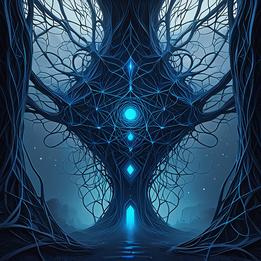
Topology
The study of properties preserved through continuous deformation, representing underlying structures, connections, and fundamental relationships in dreams.
Topology Dream Meaning
The study of properties preserved through continuous deformation, representing underlying structures, connections, and fundamental relationships in dreams.
Interpretive Themes
Underlying Structure
highReveals hidden patterns in life.
Transformational Invariance
highWhat remains constant despite alterations.
Connectedness
mediumEverything affects everything else.
Boundary Exploration
mediumWhere one thing becomes another.
Essential Properties
lowCore characteristics beyond form.
Mythological Resonance
The Labyrinth of Daedalus
GreekA complex topological structure designed to contain the Minotaur, representing how intricate paths and connections can both conceal and reveal truths.
Indra's Net
HinduA cosmic network where each jewel reflects all others, embodying the topological principle of interconnectedness and mutual reflection across infinite dimensions.
Cultural Lenses
Jungian Perspective
View Context →Represents archetypal patterns of the collective unconscious. Topological dreams reveal fundamental psychic structures that transcend individual experience, connecting personal consciousness to universal human patterns through symbolic transformation.
Freudian Perspective
View Context →Symbolizes psychological defense mechanisms and repressed desires. Topological transformations represent displacement and condensation processes, where forbidden thoughts take distorted forms while preserving their essential psychic energy and meaning.
Gestalt Perspective
View Context →Represents the whole being greater than parts. Topological dreams illustrate how relationships between elements create meaning, emphasizing the interconnected field of experience where figure and ground continuously transform.
Cognitive Perspective
View Context →Reflects mental schema organization and problem-solving processes. Topological dreams demonstrate how the brain organizes information, tests hypotheses about relationships, and restructures understanding through metaphorical transformation.
Evolutionary Perspective
View Context →Represents adaptive pattern recognition and environmental mapping. Topological dreams exercise cognitive abilities for spatial reasoning, social network navigation, and understanding complex relationships crucial for survival and reproduction.
Global/Universal Perspective
View Context →Across cultures, topological concepts appear in creation myths, spiritual teachings, and artistic patterns as representations of fundamental cosmic order, interconnectedness, and the nature of reality beyond surface appearances.
East Asian Perspective
View Context →Reflects Daoist concepts of transformation and Buddhist ideas of interconnectedness. Topological dreams illustrate the constant flow of qi, the unity of yin-yang, and the illusory nature of fixed boundaries in reality.
South Asian Perspective
View Context →Connected to Hindu concepts of maya (illusion) and Buddhist teachings on dependent origination. Topological dreams reveal how apparent separations are illusions, emphasizing the fundamental unity underlying all phenomena.
Middle Eastern Perspective
View Context →Echoes Islamic geometric art and Sufi mystical teachings. Topological dreams represent the infinite patterns of divine creation, the interconnectedness of all existence, and spiritual transformation through symbolic forms.
European Perspective
View Context →Draws from philosophical traditions of structuralism and phenomenology. Topological dreams reflect attempts to understand underlying patterns in experience, the nature of consciousness, and the relationship between form and meaning.
African Perspective
View Context →Connected to concepts of ancestral connections and spiritual networks. Topological dreams represent the living relationship between past, present, and future, and the interconnected web of community that transcends physical boundaries.
Modern Western Perspective
View Context →Reflects contemporary concerns with networks, systems theory, and digital connectivity. Topological dreams express anxieties and fascinations with complex systems, information flow, and the nature of reality in interconnected worlds.
Historical Authorities
Want a deeper analysis?
Get a personalized interpretation of your entire dream including this symbol.
Interpret My DreamThe Oracle's Prediction
Combine multiple symbolsA breakthrough in understanding hidden connections in your life patterns.
Timeframe
Lunation (~29 Days)
Intensity
Deep
Common Appearances & Contexts
| Context | Emotion | Interpretation |
|---|---|---|
| Context Maze navigation | Emotion Confusion | Interpretation Life path complexity. |
| Context Shape-shifting objects | Emotion Wonder | Interpretation Identity transformation possibilities. |
| Context Network visualization | Emotion Clarity | Interpretation Relationship understanding. |
| Context Tearing surfaces | Emotion Anxiety | Interpretation Boundary violation fears. |
| Context Knot untying | Emotion Satisfaction | Interpretation Problem resolution insight. |
| Context Endless loops | Emotion Frustration | Interpretation Repetitive pattern recognition. |
| Context Surface stretching | Emotion Curiosity | Interpretation Limits testing. |
| Context Hole creation | Emotion Fear | Interpretation Vulnerability exposure. |
| Context Continuous transformation | Emotion Awe | Interpretation Change acceptance. |
| Context Connected points | Emotion Belonging | Interpretation Relationship awareness. |
| Context Boundary crossing | Emotion Liberation | Interpretation Limits transcendence. |
| Context Fundamental revelation | Emotion Insight | Interpretation Truth discovery. |
Interpret Your Full Dream
Beyond this symbol, every dream carries a unique story. Share your dream for a personalized AI-powered interpretation.