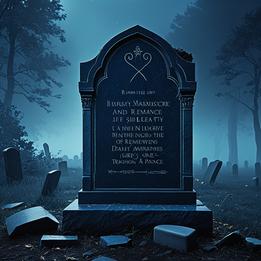
Tombstone
A marker of finality and remembrance, representing endings, legacy, and the transition between life and death.
Tombstone Dream Meaning
A marker of finality and remembrance, representing endings, legacy, and the transition between life and death.
Interpretive Themes
Cultural Lenses
Jungian Perspective
View Context →Represents the archetype of death and rebirth in the collective unconscious, symbolizing transformation, the shadow self, and integration of life's endings into psychic wholeness.
Freudian Perspective
View Context →May symbolize repressed death wishes, unresolved Oedipal conflicts with parental figures, or anxiety about castration and mortality as ultimate loss.
Gestalt Perspective
View Context →The dreamer is the tombstone—exploring what parts of self feel dead, memorialized, or finalized, and what unfinished aspects need acknowledgment.
Cognitive Perspective
View Context →Reflects schemas about mortality, memory processing of loss, or cognitive attempts to make sense of endings through concrete representation.
Evolutionary Perspective
View Context →Rooted in survival mechanisms marking burial sites to avoid disease, remember kin, and process mortality threats through ritualized memory markers.
East Asian Perspective
View Context →In Confucian traditions, tombstones honor ancestors with strict rituals; in Buddhism, they mark impermanence (anicca) while facilitating memorial services for merit transfer.
European Perspective
View Context →Christian symbolism views tombstones as temporary markers until resurrection; Gothic traditions associate them with melancholy, romantic memory, and historical lineage preservation.
African Perspective
View Context →Many cultures use tombstones as conduits for ancestor communication, with elaborate carvings representing status, lineage stories, and ongoing spiritual presence in community life.
Middle Eastern Perspective
View Context →In Islamic tradition, simple markers avoid idolatry while emphasizing humility before God; ancient practices included inscribed stones for eternal remembrance in desert cultures.
Latin American Perspective
View Context →Día de Muertos integrates colorful, decorated graves as sites for festive communion with ancestors, blending indigenous and Catholic traditions of ongoing relationship.
Modern Western Perspective
View Context →Increasingly viewed as customizable memorials reflecting personal identity, with digital additions, eco-friendly options, and focus on legacy rather than mere mortality markers.
Global/Universal Perspective
View Context →Cross-culturally, tombstones serve as physical anchors for grief, social memory devices, and symbolic boundaries between the living and spiritual realms across millennia.
Want a deeper analysis?
Get a personalized interpretation of your entire dream including this symbol.
Interpret My DreamCommon Appearances & Contexts
| Context | Emotion | Interpretation |
|---|---|---|
| Context Reading Inscription | Emotion Curiosity | Interpretation Seeking hidden truths. |
| Context Placing Flowers | Emotion Reverence | Interpretation Honoring past connections. |
| Context Falling Over | Emotion Anxiety | Interpretation Fear of forgetting. |
| Context Polishing Stone | Emotion Nostalgia | Interpretation Preserving memories actively. |
| Context Seeing Own Name | Emotion Dread | Interpretation Mortality confrontation. |
| Context Multiple Tombstones | Emotion Overwhelm | Interpretation Collective loss burden. |
| Context Ancient Tombstone | Emotion Awe | Interpretation Timeless legacy impact. |
| Context Blank Tombstone | Emotion Uncertainty | Interpretation Unwritten future legacy. |
| Context Cracking Tombstone | Emotion Fear | Interpretation Legacy deterioration anxiety. |
| Context Sunlit Tombstone | Emotion Peace | Interpretation Acceptance of transition. |
| Context Finding Tombstone | Emotion Shock | Interpretation Unexpected revelation discovery. |
| Context Building Tombstone | Emotion Purpose | Interpretation Creating lasting memorial. |
Interpret Your Full Dream
Beyond this symbol, every dream carries a unique story. Share your dream for a personalized AI-powered interpretation.