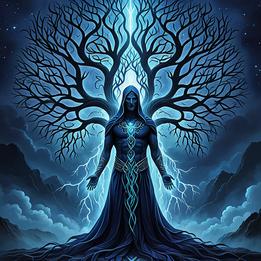
Tiphareth
The central sephirah on the Kabbalistic Tree of Life representing beauty, harmony, and the divine heart where spiritual and material realms unite.
Tiphareth Dream Meaning
The central sephirah on the Kabbalistic Tree of Life representing beauty, harmony, and the divine heart where spiritual and material realms unite.
Interpretive Themes
Mythological Resonance
Christ
ChristianThe crucified and resurrected god who mediates between divine and human realms through sacrificial love.
Apollo
GreekThe sun god whose golden lyre brings cosmic harmony through music and prophecy.
Cultural Lenses
Jungian Perspective
View Context →Represents the Self archetype—the central organizing principle of psyche integrating consciousness and unconsciousness. Historically linked to Christ imagery; modernly signifies individuation and wholeness.
Freudian Perspective
View Context →Symbolizes the ego's ideal state balancing id impulses and superego demands. Historically reflects Oedipal resolution; modernly represents mature psychological integration and narcissistic health.
Gestalt Perspective
View Context →The figure-ground relationship where center emerges as holistic awareness. Historically from perceptual psychology; modernly signifies integrated experience and present-moment wholeness.
Cognitive Perspective
View Context →Metacognitive awareness and executive function center. Historically from cognitive science; modernly represents optimal information processing and balanced decision-making.
Evolutionary Perspective
View Context →Adaptive advantage of social cohesion and altruism. Historically explains group survival; modernly represents evolved capacity for empathy and cooperation.
Middle Eastern Perspective
View Context →In Kabbalah, the sixth sephirah representing the sacrificed god-king. Historically central to Jewish mysticism; modernly used in ceremonial magic and meditation practices.
European Perspective
View Context →Rosicrucian and Hermetic symbol of the Philosopher's Stone. Historically alchemical; modernly represents spiritual transformation in Western esotericism.
Modern Western Perspective
View Context →New Age concept of heart chakra and Christ consciousness. Historically eclectic; modernly signifies personal growth and holistic healing practices.
South Asian Perspective
View Context →Analogous to Anahata chakra—heart center of love and balance. Historically from Tantric traditions; modernly integrated into global yoga and meditation.
East Asian Perspective
View Context →Similar to Zhongyong (Doctrine of the Mean) in Confucianism. Historically ethical ideal; modernly represents harmonious living and moderation.
Global/Universal Perspective
View Context →Cross-cultural symbol of center, balance, and mediation. Historically appears in mandalas and sacred geometry; modernly represents universal human yearning for harmony.
African Perspective
View Context →In some traditions, represents the vital force at life's center. Historically community-focused; modernly signifies ancestral connection and communal harmony.
Historical Authorities
Want a deeper analysis?
Get a personalized interpretation of your entire dream including this symbol.
Interpret My DreamThe Oracle's Prediction
Combine multiple symbolsA profound moment of clarity that resolves long-standing inner conflicts.
Timeframe
Lunation (~29 Days)
Intensity
Deep
Common Appearances & Contexts
| Context | Emotion | Interpretation |
|---|---|---|
| Context Golden light | Emotion Awe | Interpretation Divine presence felt. |
| Context Heart opening | Emotion Love | Interpretation Spiritual connection awakening. |
| Context Center of wheel | Emotion Peace | Interpretation Finding life balance. |
| Context Sun at zenith | Emotion Clarity | Interpretation Illumination achieved. |
| Context Scales balancing | Emotion Satisfaction | Interpretation Harmony restored. |
| Context Bridge crossing | Emotion Hope | Interpretation Transition to wholeness. |
| Context Rose blooming | Emotion Joy | Interpretation Beauty unfolding. |
| Context Sacrificial offering | Emotion Sorrow | Interpretation Ego dissolution necessary. |
| Context Tree center | Emotion Security | Interpretation Rooted in truth. |
| Context Mediator figure | Emotion Trust | Interpretation Reconciliation possible. |
| Context Heart radiating | Emotion Compassion | Interpretation Universal love expressed. |
| Context Golden ratio | Emotion Wonder | Interpretation Cosmic perfection revealed. |
Interpret Your Full Dream
Beyond this symbol, every dream carries a unique story. Share your dream for a personalized AI-powered interpretation.