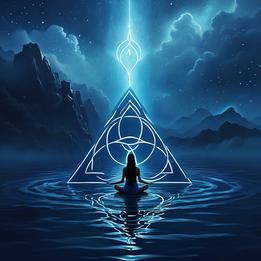
Trinity Symbol
A spiritual symbol representing three-in-one unity, often associated with divine completeness, balance, and interconnectedness across religions and philosophies.
Trinity Symbol Dream Meaning
A spiritual symbol representing three-in-one unity, often associated with divine completeness, balance, and interconnectedness across religions and philosophies.
Interpretive Themes
Mythological Resonance
Holy Trinity
ChristianFather, Son, and Holy Spirit represent the ultimate mystery of three distinct persons in one divine essence, mirroring the Trinity symbol's paradox of multiplicity within unity.
Trimurti
HinduBrahma (creator), Vishnu (preserver), and Shiva (destroyer) form a cosmic triad that governs all existence, embodying the Trinity's principle of dynamic balance through cyclical transformation.
Cultural Lenses
Global/Universal Perspective
View Context →Found across cultures as mind-body-spirit, past-present-future, or creation-preservation-destruction triads. Represents fundamental human understanding of completeness through threefold patterns in nature and consciousness.
Jungian Perspective
View Context →Symbol of the Self integrating consciousness, personal unconscious, and collective unconscious. Represents psychological wholeness through reconciling opposites via transcendent third function in individuation process.
Freudian Perspective
View Context →Represents id-ego-superego psychic structure. Dream appearance suggests conflict resolution between instinctual drives, reality principles, and moral constraints, often indicating psychosexual development stages.
Gestalt Perspective
View Context →Figure-ground-context perceptual triad. Dream symbol indicates how individual organizes experience, with emphasis on holistic perception where three elements create meaningful whole beyond parts.
Cognitive Perspective
View Context →Represents cognitive triad of thoughts-feelings-behaviors. Dream appearance suggests mental schema integration or cognitive restructuring, possibly indicating balanced information processing patterns.
Evolutionary Perspective
View Context →Evolutionary advantage of triad thinking for survival - predator-prey-environment, self-kin-group, or threat-assessment-response patterns. Symbol represents adaptive cognitive template for complex decision-making.
European Perspective
View Context →Christian Holy Trinity (Father-Son-Holy Spirit) dominant historically, but also appears in Celtic triple goddesses and Norse three Norns. Modern secular interpretations focus on mind-heart-will integration.
South Asian Perspective
View Context →Hindu Trimurti (Brahma-Vishnu-Shiva) representing creation-preservation-destruction cycles. Also appears in Buddhist Three Jewels and Jain three jewels, emphasizing spiritual refuge and ethical foundations.
Middle Eastern Perspective
View Context →Ancient Mesopotamian triad deities, Zoroastrian good thought-good word-good deed, and Islamic subtle distinctions rejecting literal trinity but accepting tripartite spiritual concepts in Sufism.
East Asian Perspective
View Context →Taoist Three Treasures (jing-qi-shen), Confucian three bonds, and Buddhist Three Bodies of Buddha. Represents cosmic principles, social harmony, and enlightenment stages respectively.
African Perspective
View Context →Yoruba three major orishas, Akan soul components, and Bantu life force concepts. Often represents ancestral connections, community roles, and natural world triads in traditional cosmology.
Modern Western Perspective
View Context →Secularized as work-life-balance, sustainable development's triple bottom line, or psychological well-being models. Appears in corporate logos, self-help literature, and holistic health approaches as integration symbol.
Historical Authorities
Want a deeper analysis?
Get a personalized interpretation of your entire dream including this symbol.
Interpret My DreamThe Oracle's Prediction
Combine multiple symbolsHealing of a triangular conflict or the formation of a deeply harmonious partnership.
Timeframe
Lunation (~29 Days)
Intensity
Deep
A sudden insight that integrates previously conflicting beliefs or practices.
Timeframe
Immediate (Next 48h)
Intensity
Deep
Common Appearances & Contexts
| Context | Emotion | Interpretation |
|---|---|---|
| Context Shining brightly | Emotion Awe | Interpretation Divine revelation received. |
| Context Fracturing apart | Emotion Anxiety | Interpretation Spiritual disintegration feared. |
| Context Rotating slowly | Emotion Peace | Interpretation Cosmic order perceived. |
| Context In water | Emotion Serenity | Interpretation Emotional integration occurring. |
| Context On fire | Emotion Passion | Interpretation Transformative energy present. |
| Context Floating above | Emotion Transcendence | Interpretation Higher perspective gained. |
| Context Buried underground | Emotion Longing | Interpretation Hidden wholeness sought. |
| Context In mirror | Emotion Self-awareness | Interpretation Inner trinity recognized. |
| Context Changing colors | Emotion Wonder | Interpretation Multidimensional reality unfolding. |
| Context With chains | Emotion Conflict | Interpretation Unity constrained externally. |
| Context In darkness | Emotion Mystery | Interpretation Unknown integration approaching. |
| Context Shattering glass | Emotion Shock | Interpretation Sacred broken suddenly. |
Interpret Your Full Dream
Beyond this symbol, every dream carries a unique story. Share your dream for a personalized AI-powered interpretation.