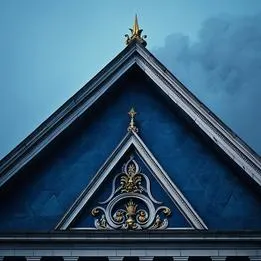
Pediment Dream Meaning
A triangular gable crowning classical architecture, symbolizing structure, ideals, and the meeting of human aspiration with divine order.
Common Appearances & Contexts
| Context | Emotion | Interpretation |
|---|---|---|
| Admiring a pediment | Awe | Respect for ideals. |
| Building a pediment | Pride | Creating personal structure. |
| Pediment crumbling | Anxiety | Ideals under threat. |
| Hiding behind pediment | Fear | Sheltering from authority. |
| Climbing a pediment | Determination | Striving for goals. |
| Pediment adorned with statues | Wonder | Ideals given form. |
| Pediment on a home | Security | Personal order established. |
| Pediment blocking path | Frustration | Tradition as obstacle. |
| Cleaning a pediment | Reverence | Caring for values. |
| Pediment in a storm | Vulnerability | Structure tested. |
| Pediment glowing | Hope | Ideals illuminated. |
| Pediment missing | Loss | Lack of structure. |
Interpretive Themes
Aspiration & Ideals
highThe peak represents lofty aims.
Structure & Order
highArchitectural framework for life.
Authority & Tradition
mediumOften crowns institutional buildings.
Balance & Harmony
mediumGeometric perfection and equilibrium.
Divine Connection
lowCrowning temple roofs historically.
Cultural Lenses
Jungian Perspective
View Context →Represents the Self archetype or the transcendent function—the psyche's striving for wholeness and integration. The triangular form symbolizes the unification of opposites (conscious/unconscious) into a higher, stable structure.
Freudian Perspective
View Context →A phallic symbol representing paternal authority, superego, and societal repression. Its prominent, crowning position signifies dominance and the imposition of moral order, potentially reflecting dreamer's father complex or societal constraints.
Gestalt Perspective
View Context →The dreamer's projection of their need for structure or completion. The pediment is the 'figure'—what the psyche is foregrounding. Ask: 'What part of my life feels like this stable, crowning triangle?'
Cognitive Perspective
View Context →A mental schema for 'authority,' 'tradition,' or 'ideal state.' The brain uses this familiar architectural image to process abstract concepts of order, goal structures, or societal expectations during sleep consolidation.
Evolutionary Perspective
View Context →A super-stimulus for shelter and secure vantage points. The triangular form mimics protective mountain peaks or overhangs, triggering innate feelings of safety, dominance, and a good defensive position for the tribe.
European Perspective
View Context →Deeply tied to Greco-Roman heritage, Enlightenment ideals, and institutional power. Historically crowns temples, parliaments, and museums, symbolizing democracy, reason, and cultural supremacy. Modernly evokes classical education and tradition.
East Asian Perspective
View Context →Less common historically; when present, may integrate with temple roof styles (e.g., in Japanese Kara-yō). Can symbolize imported Western ideals, modernity, or the meeting point of different cultural philosophies (triangle as stability in Daoist/Buddhist thought).
Middle Eastern Perspective
View Context →In ancient Mesopotamia and Persia, triangular forms in architecture (like gables) existed. Can symbolize divine protection, the meeting of heaven and earth (ziggurat concept), or, in modern context, colonial or neo-classical influence.
South Asian Perspective
View Context →In Vastu Shastra, triangular shapes (like in temple shikharas) are auspicious, representing the fire element and aspiration. A classical pediment might symbolize dharma (cosmic order) or the structured path to moksha (liberation).
African Perspective
View Context →In some regions, triangular roof forms are practical. Symbolically, the triangle can represent the community (elders, adults, children), ancestors, or the connection between the spiritual, human, and natural worlds. A pediment may embody these layered relationships.
Modern Western Perspective
View Context →Often seen as decorative or historical, on banks, courthouses, or universities. Can symbolize outdated institutions, the weight of tradition, classical beauty, or a yearning for perceived stability and order of past eras.
Global/Universal Perspective
View Context →A fundamental architectural element providing shelter and denoting importance. Universally, the peak/triangle symbolizes aspiration, hierarchy, and stability. The pediment crowns a space, marking it as significant, ordered, and connected to higher principles.
Interpret Your Full Dream
Beyond this symbol, every dream carries a unique story. Share your dream for a personalized AI-powered interpretation.