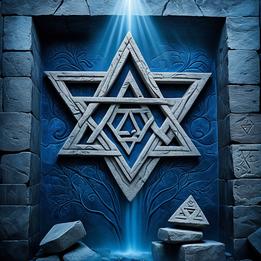
Tetragrammaton
The four-letter Hebrew name of God (YHWH), considered too sacred to pronounce, representing divine essence, power, and ultimate mystery.
Tetragrammaton Dream Meaning
The four-letter Hebrew name of God (YHWH), considered too sacred to pronounce, representing divine essence, power, and ultimate mystery.
Interpretive Themes
Mythological Resonance
The Burning Bush
HebrewMoses encounters the divine presence in a bush that burns without being consumed, where the sacred name is revealed as 'I Am That I Am'.
The Ineffable Father
GnosticThe ultimate divine source beyond all names and forms, whose true nature can only be approached through negation and silence.
Cultural Lenses
Jungian Perspective
View Context →Represents the Self archetype - the central, unifying principle of the psyche. Dreaming of it indicates individuation process, integration of consciousness with the collective unconscious's divine aspect.
Freudian Perspective
View Context →Symbolizes the superego's ultimate authority figure (the father-God). May represent repressed religious upbringing, fear of paternal punishment, or sublimated sexual energy directed toward spiritual ideals.
Gestalt Perspective
View Context →Represents a projected aspect of self - the part one considers most sacred, powerful, or unnameable. The dream asks: 'What in me is so ultimate I dare not name it?'
Cognitive Perspective
View Context →Manifestation of schema for 'ultimate authority' or 'sacred mystery.' Brain processes abstract concepts of divinity through this culturally learned symbol during sleep consolidation of existential thoughts.
Evolutionary Perspective
View Context →Activation of agency detection systems toward ultimate intentional force. Represents cognitive adaptation for perceiving superordinate social hierarchy, possibly reducing anxiety about uncontrollable events through symbolic mastery.
Middle Eastern Perspective
View Context →In Jewish tradition, the unpronounceable name represents God's essence. Kabbalah sees it as cosmic blueprint. Modern contexts range from Orthodox reverence to academic study of ancient Near Eastern theology.
European Perspective
View Context →Historically studied by Christian Hebraists and Renaissance occultists. In modern secular Europe, often appears in historical or esoteric contexts rather than religious practice, symbolizing Western mystical heritage.
Modern Western Perspective
View Context →Appears in popular culture (films, games) as powerful magical symbol. In secular contexts, represents abstract 'ultimate truth' or 'cosmic secret.' New Age movements sometimes appropriate it for mystical practices.
Global/Universal Perspective
View Context →Cross-culturally represents the human tendency to conceptualize ultimate reality through sacred language. Appears in comparative religion studies as example of how different cultures approach naming the divine.
South Asian Perspective
View Context →Comparable to Sanskrit mantras like 'Aum' - sacred sounds representing ultimate reality. In Hindu-Buddhist contexts, similar concepts exist of unpronounceable divine essence, though without the specific Hebrew cultural history.
East Asian Perspective
View Context →No direct equivalent, but similar concepts exist in Daoist 'unnamable Dao' and Buddhist 'suchness.' Modern East Asian interpretations might view it as Western counterpart to ineffable cosmic principles in their traditions.
African Perspective
View Context →In African traditional religions, comparable to taboo names of high gods or secret names containing power. In modern African Christianity, may be approached with similar reverence as in its original Jewish context.
Historical Authorities
Want a deeper analysis?
Get a personalized interpretation of your entire dream including this symbol.
Interpret My DreamThe Oracle's Prediction
Combine multiple symbolsA profound encounter with the numinous that reorients your understanding of reality.
Timeframe
Seasonal (~3 Months)
Intensity
Deep
The danger of spiritual inflation when approaching ultimate mysteries.
Timeframe
Immediate (Next 48h)
Intensity
Deep
Common Appearances & Contexts
| Context | Emotion | Interpretation |
|---|---|---|
| Context Reading ancient text | Emotion Awe | Interpretation Divine revelation approaching. |
| Context Hearing it chanted | Emotion Fear | Interpretation Confronting overwhelming power. |
| Context Writing it down | Emotion Reverence | Interpretation Seeking sacred connection. |
| Context Seeing it glow | Emotion Wonder | Interpretation Spiritual illumination occurring. |
| Context Trying to pronounce | Emotion Anxiety | Interpretation Fear of transgression. |
| Context It appears in sky | Emotion Awe | Interpretation Cosmic significance revealed. |
| Context Carved in stone | Emotion Reverence | Interpretation Eternal truth encountered. |
| Context Hidden in puzzle | Emotion Curiosity | Interpretation Seeking hidden wisdom. |
| Context Burning away | Emotion Fear | Interpretation Purification through fire. |
| Context Whispered in ear | Emotion Wonder | Interpretation Divine communication received. |
| Context On a door | Emotion Anxiety | Interpretation Threshold to unknown. |
| Context Fading from view | Emotion Longing | Interpretation Lost spiritual connection. |
Interpret Your Full Dream
Beyond this symbol, every dream carries a unique story. Share your dream for a personalized AI-powered interpretation.