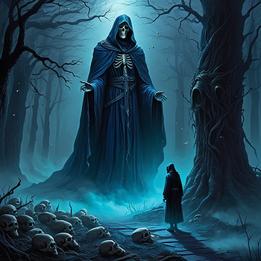
Necromancy
The practice of communicating with or raising the dead, often symbolizing a desire to access hidden knowledge, unresolved past issues, or forbidden power.
Necromancy Dream Meaning
The practice of communicating with or raising the dead, often symbolizing a desire to access hidden knowledge, unresolved past issues, or forbidden power.
Interpretive Themes
Mythological Resonance
Orpheus
GreekDescended into the Underworld to retrieve his wife Eurydice, using music to communicate with the dead and challenge death's finality.
Odin
NorseHanged himself on Yggdrasil to gain runic knowledge from the dead, sacrificing comfort for wisdom from beyond.
Cultural Lenses
Jungian Perspective
View Context →Represents engagement with the collective unconscious or shadow self; historically seen in alchemical traditions as nigredo (blackening), modernly as integrating repressed aspects for wholeness.
Freudian Perspective
View Context →Symbolizes unresolved Oedipal conflicts or death drive (Thanatos); historically linked to taboo desires, modernly to repressed childhood traumas seeking expression.
Gestalt Perspective
View Context →Indicates unfinished business with deceased figures; historically part of closure rituals, modernly a projection of unmet needs or unspoken words needing resolution.
Cognitive Perspective
View Context →Reflects memory processing or problem-solving with past information; historically absent in scientific models, modernly viewed as brain organizing experiences during sleep.
Evolutionary Perspective
View Context →May stem from threat detection or social bonding with ancestors; historically adaptive for survival cues, modernly a byproduct of pattern recognition in grief.
Global/Universal Perspective
View Context →Cross-culturally, necromancy appears in shamanic or funerary rites; historically for divination or honoring dead, modernly in horror genres as a universal fear motif.
East Asian Perspective
View Context →In Chinese and Japanese traditions, it relates to ancestor worship; historically part of Confucian filial piety, modernly seen in ghost festival rituals for familial harmony.
South Asian Perspective
View Context →Linked to Tantric or Aghori practices in Hinduism; historically for spiritual liberation, modernly viewed as extreme asceticism or cultural taboo in mainstream society.
Middle Eastern Perspective
View Context →Appears in Islamic and pre-Islamic lore as sihr (magic); historically condemned in religious texts, modernly associated with folk superstitions or jinn narratives.
European Perspective
View Context →Rooted in medieval grimoires and witch trials; historically a Christian heresy, modernly romanticized in Gothic literature and neo-pagan revivals.
African Perspective
View Context →Part of vodun or sangoma traditions; historically for healing or justice, modernly often misunderstood as 'zombie' stereotypes in Western media.
Modern Western Perspective
View Context →Popularized in fantasy games and films; historically fringe occultism, modernly a metaphor for AI or digital afterlife technologies raising ethical questions.
Historical Authorities
Want a deeper analysis?
Get a personalized interpretation of your entire dream including this symbol.
Interpret My DreamThe Oracle's Prediction
Combine multiple symbolsA hidden conflict or repressed issue will surface, requiring confrontation.
Timeframe
Seasonal (~3 Months)
Intensity
Deep
Common Appearances & Contexts
| Context | Emotion | Interpretation |
|---|---|---|
| Context Raising skeletons | Emotion Fear | Interpretation Unearthing buried fears. |
| Context Speaking to ancestors | Emotion Awe | Interpretation Seeking ancestral wisdom. |
| Context Forbidden ritual | Emotion Curiosity | Interpretation Testing moral boundaries. |
| Context Controlling spirits | Emotion Power | Interpretation Desire for dominance. |
| Context Ghostly guidance | Emotion Hope | Interpretation Looking for direction. |
| Context Cemetery at night | Emotion Anxiety | Interpretation Facing mortality anxieties. |
| Context Ancient spellbook | Emotion Fascination | Interpretation Attraction to secrets. |
| Context Failed resurrection | Emotion Despair | Interpretation Fear of irreversible loss. |
| Context Communing peacefully | Emotion Peace | Interpretation Acceptance of death. |
| Context Dark pact | Emotion Guilt | Interpretation Moral compromise fears. |
| Context Learning from ghosts | Emotion Wonder | Interpretation Openness to mysteries. |
| Context Spirit rebellion | Emotion Panic | Interpretation Loss of control. |
Interpret Your Full Dream
Beyond this symbol, every dream carries a unique story. Share your dream for a personalized AI-powered interpretation.