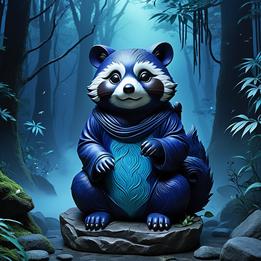
Tanuki Statue
A Japanese mythological creature statue representing transformation, prosperity, and trickery, often seen as a guardian spirit with supernatural abilities.
Tanuki Statue Dream Meaning
A Japanese mythological creature statue representing transformation, prosperity, and trickery, often seen as a guardian spirit with supernatural abilities.
Interpretive Themes
Mythological Resonance
Bunbuku Chagama
JapaneseA tanuki transforms into a teapot to reward a kind priest, then escapes to live freely—a tale of magical repayment and liberation.
Coyote (Native American)
GlobalLike the tanuki, Coyote is a trickster who blurs lines between wisdom and folly, teaching through chaotic, transformative adventures.
Cultural Lenses
Jungian Perspective
View Context →Represents the trickster archetype—a catalyst for consciousness development through disruptive yet transformative energy that challenges rigid ego structures and facilitates psychological growth.
Freudian Perspective
View Context →Symbolizes repressed desires for wealth and sexual potency, with exaggerated testicles representing unconscious wishes for virility and material success that society deems inappropriate to express openly.
Gestalt Perspective
View Context →Represents parts of self—the playful trickster, prosperous provider, and protective guardian—that seek integration, with the statue's fixed form highlighting aspects needing acknowledgment in waking life.
Cognitive Perspective
View Context →Functions as a mental schema for processing change and opportunity, where the familiar folkloric image helps organize thoughts about transformation, risk assessment, and prosperity-seeking behaviors.
Evolutionary Perspective
View Context →Taps into adaptive advantages of deception detection and resource acquisition, with the trickster aspect honing social intelligence and the prosperity symbolism reinforcing survival-driven accumulation behaviors.
East Asian Perspective
View Context →In Japanese folklore, tanuki are shape-shifting yōkai (spirits) associated with prosperity, protection, and playful mischief; statues with large bellies and testicles invite business success while warding off evil.
Modern Western Perspective
View Context →Often viewed as exotic decor or anime-inspired characters, losing most ritual significance but retaining appeal as symbols of whimsy, Japanese culture, and commercialized spirituality.
European Perspective
View Context →Parallels trickster figures like Reynard the Fox—clever animals using deception for survival, though lacking tanuki's explicit prosperity symbolism and instead emphasizing cunning over material gain.
Global/Universal Perspective
View Context →Fits the cross-cultural trickster archetype found in myths worldwide—a boundary-crosser who disrupts norms to enable transformation, though specific attributes vary by region.
South Asian Perspective
View Context →Resonates with Hanuman's playful yet powerful nature in Hindu mythology—a shape-shifting guardian deity demonstrating how mischief and devotion can coexist in spiritual practice.
North American Perspective
View Context →Echoes Native American coyote/trickster tales where humorous deception teaches moral lessons, though without tanuki's explicit link to commerce and material prosperity.
African Perspective
View Context →Similar to Anansi the spider—a trickster figure whose cleverness brings both chaos and cultural knowledge, emphasizing wisdom acquisition over material accumulation.
Historical Authorities
Want a deeper analysis?
Get a personalized interpretation of your entire dream including this symbol.
Interpret My DreamThe Oracle's Prediction
Combine multiple symbolsAn unexpected financial opportunity will arise through unconventional means.
Timeframe
Lunation (~29 Days)
Intensity
Deep
Common Appearances & Contexts
| Context | Emotion | Interpretation |
|---|---|---|
| Context Restaurant entrance | Emotion Welcoming | Interpretation Business success incoming. |
| Context Forest path | Emotion Curious | Interpretation Hidden truths revealed. |
| Context Home garden | Emotion Secure | Interpretation Domestic protection active. |
| Context Marketplace | Emotion Hopeful | Interpretation Financial opportunities approaching. |
| Context Temple grounds | Emotion Reverent | Interpretation Spiritual guidance offered. |
| Context Dark alley | Emotion Cautious | Interpretation Deception warning present. |
| Context Child's room | Emotion Playful | Interpretation Imagination flourishing. |
| Context Business office | Emotion Ambitious | Interpretation Career advancement likely. |
| Context Abandoned shrine | Emotion Nostalgic | Interpretation Past traditions remembered. |
| Context Stormy night | Emotion Anxious | Interpretation Change unavoidable. |
| Context Wedding ceremony | Emotion Joyful | Interpretation Fertility blessings given. |
| Context Crossroads | Emotion Uncertain | Interpretation Multiple paths available. |
Interpret Your Full Dream
Beyond this symbol, every dream carries a unique story. Share your dream for a personalized AI-powered interpretation.