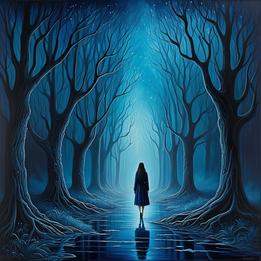
Subjunctive
A grammatical mood expressing hypothetical, conditional, or unreal situations, often linked to artistic expression of possibility and alternative realities.
Subjunctive Dream Meaning
A grammatical mood expressing hypothetical, conditional, or unreal situations, often linked to artistic expression of possibility and alternative realities.
Interpretive Themes
Mythological Resonance
Mnemosyne
GreekGoddess of memory who birthed the nine Muses, representing the potentiality of all artistic expression before it manifests.
Yggdrasil
NorseThe world tree connecting nine realms, symbolizing the infinite branching possibilities of existence.
Cultural Lenses
Jungian Perspective
View Context →Represents the collective unconscious exploration of archetypal possibilities and shadow selves, with art as a medium for individuation through imagined alternatives.
Freudian Perspective
View Context →Symbolizes repressed desires and wish-fulfillment fantasies expressed through artistic sublimation, where hypothetical scenarios reveal unconscious conflicts.
Gestalt Perspective
View Context →Seen as the dreamer's projection of unfinished situations or unresolved possibilities, with art representing the 'here and now' of potential completion.
Cognitive Perspective
View Context →Reflects mental simulation and counterfactual thinking processes, where artistic expression serves as cognitive rehearsal for hypothetical scenarios and problem-solving.
Evolutionary Perspective
View Context →Represents adaptive advantage of mental time travel and scenario planning, with arts evolving as safe spaces to explore survival alternatives.
East Asian Perspective
View Context →In traditional arts like ink painting and poetry, represents the Taoist concept of wu-wei (non-action) and Buddhist emptiness, where potentiality is more real than actuality.
European Perspective
View Context →Rooted in Renaissance humanism and Romanticism, where art explores individual agency and alternative destinies, from Shakespearean soliloquies to speculative fiction.
Modern Western Perspective
View Context →In contemporary art, represents postmodern fragmentation and hyperreality, where digital media creates infinite conditional realities and simulated experiences.
African Perspective
View Context →In oral traditions and mask rituals, represents ancestral wisdom and spirit world possibilities, where art mediates between visible and invisible realities.
Latin American Perspective
View Context →In magical realism, represents the blending of indigenous cosmologies with colonial histories, where art expresses alternative realities as political resistance.
Middle Eastern Perspective
View Context →In Islamic art and poetry, represents divine potentiality and the unseen (al-ghayb), where geometric patterns suggest infinite possibilities within divine unity.
Global/Universal Perspective
View Context →Cross-cultural human capacity for counterfactual thinking expressed through universal art forms, representing our shared ability to imagine beyond immediate reality.
Historical Authorities
Want a deeper analysis?
Get a personalized interpretation of your entire dream including this symbol.
Interpret My DreamThe Oracle's Prediction
Combine multiple symbolsA breakthrough in understanding alternative perspectives or hidden aspects of yourself.
Timeframe
Lunation (~29 Days)
Intensity
Deep
Common Appearances & Contexts
| Context | Emotion | Interpretation |
|---|---|---|
| Context Making art | Emotion Inspired | Interpretation Creative possibilities unfolding. |
| Context Listening to music | Emotion Nostalgic | Interpretation Alternative past imagined. |
| Context Writing poetry | Emotion Reflective | Interpretation Exploring emotional what-ifs. |
| Context Watching theater | Emotion Hopeful | Interpretation Different futures possible. |
| Context Composing music | Emotion Anxious | Interpretation Uncertain creative direction. |
| Context Painting canvas | Emotion Curious | Interpretation Imagining unseen worlds. |
| Context Reading fiction | Emotion Wistful | Interpretation Alternative lives possible. |
| Context Dancing freely | Emotion Liberated | Interpretation Breaking from reality. |
| Context Directing film | Emotion Ambitious | Interpretation Crafting new narratives. |
| Context Sculpting clay | Emotion Determined | Interpretation Shaping potential forms. |
| Context Performing drama | Emotion Empowered | Interpretation Living alternate selves. |
| Context Designing architecture | Emotion Visionary | Interpretation Building ideal spaces. |
Interpret Your Full Dream
Beyond this symbol, every dream carries a unique story. Share your dream for a personalized AI-powered interpretation.