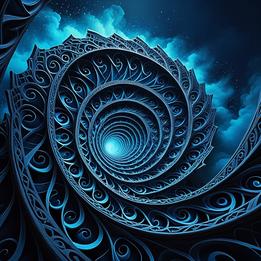
Spiraling
A dynamic, often cyclical pattern representing transformation, descent into chaos, or ascent toward enlightenment.
Spiraling Dream Meaning
A dynamic, often cyclical pattern representing transformation, descent into chaos, or ascent toward enlightenment.
Interpretive Themes
Transformation
highOften indicates personal growth or metamorphosis.
Chaos and Order
mediumMay reflect internal or external turmoil.
Cyclical Nature
highSuggests recurring life phases or lessons.
Descent/Ascent
mediumCan indicate regression or progression.
Infinity
lowConnects to cosmic or eternal concepts.
Mythological Resonance
Triskelion
CelticThe triple spiral representing motion, cycles, and the three realms of earth, sea, and sky.
Labyrinth of Crete
GreekThe spiraling path designed by Daedalus that both entrapped the Minotaur and guided Theseus to victory.
Cultural Lenses
Jungian Perspective
View Context →Represents the individuation process—the spiral journey toward wholeness, integrating conscious and unconscious. Symbolizes the mandala, self-organization, and the cyclical nature of psychic development.
Freudian Perspective
View Context →May symbolize repressed sexual energy, particularly oral or anal fixation, or cyclical neurotic patterns. Can represent regression to earlier developmental stages or obsessive thought loops.
Gestalt Perspective
View Context →Seen as a holistic pattern of experience—the figure-ground relationship in motion. Represents how the self organizes perception in cyclical, unfinished loops seeking closure and integration.
Cognitive Perspective
View Context →Reflects cognitive processes like rumination, problem-solving cycles, or memory retrieval patterns. May indicate information processing overload or the brain's natural tendency toward pattern recognition.
Evolutionary Perspective
View Context →Rooted in survival mechanisms—spiral patterns in nature (shells, galaxies) signal growth, efficiency, or danger. May trigger primal responses to vortices (water, wind) as threats or resources.
East Asian Perspective
View Context →In Taoism and Buddhism, represents the dynamic balance of yin-yang, the cyclical nature of existence (samsara), and the path to enlightenment. Often appears in meditation symbols and temple architecture.
South Asian Perspective
View Context →Sacred symbol in Hinduism (e.g., chakras as energy spirals) and Buddhism (endless knot). Represents cosmic order, cyclical time (kalpas), and the spiral journey of the soul through reincarnation.
Middle Eastern Perspective
View Context →Ancient Mesopotamian and Islamic art feature spirals as symbols of eternity, divine order, and cosmic movement. In Sufism, represents the soul's spiral ascent toward union with the divine.
European Perspective
View Context →Celtic spirals symbolize life, death, and rebirth; medieval Christian art uses spirals for divine ascent. In Renaissance art, represents the golden ratio and ideal beauty in nature.
African Perspective
View Context →In many traditions, spirals represent the life cycle, ancestral connections, and cosmic energy. Used in rituals, body art, and architecture to symbolize growth, community, and spiritual journey.
North American Perspective
View Context →Native American cultures view spirals in petroglyphs and art as symbols of migration, life journeys, and spiritual portals. Modern context includes stress spirals and creative growth metaphors.
Global/Universal Perspective
View Context →A cross-cultural archetype appearing in nature (shells, hurricanes), art, and spirituality worldwide. Universally represents cycles, transformation, and the dynamic interplay between chaos and order.
Historical Authorities
Want a deeper analysis?
Get a personalized interpretation of your entire dream including this symbol.
Interpret My DreamThe Oracle's Prediction
Combine multiple symbolsA breakthrough in personal understanding or meditation practice.
Timeframe
Seasonal (~3 Months)
Intensity
Deep
Common Appearances & Contexts
| Context | Emotion | Interpretation |
|---|---|---|
| Context Downward spiral | Emotion Fear | Interpretation Loss of control. |
| Context Upward spiral | Emotion Hope | Interpretation Progress or ascension. |
| Context Spiral staircase | Emotion Curiosity | Interpretation Journey into self. |
| Context Spiral galaxy | Emotion Awe | Interpretation Cosmic connection. |
| Context Spiral vortex | Emotion Panic | Interpretation Being consumed. |
| Context Spiral pattern | Emotion Fascination | Interpretation Natural order. |
| Context Spiral descent | Emotion Despair | Interpretation Hitting bottom. |
| Context Spiral ascent | Emotion Joy | Interpretation Rising above. |
| Context Spiral maze | Emotion Confusion | Interpretation Complex life path. |
| Context Spiral energy | Emotion Euphoria | Interpretation Vital life force. |
| Context Spiral shell | Emotion Peace | Interpretation Protected growth. |
| Context Spiral dance | Emotion Ecstasy | Interpretation Ritual celebration. |
Interpret Your Full Dream
Beyond this symbol, every dream carries a unique story. Share your dream for a personalized AI-powered interpretation.