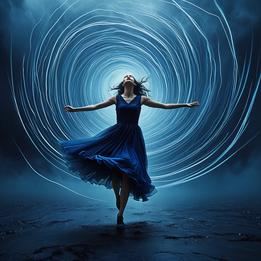
Twirl
A spinning or rotating movement, often representing transition, self-expression, or cyclical patterns in life's journey.
Twirl Dream Meaning
A spinning or rotating movement, often representing transition, self-expression, or cyclical patterns in life's journey.
Interpretive Themes
Mythological Resonance
Dionysus
GreekGod of ecstatic dance and transformation whose followers twirled in frenzied rituals to transcend ordinary consciousness.
Whirling Dervishes
SufiMystics who twirl in meditation to achieve union with the divine through circular movement.
Cultural Lenses
Jungian Perspective
View Context →Represents the individuation process - spinning toward wholeness. The mandala-like circular motion symbolizes integration of conscious and unconscious aspects of self, with historical roots in alchemical symbolism of transformation.
Freudian Perspective
View Context →Often represents repressed sexual energy or childhood experiences. The circular motion may symbolize regression to oral or anal stages, with modern context linking to dance as sublimated sexual expression.
Gestalt Perspective
View Context →The dreamer IS the twirl - representing how they move through life. The action reveals current life patterns and avoidance mechanisms, with ritual context in therapeutic movement practices.
Cognitive Perspective
View Context →Represents mental processing of spatial relationships and movement memory. The brain rehearses coordination and balance, with modern context in virtual reality and motion simulation experiences.
Evolutionary Perspective
View Context →Rooted in predator avoidance and mating displays. Circular movement disorients threats while demonstrating fitness, with historical survival advantages in both hunting and courtship rituals.
East Asian Perspective
View Context →Symbolizes the eternal cycle of yin and yang, often in Daoist and Buddhist contexts. Traditional dance forms incorporate twirling to represent cosmic harmony, with modern practice in meditation and martial arts.
South Asian Perspective
View Context →Sacred movement in classical dance like Bharatanatyam, representing cosmic cycles and divine energy. Ritual context in temple ceremonies, with modern adaptation in Bollywood and spiritual practices.
Middle Eastern Perspective
View Context →Sufi whirling as spiritual practice to reach divine union. Historical mystical tradition representing cosmic rotation, with modern context in both religious ceremony and cultural performance.
European Perspective
View Context →Folk dances like waltz and traditional spinning rituals marking seasonal transitions. Historical context in pagan celebrations, with modern preservation in cultural festivals and ballroom dance.
African Perspective
View Context →Ritual dance movements connecting to ancestors and earth rhythms. Traditional ceremonies use twirling to induce trance states, with modern context in both religious practice and contemporary dance.
North American Perspective
View Context →Native American ceremonial dances and modern expressive forms. Historical context in healing rituals and vision quests, with contemporary adaptation in powwows and performance art.
Global/Universal Perspective
View Context →Cross-cultural symbol of transition and celebration. Appears in childhood play worldwide, representing universal human experiences of joy, change, and self-expression across all societies.
Historical Authorities
Want a deeper analysis?
Get a personalized interpretation of your entire dream including this symbol.
Interpret My DreamThe Oracle's Prediction
Combine multiple symbolsA new connection through shared creative expression.
Timeframe
Lunation (~29 Days)
Intensity
Deep
Common Appearances & Contexts
| Context | Emotion | Interpretation |
|---|---|---|
| Context Alone in field | Emotion Joyful | Interpretation Personal freedom expression |
| Context During argument | Emotion Frustrated | Interpretation Avoiding confrontation |
| Context At party | Emotion Excited | Interpretation Social connection |
| Context In darkness | Emotion Anxious | Interpretation Lost direction |
| Context On stage | Emotion Nervous | Interpretation Performance anxiety |
| Context With children | Emotion Playful | Interpretation Return to innocence |
| Context During storm | Emotion Fearful | Interpretation Chaos overwhelm |
| Context At crossroads | Emotion Confused | Interpretation Decision paralysis |
| Context With partner | Emotion Loving | Interpretation Harmonious connection |
| Context In mirror | Emotion Curious | Interpretation Self-examination |
| Context Falling down | Emotion Panicked | Interpretation Loss of control |
| Context Reaching upward | Emotion Hopeful | Interpretation Aspiration growth |
Interpret Your Full Dream
Beyond this symbol, every dream carries a unique story. Share your dream for a personalized AI-powered interpretation.