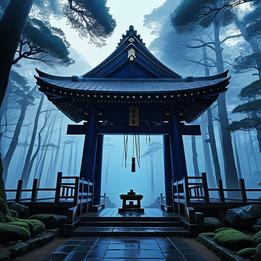
Shinto Shrine
A sacred space in Shintoism representing connection to kami (spirits), purification, and harmony with nature. It symbolizes spiritual reverence and ancestral traditions.
Shinto Shrine Dream Meaning
A sacred space in Shintoism representing connection to kami (spirits), purification, and harmony with nature. It symbolizes spiritual reverence and ancestral traditions.
Interpretive Themes
Mythological Resonance
Amaterasu
ShintoThe sun goddess who hid in a cave, plunging the world into darkness, until lured out by ritual dance, restoring light and order.
Sacred Groves
CelticNatural sanctuaries where druids performed rituals, believed to be portals to the Otherworld and homes of spirits.
Cultural Lenses
Jungian Perspective
View Context →Represents the Self archetype—integration of conscious and unconscious. The shrine as mandala symbolizes wholeness, with kami as anima/animus projections. Modernly, it signifies individuation through sacred space.
Freudian Perspective
View Context →Symbolizes superego—moral constraints and paternal authority. The torii gate may represent psychosexual barriers, with rituals as obsessive-compulsive behaviors. Modernly, reflects repressed desires in structured form.
Gestalt Perspective
View Context →The shrine is a holistic figure-ground relationship—foregrounding spirituality against life's background. Each element (torii, temizuya) represents parts of self needing integration for wholeness in modern fragmented existence.
Cognitive Perspective
View Context →Represents schema for sacredness—mental framework organizing spiritual experiences. Rituals are cognitive scripts reducing anxiety. Modernly, it's a memory structure for cultural identity and meaning-making.
Evolutionary Perspective
View Context →Symbolizes adaptive group cohesion—sacred spaces evolved to reinforce social bonds and reduce existential anxiety through shared rituals. Modernly, it fulfills innate need for transcendent meaning.
East Asian Perspective
View Context →In Shinto tradition, shrines house kami (nature spirits/ancestors) and emphasize purification (misogi). Historically central to community life, they now blend worship with cultural tourism, maintaining animistic worldviews.
Global/Universal Perspective
View Context →Represents universal human need for sacred space—cross-culturally, shrines serve as loci for transcendence, ritual, and community. Historically ancient, modernly they adapt as spiritual anchors in secular societies.
South Asian Perspective
View Context →Parallels Hindu temple as dwelling of deities (devtas), with torii resembling temple gopuram. Historically ritual-focused, modernly both serve as pilgrimage sites blending devotion with cultural heritage tourism.
European Perspective
View Context →Comparable to pagan groves or Christian chapels—natural sacred spaces. Historically sites of folk rituals, modernly viewed through romanticized lens of 'Eastern spirituality' or anthropological interest.
Modern Western Perspective
View Context →Often exoticized as 'Zen' aesthetic—minimalist spirituality divorced from ritual complexity. Historically unknown, modernly appropriated for mindfulness practices, representing search for simplicity in complex world.
North American Perspective
View Context →Viewed through cultural exchange lens—sometimes as spiritual novelty, other times as serious practice. Historically absent, modernly appears in diaspora communities or as eclectic spiritual centers.
African Perspective
View Context →Resonates with ancestral shrine traditions where natural sites house spirits. Historically central to community rites, modernly persists in syncretic forms, emphasizing continuity between living and ancestral realms.
Historical Authorities
Want a deeper analysis?
Get a personalized interpretation of your entire dream including this symbol.
Interpret My DreamThe Oracle's Prediction
Combine multiple symbolsA reconciliation or deepened bond with family or community will occur.
Timeframe
Lunation (~29 Days)
Intensity
Deep
Common Appearances & Contexts
| Context | Emotion | Interpretation |
|---|---|---|
| Context Entering a shrine alone | Emotion solitude | Interpretation Personal spiritual journey or introspection. |
| Context Purifying at temizuya | Emotion cleansing | Interpretation Desire to wash away guilt or stress. |
| Context Offering at haiden | Emotion gratitude | Interpretation Expressing thanks or making a wish. |
| Context Seeing torii gate | Emotion transition | Interpretation Crossing into sacred or new phase. |
| Context Shrine in disrepair | Emotion neglect | Interpretation Feeling disconnected from spirituality. |
| Context Crowded shrine festival | Emotion community | Interpretation Seeking belonging or shared celebration. |
| Context Shrine in urban setting | Emotion contrast | Interpretation Modern life conflicting with tradition. |
| Context Receiving omikuji fortune | Emotion anticipation | Interpretation Seeking guidance about future decisions. |
| Context Shrine surrounded by forest | Emotion serenity | Interpretation Finding peace in natural sanctuary. |
| Context Unable to enter shrine | Emotion exclusion | Interpretation Feeling unworthy or blocked spiritually. |
| Context Shrine at night | Emotion mystery | Interpretation Exploring subconscious or hidden aspects. |
| Context Rebuilding a shrine | Emotion renewal | Interpretation Restoring faith or personal foundations. |
Interpret Your Full Dream
Beyond this symbol, every dream carries a unique story. Share your dream for a personalized AI-powered interpretation.