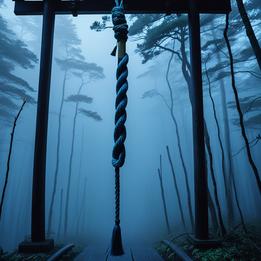
Shimenawa Rope
A sacred straw rope used in Shinto to mark boundaries between the sacred and profane, often seen at shrines and around sacred objects.
Shimenawa Rope Dream Meaning
A sacred straw rope used in Shinto to mark boundaries between the sacred and profane, often seen at shrines and around sacred objects.
Interpretive Themes
Mythological Resonance
Amaterasu
JapaneseThe sun goddess who retreated into a cave, plunging the world into darkness, until other gods used a sacred rope to mark the cave entrance and lure her out, restoring light and order.
Gleipnir
NorseThe magical ribbon made of impossible things (cat's footsteps, woman's beard, etc.) that finally bound the wolf Fenrir, representing how boundaries can contain even the most chaotic forces.
Cultural Lenses
Jungian Perspective
View Context →Symbol of the Self's wholeness and the mandala, marking the sacred center of the psyche. The rope's twist may represent the union of opposites (conscious/unconscious).
Freudian Perspective
View Context →A phallic symbol representing authority and prohibition, or an anal/birth symbol of containment and separation from primal, messy desires.
Gestalt Perspective
View Context →Represents a self-imposed boundary or limit. The dreamer projects their need for separation, protection, or definition onto this figure/ground element.
Cognitive Perspective
View Context →A schema for 'sacred boundary' learned through cultural exposure. The brain uses it to process concepts of safety, taboo, and social-spiritual order.
Evolutionary Perspective
View Context →Taps into innate threat-detection for territorial boundaries and coalitional signaling for group identity and shared sacred spaces, promoting social cohesion.
East Asian Perspective
View Context →In Shinto, it purifies and demarcates sacred space (kami dwellings). Historically used in rituals; modernly, it marks shrines, New Year decorations, and sumo rings.
Global/Universal Perspective
View Context →A universal motif of the sacred cord or boundary marker, seen in cultures worldwide (e.g., temple cords, prayer ropes) to separate holy from profane.
Modern Western Perspective
View Context →Often viewed as an exotic spiritual artifact or aesthetic symbol. Can represent a fascination with Eastern philosophy, minimalism, or a desire for personal sacred space.
European Perspective
View Context →Echoes pre-Christian traditions of marking sacred groves with ropes or ribbons. Parallels exist in Celtic and Norse practices of cord magic and boundary-setting.
South Asian Perspective
View Context →Resonates with concepts of 'lāṅgala' (plough as boundary) in Vedic ritual and the sacred thread (yajñopavīta), symbolizing spiritual duty and separation from impurity.
Middle Eastern Perspective
View Context →Parallels ancient Mesopotamian temple rites using cords to measure sacred space. In Islam, the concept of 'ḥaram' (sanctuary) defines similar spiritual boundaries.
African Perspective
View Context →Analogous to practices using ropes, vines, or chalk lines to demarcate ritual spaces, separate communities from wilderness, or contain spiritual power in many traditions.
Historical Authorities
Want a deeper analysis?
Get a personalized interpretation of your entire dream including this symbol.
Interpret My DreamThe Oracle's Prediction
Combine multiple symbolsYou will establish a meaningful personal ritual or boundary.
Timeframe
Seasonal (~3 Months)
Intensity
Deep
Common Appearances & Contexts
| Context | Emotion | Interpretation |
|---|---|---|
| Context Seeing a shimenawa at a shrine entrance | Emotion peaceful | Interpretation Entering a protected, sacred space in life. |
| Context A shimenawa breaking or fraying | Emotion anxious | Interpretation Fear of lost protection or violated boundaries. |
| Context Hanging a shimenawa yourself | Emotion proud | Interpretation Actively creating sacred space or setting limits. |
| Context A shimenawa around a forbidden object | Emotion curious | Interpretation Confronting something off-limits or powerful. |
| Context Walking under a shimenawa | Emotion reverent | Interpretation Undergoing a purification or transition. |
| Context A shimenawa in an unexpected place (e.g., home) | Emotion confused | Interpretation Sacred intrusion into everyday life. |
| Context A giant, overwhelming shimenawa | Emotion awed | Interpretation Facing immense spiritual power or duty. |
| Context Ignoring or crossing a shimenawa | Emotion defiant | Interpretation Rebelling against spiritual or social rules. |
| Context A shimenawa glowing or moving | Emotion fearful | Interpretation Direct encounter with active spiritual force. |
| Context Weaving or repairing a shimenawa | Emotion focused | Interpretation Mending spiritual connections or traditions. |
| Context A shimenawa as a weapon or tool | Emotion empowered | Interpretation Using spiritual principles actively. |
| Context A shimenawa disappearing | Emotion lost | Interpretation Loss of spiritual guidance or boundaries. |
Interpret Your Full Dream
Beyond this symbol, every dream carries a unique story. Share your dream for a personalized AI-powered interpretation.