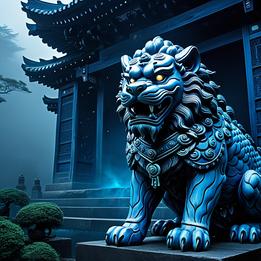
Komainu Lion
Guardian lion-dog statues from Japanese Shinto and Buddhist traditions, symbolizing protection, warding off evil, and divine power.
Komainu Lion Dream Meaning
Guardian lion-dog statues from Japanese Shinto and Buddhist traditions, symbolizing protection, warding off evil, and divine power.
Interpretive Themes
Mythological Resonance
Shishi
JapaneseThe Chinese lion guardians that inspired Komainu, believed to protect Buddhist temples and ward off evil spirits through their fierce presence.
Cerberus
GreekThe three-headed dog guarding the entrance to Hades, preventing the dead from leaving and the living from entering, similar to Komainu's threshold protection.
Cultural Lenses
Jungian Perspective
View Context →Represents the Self or the protective, ordering function of the psyche (the 'guardian of the threshold'). It integrates animal instinct (lion) with spiritual wisdom, symbolizing individuation and defense against unconscious chaos.
Freudian Perspective
View Context →May symbolize the superego—the internalized parent or societal authority that enrules and protects the psyche from id-driven, primal desires. The imposing figure represents repressed power and moral guardianship.
Gestalt Perspective
View Context →The dreamer's own protective aspect or a projected boundary. Ask: 'What part of me is this guardian?' It represents the self's need for safety, structure, and the ability to say 'no' to external threats.
Cognitive Perspective
View Context →A mental schema for 'protection' and 'sacred space.' Dreaming of it may indicate the brain processing threats, seeking security, or reinforcing concepts of safety and spiritual order during sleep consolidation.
Evolutionary Perspective
View Context →Taps into deep-seated adaptive fears and protective mechanisms. The lion-like form triggers threat detection systems, while the guardian role reflects the evolutionary need to defend territory, resources, and social group from harm.
East Asian Perspective
View Context →Primarily Japanese (Komainu) and Chinese (Shishi) guardian lions. Historically placed at Shinto shrines/Buddhist temples to ward evil. Modernly, they symbolize cultural identity, protection for businesses/homes, and a link to tradition.
Global/Universal Perspective
View Context →A manifestation of the universal archetype of the guardian beast or threshold protector, found in cultures worldwide (e.g., sphinxes, griffins). Represents humanity's shared need to demarcate and defend the sacred from the profane.
South Asian Perspective
View Context →Relates to simhavalokana (lion gaze) in Buddhism and guardian yakshas/yakshinis in Hindu/Jain temple architecture. Symbolizes the power of the Dharma to protect and the fierce compassion that guards spiritual practitioners.
Modern Western Perspective
View Context →Often viewed as exotic decor or a symbol of Zen aesthetics. Can represent a fascination with Eastern spirituality, a desire for personal 'mindfulness' guardianship, or an appreciation for mythic symbolism in art and design.
European Perspective
View Context →Echoes heraldic lions and gargoyles on medieval cathedrals—symbols of nobility, courage, and protection against evil spirits. Shares the theme of stone guardians embodying collective power and warding off misfortune.
African Perspective
View Context →Resonates with lion symbolism in many cultures as a symbol of royalty, strength, and ancestral protection. Like guardian spirits or totems, it represents a lineage's power watching over the community and its sacred spaces.
Middle Eastern Perspective
View Context →Parallels ancient lamassu and other hybrid guardian creatures (like those from Mesopotamia and Persia) that protected city gates and palaces. Embodies the concept of divine authority and the king's role as protector of the realm.
Historical Authorities
Want a deeper analysis?
Get a personalized interpretation of your entire dream including this symbol.
Interpret My DreamThe Oracle's Prediction
Combine multiple symbolsA new protective figure will enter your life.
Timeframe
Seasonal (~3 Months)
Intensity
Deep
Common Appearances & Contexts
| Context | Emotion | Interpretation |
|---|---|---|
| Context Seeing a Komainu at a temple entrance | Emotion reverence | Interpretation Entering a sacred or protected phase of life. |
| Context A Komainu statue coming to life | Emotion awe | Interpretation Awakening of inner guardianship or spiritual power. |
| Context A damaged or broken Komainu | Emotion anxiety | Interpretation Feeling unprotected or that spiritual defenses are failing. |
| Context Placing a Komainu at your home | Emotion security | Interpretation Actively establishing boundaries or seeking protection. |
| Context A Komainu roaring silently | Emotion urgency | Interpretation A silent warning or intuition of unseen danger. |
| Context Petting or touching a Komainu | Emotion connection | Interpretation Seeking direct contact with protective or ancestral forces. |
| Context A Komainu turning its head away | Emotion rejection | Interpretation Feeling unworthy of protection or guidance. |
| Context Multiple Komainu lining a path | Emotion guidance | Interpretation Being led through a challenging or spiritual journey. |
| Context A Komainu with glowing eyes | Emotion fear | Interpretation Confrontation with intense, judgmental spiritual awareness. |
| Context A small, personal Komainu figurine | Emotion comfort | Interpretation Internalizing a sense of personal safety and strength. |
| Context A Komainu statue weeping | Emotion sorrow | Interpretation Grief over a loss of sanctity or broken vows. |
| Context Riding on a Komainu's back | Emotion exhilaration | Interpretation Mastery over primal fears or harnessing protective instincts. |
Interpret Your Full Dream
Beyond this symbol, every dream carries a unique story. Share your dream for a personalized AI-powered interpretation.