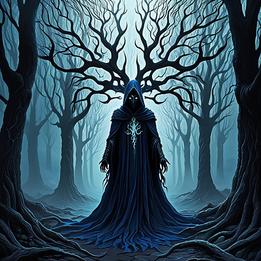
Qliphoth
In Kabbalistic mysticism, the Qliphoth represent the impure, chaotic 'shells' or 'husks' opposite the divine emanations of the Tree of Life, symbolizing spiritual obstacles, demonic forces, and the shadow self.
Qliphoth Dream Meaning
In Kabbalistic mysticism, the Qliphoth represent the impure, chaotic 'shells' or 'husks' opposite the divine emanations of the Tree of Life, symbolizing spiritual obstacles, demonic forces, and the shadow self.
Interpretive Themes
Mythological Resonance
Samael
KabbalahThe angel of poison and death who rules certain Qliphothic realms, representing the necessary destruction that precedes creation.
Echidna
GreekThe mother of monsters who dwells in dark caves, birthing hybrid creatures from the shadow places between worlds.
Cultural Lenses
Jungian Perspective
View Context →Represents the personal and collective Shadow—the totality of repressed, inferior traits and potentialities. Integration is crucial for individuation, though fraught with danger, as it contains both creative and destructive energies.
Freudian Perspective
View Context →Manifests the repressed contents of the Id—primitive, aggressive, and libidinal impulses breaking through from the unconscious. Symbolizes the return of the repressed in a distorted, often terrifying form.
Gestalt Perspective
View Context →Represents disowned parts of the self that are split off and projected. The dream work involves reclaiming these 'shells' to achieve wholeness and complete unfinished psychological business.
Cognitive Perspective
View Context →May symbolize maladaptive thought patterns, cognitive distortions, or schemas related to fear, threat, and impurity. The brain processes unresolved anxieties or taboo concepts through this symbolic framework.
Evolutionary Perspective
View Context →Could tap into ancient adaptive fears of contamination, predation, and social ostracization. Symbolizes threats to group cohesion or personal survival that were paramount in ancestral environments.
Middle Eastern Perspective
View Context →Rooted in Jewish Kabbalah, historically viewed as demonic shells or spiritual refuse from creation. In modern esoteric practice, they are often seen as a dangerous but potent path for spiritual ascent via 'the left-hand path'.
European Perspective
View Context →Influenced Western occultism (e.g., Thelema, Chaos Magick) as a map of adversarial initiation and exploration of the abyss. Represents the inversion or shadow of established religious and mystical structures.
Modern Western Perspective
View Context →Often secularized into a metaphor for psychological shadow work, trauma, or exploring societal taboos. Prevalent in fantasy/horror media as a symbol of cosmic horror or personal corruption.
Global/Universal Perspective
View Context →Archetypally resonates with concepts of a shadow world, underworld, or anti-structure that mirrors and opposes the ordered, divine cosmos, appearing in various dualistic mythologies worldwide.
North American Perspective
View Context →In contemporary occult and neopagan subcultures, often approached as a system for intense shadow work and breaking personal limitations, sometimes divorced from its original Judaic context.
Historical Authorities
Want a deeper analysis?
Get a personalized interpretation of your entire dream including this symbol.
Interpret My DreamThe Oracle's Prediction
Combine multiple symbolsA hidden psychological pattern will surface with disruptive intensity.
Timeframe
Immediate (Next 48h)
Intensity
Deep
Common Appearances & Contexts
| Context | Emotion | Interpretation |
|---|---|---|
| Context Climbing a tree | Emotion Anxiety | Interpretation Spiritual ascent blocked. |
| Context Fighting a monster | Emotion Terror | Interpretation Confronting inner demons. |
| Context Being trapped | Emotion Despair | Interpretation Feeling spiritually stuck. |
| Context Breaking a mirror | Emotion Shock | Interpretation Shattering self-illusions. |
| Context Navigating a maze | Emotion Confusion | Interpretation Lost in spiritual confusion. |
| Context Falling into darkness | Emotion Dread | Interpretation Descent into shadow. |
| Context Hearing whispers | Emotion Unease | Interpretation Temptation or corruption. |
| Context Purifying in fire | Emotion Agony | Interpretation Painful transformation process. |
| Context Meeting a double | Emotion Horror | Interpretation Encountering the shadow self. |
| Context Solving a riddle | Emotion Determination | Interpretation Seeking forbidden knowledge. |
| Context Watching decay | Emotion Revulsion | Interpretation Witnessing spiritual corruption. |
| Context Crossing a barrier | Emotion Apprehension | Interpretation Entering forbidden territory. |
Interpret Your Full Dream
Beyond this symbol, every dream carries a unique story. Share your dream for a personalized AI-powered interpretation.