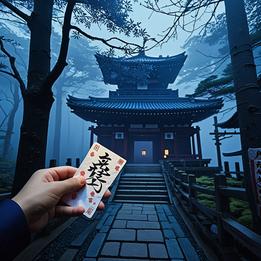
Omikuji Fortune
A Japanese paper fortune slip drawn at Shinto shrines or Buddhist temples, offering predictions about one's future, luck, and life circumstances.
Omikuji Fortune Dream Meaning
A Japanese paper fortune slip drawn at Shinto shrines or Buddhist temples, offering predictions about one's future, luck, and life circumstances.
Interpretive Themes
Fate vs. Free Will
highQuestions whether outcomes are fixed or influenced.
Seeking Guidance
highReflects need for clarity or reassurance.
Ancestral Connection
mediumTies to tradition and collective wisdom.
Chance and Randomness
mediumHighlights unpredictable elements of existence.
Spiritual Awakening
highEncourages self-examination and growth.
Mythological Resonance
The Oracle of Delphi
GreekA priestess who channeled Apollo to deliver cryptic prophecies, guiding kings and commoners alike through ambiguous pronouncements.
The Norns
NorseThe three goddesses of destiny (Urd, Verdandi, Skuld) who weave the threads of past, present, and future at the base of Yggdrasil.
Cultural Lenses
Jungian Perspective
View Context →Represents the collective unconscious offering archetypal guidance; the slip symbolizes synchronicity, where external events mirror inner psychological states, urging integration of unconscious wisdom.
Freudian Perspective
View Context →May symbolize wish-fulfillment for control over uncertainty or repressed anxieties about fate; the act of drawing reflects latent desires or fears projected onto an external authority figure.
Gestalt Perspective
View Context →Seen as a projection of the dreamer's self; each part of the ritual (drawing, reading, tying) represents aspects of the dreamer's approach to life choices and personal responsibility.
Cognitive Perspective
View Context →Reflects mental schemas for processing uncertainty; the dream may highlight cognitive biases, like over-reliance on external validation or pattern-seeking in random events to reduce anxiety.
Evolutionary Perspective
View Context →Taps into adaptive mechanisms for risk assessment and social cohesion; dreaming of fortunes may stem from ancestral needs to predict outcomes and seek group-approved guidance for survival.
East Asian Perspective
View Context →Rooted in Shinto and Buddhist traditions, omikuji are ritual tools for connecting with kami (spirits) or karma; historically, they guided major decisions, and modernly, they blend spirituality with cultural tourism.
Global/Universal Perspective
View Context →A universal symbol of divination and fate, akin to tarot or astrology; reflects human desire to foresee the future and find meaning in randomness across cultures and eras.
Modern Western Perspective
View Context →Often viewed through a lens of pop culture or mindfulness; may represent a search for meaning in a secular world, or critique of superstition versus rational decision-making.
European Perspective
View Context →Parallels historical practices like sortes (lottery divination) in ancient Rome or medieval fortune-telling; in modern Europe, it might symbolize cross-cultural fascination or spiritual eclecticism.
South Asian Perspective
View Context →Relates to concepts of prarabdha (destiny) in Hinduism or karma in Buddhism; similar to practices like astrology (jyotisha), emphasizing life paths shaped by past actions and divine will.
North American Perspective
View Context →In multicultural contexts, it may symbolize identity exploration or spiritual curiosity; in indigenous traditions, it could parallel vision quests or ceremonies seeking guidance from ancestors.
African Perspective
View Context →Echoes divination practices like casting bones or consulting oracles, which connect to ancestral wisdom and community decision-making; symbolizes interplay between individual fate and collective harmony.
Historical Authorities
Want a deeper analysis?
Get a personalized interpretation of your entire dream including this symbol.
Interpret My DreamThe Oracle's Prediction
Combine multiple symbolsA period of significant self-reflection and insight will open.
Timeframe
Lunation (~29 Days)
Intensity
Deep
Common Appearances & Contexts
| Context | Emotion | Interpretation |
|---|---|---|
| Context Drawing a good fortune (daikichi) | Emotion elation | Interpretation Suggests optimism, confidence, or upcoming positive change. |
| Context Drawing a bad fortune (kyō) | Emotion dread | Interpretation May indicate fear of failure, anxiety, or subconscious warnings. |
| Context Tying the fortune to a tree or rack | Emotion relief | Interpretation Symbolizes releasing worries or transforming bad luck. |
| Context Receiving an omikuji as a gift | Emotion curiosity | Interpretation Could represent external influences or advice impacting your path. |
| Context Losing the fortune slip | Emotion confusion | Interpretation May reflect feeling directionless or ignoring guidance. |
| Context Multiple omikuji with conflicting messages | Emotion frustration | Interpretation Suggests inner conflict or decision paralysis. |
| Context Reading the fortune aloud to someone | Emotion vulnerability | Interpretation Indicates sharing fears or hopes, seeking validation. |
| Context A digital or fake omikuji | Emotion skepticism | Interpretation Questions authenticity of guidance or modern spirituality. |
| Context Choosing not to draw a fortune | Emotion defiance | Interpretation Represents rejecting external fate, asserting independence. |
| Context The fortune slip is blank | Emotion bewilderment | Interpretation Symbolizes unknown future or lack of clear answers. |
| Context Finding an old, weathered omikuji | Emotion nostalgia | Interpretation Connects to past decisions or unresolved life phases. |
| Context The fortune changes text as you read | Emotion awe | Interpretation Suggests evolving perspectives or dynamic life paths. |
Interpret Your Full Dream
Beyond this symbol, every dream carries a unique story. Share your dream for a personalized AI-powered interpretation.