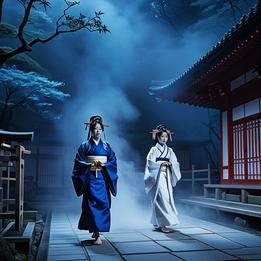
Kagura Dance
A sacred Shinto ritual dance performed to honor kami (spirits/gods), often involving purification, storytelling, and divine communication.
Kagura Dance Dream Meaning
A sacred Shinto ritual dance performed to honor kami (spirits/gods), often involving purification, storytelling, and divine communication.
Interpretive Themes
Divine Connection
highDream may signal seeking guidance or blessing.
Cultural Heritage
mediumCould reflect identity exploration or roots.
Ritual Purification
highOften precedes new beginnings or healing.
Performance and Mask
mediumMay relate to social personas or hiding.
Cyclical Renewal
lowSuggests transitions or repetitive patterns.
Mythological Resonance
Ame-no-Uzume
ShintoThe goddess of dawn and revelry whose ecstatic dance lured Amaterasu from the cave, using joy and performance to restore cosmic balance.
Orpheus
GreekA musician whose lyre playing could charm gods, animals, and stones, using art to traverse between worlds and communicate with spirits.
Cultural Lenses
Jungian Perspective
View Context →Represents archetypal ritual connecting conscious ego to collective unconscious; dance symbolizes individuation process, integrating shadow or anima/animus through sacred performance.
Freudian Perspective
View Context →May symbolize repressed desires or childhood rituals; rhythmic movement could relate to psychosexual stages, with masks representing hidden wishes or superego constraints.
Gestalt Perspective
View Context →Each dance element represents part of self; the whole performance reflects integration of conflicting aspects, with audience/projection dynamics highlighting unfinished business.
Cognitive Perspective
View Context →Brain processing ritual schemas or cultural scripts; dream may reinforce social cognition, memory consolidation of traditions, or problem-solving through metaphorical movement.
Evolutionary Perspective
View Context →Taps into adaptive benefits of group ritual: social cohesion, tradition transmission, and supernatural belief systems that enhanced survival through coordinated behavior and shared meaning.
East Asian Perspective
View Context →In Shinto context, historically purifies space and invites kami blessings; modernly preserves cultural identity while adapting to secular performances, maintaining spiritual resonance.
Global/Universal Perspective
View Context →Part of worldwide shamanic dance traditions that mediate between human and spirit worlds; represents universal human need for ritual expression and transcendental experience.
South Asian Perspective
View Context →Parallels to classical dance-drama like Kathakali; seen as sacred offering (naivedya) to deities, with mudras and movement carrying cosmic symbolism and devotional energy.
Modern Western Perspective
View Context →Often exoticized as 'Eastern spirituality'; may represent search for authentic experience beyond materialism, or appropriation concerns in wellness/New Age contexts.
African Perspective
View Context →Resonates with possession dances like Zar or Bori; viewed as channeling ancestral spirits, with similar functions of healing, community bonding, and maintaining cosmic balance.
Latin American Perspective
View Context →Echoes syncretic dances like Danza de los Voladores; blends indigenous ritual with colonial influences, representing survival of spiritual practices under cultural pressure.
Oceanian Perspective
View Context →Similar to Maori haka or Polynesian ceremonial dance; serves as vehicle for mana (spiritual power), storytelling, and connecting to land/ancestors through embodied tradition.
Historical Authorities
Want a deeper analysis?
Get a personalized interpretation of your entire dream including this symbol.
Interpret My DreamThe Oracle's Prediction
Combine multiple symbolsA creative or intuitive breakthrough will manifest through artistic expression.
Timeframe
Immediate (Next 48h)
Intensity
Deep
Common Appearances & Contexts
| Context | Emotion | Interpretation |
|---|---|---|
| Context Watching Kagura at a shrine | Emotion Serenity | Interpretation Seeking spiritual peace or observing life's sacred aspects. |
| Context Performing Kagura yourself | Emotion Empowerment | Interpretation Taking active role in spiritual or personal transformation. |
| Context Kagura interrupted or chaotic | Emotion Anxiety | Interpretation Fear of broken traditions or spiritual disconnection. |
| Context Learning Kagura steps | Emotion Focus | Interpretation Mastering a new skill or integrating wisdom. |
| Context Kagura in a modern setting | Emotion Confusion | Interpretation Navigating tradition vs. innovation in life. |
| Context Kagura with family or community | Emotion Belonging | Interpretation Desire for social harmony or shared values. |
| Context Kagura costumes or masks | Emotion Fascination | Interpretation Exploring hidden aspects of self or others. |
| Context Kagura as part of a festival | Emotion Celebration | Interpretation Marking a milestone or joyous occasion. |
| Context Kagura performed for you alone | Emotion Honored | Interpretation Feeling specially recognized or divinely favored. |
| Context Kagura with unfamiliar rituals | Emotion Curiosity | Interpretation Openness to new spiritual or cultural experiences. |
| Context Kagura that feels empty or mechanical | Emotion Disappointment | Interpretation Rituals losing meaning or feeling inauthentic. |
| Context Kagura leading to a vision | Emotion Awe | Interpretation Receiving profound insight or prophetic message. |
Interpret Your Full Dream
Beyond this symbol, every dream carries a unique story. Share your dream for a personalized AI-powered interpretation.