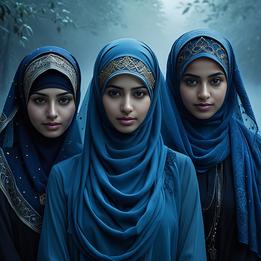
Hijab Veil
A head covering representing modesty, faith, and spiritual protection, often symbolizing the boundary between sacred and secular worlds.
Hijab Veil Dream Meaning
A head covering representing modesty, faith, and spiritual protection, often symbolizing the boundary between sacred and secular worlds.
Interpretive Themes
Spiritual Protection
highOften linked to divine connection and purity.
Identity and Belonging
highCan signal community membership or personal faith.
Modesty and Humility
mediumRelated to spiritual submission and focus.
Separation and Boundary
mediumDistinguishes private from public spheres.
Transformation and Initiation
lowSometimes appears in rites of passage dreams.
Mythological Resonance
Fatimah al-Zahra
Islamic/Pre-IslamicDaughter of the Prophet Muhammad, revered for her piety and modesty; her veil symbolizes purity, dignity, and spiritual protection in Islamic tradition.
The Veil of Isis
Greco-RomanThe goddess Isis, whose veil shrouds the mysteries of nature and the divine; to lift it is to attain ultimate wisdom, representing the boundary between the knowable and the unknowable.
Cultural Lenses
Middle Eastern Perspective
View Context →Historically signifies modesty and piety in Islamic tradition; modern contexts range from religious obligation to feminist reclamation, often representing cultural identity amid political tensions.
South Asian Perspective
View Context →In regions like Pakistan and Bangladesh, integrates with local dress (dupatta) as cultural-religious hybrid; represents family honor, modesty, and sometimes class distinctions in contemporary society.
Modern Western Perspective
View Context →Often politicized in debates about religious freedom vs. secularism; can symbolize resistance, identity assertion, or perceived oppression depending on political context and personal experience.
African Perspective
View Context →In North African countries like Egypt and Morocco, blends Islamic practice with Berber traditions; represents spiritual protection, cultural continuity, and sometimes post-colonial identity reclamation.
European Perspective
View Context →In contemporary Europe, frequently appears in immigration and integration debates; symbolizes cultural difference, religious visibility, and tensions between secular values and religious expression.
Jungian Perspective
View Context →Represents the persona—the social mask concealing the true self; may symbolize the veil between conscious and unconscious, or the feminine principle of containment and mystery in the psyche.
Freudian Perspective
View Context →Could symbolize repression of sexuality or desires; the veil as barrier suggesting forbidden aspects of the self, potentially relating to childhood experiences with authority or modesty teachings.
Gestalt Perspective
View Context →Represents parts of self being hidden or revealed; the dreamer may be both wearer and observer, exploring boundaries between public presentation and private authenticity in current life situations.
Cognitive Perspective
View Context →May reflect schemas about identity, social roles, or security; could indicate cognitive processing of belonging, values conflict, or adaptation to cultural expectations in waking life.
Evolutionary Perspective
View Context →Could relate to mate selection signals—modesty as indicator of fidelity or group belonging; the veil as social signaling device for trustworthiness, commitment, or in-group identification in human social evolution.
East Asian Perspective
View Context →In non-Muslim majority contexts like China, often viewed through media lens as foreign symbol; may represent religious otherness, globalization effects, or curiosity about different spiritual practices in modern cosmopolitan settings.
Global/Universal Perspective
View Context →Across cultures, head coverings appear in various religions (nuns, Sikh turbans) representing devotion; universally symbolizes the sacred-secular boundary, humility before the divine, and human longing for spiritual connection.
Historical Authorities
Want a deeper analysis?
Get a personalized interpretation of your entire dream including this symbol.
Interpret My DreamThe Oracle's Prediction
Combine multiple symbolsYou will gain powerful clarity regarding the boundaries between your public and private self.
Timeframe
Immediate (Next 48h)
Intensity
Deep
Common Appearances & Contexts
| Context | Emotion | Interpretation |
|---|---|---|
| Context Wearing a hijab for the first time | Emotion anxiety | Interpretation May indicate fear of commitment or new responsibilities. |
| Context Removing a hijab in public | Emotion liberation | Interpretation Could symbolize shedding constraints or revealing true self. |
| Context Someone gifting you a hijab | Emotion acceptance | Interpretation Suggests embracing spiritual guidance or tradition. |
| Context Hijab being forcibly taken off | Emotion violation | Interpretation May represent loss of autonomy or spiritual attack. |
| Context Choosing a colorful hijab | Emotion joy | Interpretation Indicates creative expression within spiritual framework. |
| Context Hijab blowing away in wind | Emotion vulnerability | Interpretation Could signal exposure or loss of spiritual protection. |
| Context Sewing or mending a hijab | Emotion determination | Interpretation Suggests repairing faith or recommitting to values. |
| Context Seeing a hijab in a non-religious setting | Emotion confusion | Interpretation May indicate spiritual messages in unexpected places. |
| Context Multiple women wearing identical hijabs | Emotion belonging | Interpretation Represents community solidarity or conformity pressures. |
| Context Hijab transforming into another object | Emotion wonder | Interpretation Suggests spiritual evolution or changing beliefs. |
| Context Being unable to find your hijab | Emotion panic | Interpretation May indicate spiritual disconnection or lost identity. |
| Context Hijab feeling too tight or restrictive | Emotion suffocation | Interpretation Could symbolize feeling constrained by beliefs or expectations. |
Interpret Your Full Dream
Beyond this symbol, every dream carries a unique story. Share your dream for a personalized AI-powered interpretation.