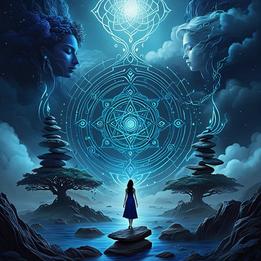
Five Elements
A universal system describing fundamental forces or phases of nature that interact to create balance, transformation, and the cycle of existence.
Five Elements Dream Meaning
A universal system describing fundamental forces or phases of nature that interact to create balance, transformation, and the cycle of existence.
Interpretive Themes
Balance & Harmony
highDream may indicate seeking stability.
Transformation & Change
highSignals a major life transition.
Interconnection
mediumHighlights relationships or systems thinking.
Foundation & Structure
mediumConcern with core beliefs or stability.
Creative Potential
lowMay point to untapped energy or ideas.
Mythological Resonance
Wu Xing
Chinese PhilosophyThe ancient system of five phases (Wood, Fire, Earth, Metal, Water) describing the cyclical interactions and transformations of all phenomena in the universe.
Classical Elements
GreekEmpedocles' doctrine of four root elements (Earth, Water, Air, Fire) from which all matter is composed, later expanded by Aristotle with the quintessence (Aether).
Cultural Lenses
Global/Universal Perspective
View Context →A cross-cultural archetype representing fundamental natural forces. Historically used to explain cosmology, medicine, and philosophy. Modernly, a metaphor for ecological balance and systemic thinking.
Jungian Perspective
View Context →Archetypes of primal energy within the collective unconscious. Represent fundamental psychic forces (e.g., emotion as Water, intellect as Air). Integration signifies individuation and wholeness of the Self.
East Asian Perspective
View Context →Wu Xing (Wood, Fire, Earth, Metal, Water) - a dynamic system of phases, not static elements. Governs traditional Chinese medicine, feng shui, and martial arts. Central to understanding cyclical change and harmony.
South Asian Perspective
View Context →Pancha Mahabhuta (Earth, Water, Fire, Air, Space/Aether) in Ayurveda and Hinduism. The building blocks of the material universe and the human body. Balance is essential for health and spiritual progress.
Middle Eastern Perspective
View Context →Ancient systems (e.g., in Greek-influenced Islamic philosophy) often used four elements. Symbolizes the material world's composition. In mysticism (e.g., Sufism), can represent stages of spiritual refinement.
European Perspective
View Context →Classical Greek system (Earth, Water, Air, Fire) used by Empedocles and Aristotle. Dominated Western alchemy, medicine, and astrology for centuries. Modernly, a symbolic framework in literature and psychology.
African Perspective
View Context →Varied by region; often integrated with ancestral and nature spirits. Elements are alive and communicative. Rituals may invoke them for healing, agriculture, or community harmony. Represents interdependence with nature.
North American Perspective
View Context →In many Indigenous traditions, elements are sacred relatives and teachers (e.g., the Four Directions often associated with elements). Central to ceremonies, storytelling, and a holistic worldview of reciprocity.
Latin American Perspective
View Context →Syncretic blends of Indigenous (e.g., Inca, Maya), African, and European systems. Seen in curanderismo and earth-based spirituality. Elements are active deities or forces in rituals for healing and balance.
Freudian Perspective
View Context →May symbolize basic drives and libidinal energy. For example, Fire could represent passion or aggression; Water might symbolize the fluidity of emotions or the unconscious. Imbalance points to repressed conflicts.
Gestalt Perspective
View Context →Each element represents a disowned part of the self or a polarities. Dreamwork involves 'becoming' each element to reclaim its energy. The system as a whole symbolizes the dreamer's complete existential field.
Cognitive Perspective
View Context →A mental schema for categorizing and understanding the physical world and abstract concepts. The dream processes memories or concepts related to change, foundation, or systems. Reflects problem-solving about balance.
Evolutionary Perspective
View Context →A cognitive adaptation for early humans to model and predict environmental dynamics (weather, seasons, resource cycles). The dream activates this ancient survival module to assess personal or social ecosystem stability.
Historical Authorities
Want a deeper analysis?
Get a personalized interpretation of your entire dream including this symbol.
Interpret My DreamThe Oracle's Prediction
Combine multiple symbolsA significant rebalancing of physical or energetic systems.
Timeframe
Seasonal (~3 Months)
Intensity
Deep
A profound realization about the interconnected nature of a challenging situation.
Timeframe
Lunation (~29 Days)
Intensity
Deep
Common Appearances & Contexts
| Context | Emotion | Interpretation |
|---|---|---|
| Context Elements in perfect harmony | Emotion Peace | Interpretation Indicates inner balance and life alignment. |
| Context One element overpowering others | Emotion Anxiety | Interpretation Suggests an imbalance or dominant force causing stress. |
| Context Watching elements transform into each other | Emotion Wonder | Interpretation Symbolizes acceptance of natural life changes. |
| Context Trying to control the elements | Emotion Frustration | Interpretation Reflects struggle against uncontrollable circumstances. |
| Context A missing element | Emotion Longing | Interpretation Points to a perceived lack or unfulfilled need. |
| Context Elements in conflict or battle | Emotion Fear | Interpretation Represents internal or external turmoil. |
| Context Nurturing a weak element | Emotion Compassion | Interpretation Suggests caring for a neglected aspect of self. |
| Context Elements forming a new pattern | Emotion Hope | Interpretation Indicates creative problem-solving or new beginnings. |
| Context Being an element yourself | Emotion Empowerment | Interpretation Connects to core identity and personal power. |
| Context Elements decaying or dying | Emotion Grief | Interpretation May symbolize endings, loss, or necessary decay. |
| Context Teaching others about the elements | Emotion Pride | Interpretation Reflects a desire to share wisdom or guide. |
| Context Elements in a modern setting (e.g., office) | Emotion Confusion | Interpretation Suggests integrating ancient wisdom into daily life. |
Interpret Your Full Dream
Beyond this symbol, every dream carries a unique story. Share your dream for a personalized AI-powered interpretation.