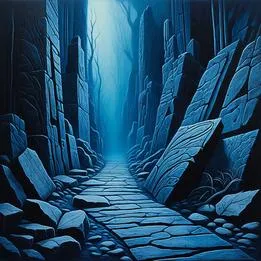
Etching
The Oracle's Essence
A deliberate, permanent marking process that signifies deep imprinting, legacy creation, and transformative journey through careful action.
Interpretive Themes
Modern Visibility
In modern contexts, etching often symbolizes digital or emotional imprinting, artistic expression, and the lasting impact of choices in a fast-paced world.
Cultural Lenses
Jungian
Learn More →Represents individuation process—carving out authentic self from collective unconscious. The etching tool symbolizes conscious effort to shape archetypal patterns into personal identity, creating permanent psychic structures.
Freudian
Learn More →Symbolizes sublimation of aggressive or sexual impulses into creative acts. The etching action represents controlled penetration and marking, transforming primal urges into socially acceptable artistic or intellectual expressions.
Gestalt
Learn More →Represents the figure-ground relationship in consciousness. The etched line creates distinction between self and environment, marking boundaries and bringing unconscious patterns into awareness through deliberate action.
Cognitive
Learn More →Symbolizes memory consolidation and schema formation. The etching process represents how repeated thoughts or experiences create neural pathways, permanently shaping cognitive patterns and behavioral responses.
Evolutionary
Learn More →Represents tool use for territory marking and social signaling. Etching mimics ancestral behaviors of creating permanent signs for navigation, ownership, or ritual purposes, satisfying deep-seated needs for legacy.
East Asian
Learn More →In Chinese tradition, etching represents the carving of jade seals—authority and authenticity. In Japanese culture, it relates to woodblock printing (ukiyo-e), capturing fleeting beauty permanently through disciplined craft.
European
Learn More →Historically linked to engraving heraldic symbols and religious icons. In Renaissance, etching became artistic innovation (Dürer, Rembrandt), symbolizing both technical mastery and the permanent recording of humanistic ideals.
Middle Eastern
Learn More →Connected to ancient cuneiform and hieroglyphic writing systems. In Islamic art, etching appears as geometric patterns in metalwork, representing the eternal nature of divine order through precise, repetitive craftsmanship.
African
Learn More →In many traditions, etching appears in scarification rituals and pottery decoration. It represents community identity, spiritual protection, and the transmission of ancestral knowledge through permanent bodily or artistic marks.
Latin American
Learn More →In Mesoamerican cultures, etching appears in jade and obsidian artifacts. In modern contexts, it relates to muralism and political graffiti, representing both ancient heritage and contemporary social commentary through permanent public marks.
Modern Western
Learn More →Symbolizes both digital data etching (permanent records) and tattoo culture. Represents the tension between authentic self-expression and commercial branding, with etching as a metaphor for creating lasting personal or professional identity.
Global/Universal
Learn More →Across cultures, etching represents humanity's fundamental drive to leave marks—from prehistoric cave engravings to modern digital footprints. It symbolizes our existential need for permanence, memory preservation, and communication across time.
Contextual Nuances
Etching stone
Building permanent foundation.
Etching glass
Creating delicate permanence.
Etching metal
Forging strong identity.
Etching wood
Natural transformation process.
Etching skin
Personal, bodily imprint.
Questions for Reflection
- "What aspects of your identity are you trying to make permanent?"
- "What emotional or psychological patterns are being etched into your daily life?"
- "How does the permanence of etching contrast with your current life transitions?"
Related Weavings
The Portal is Always Open
Every dream is a personalized dispatch from the deep. Don't let yours fade into static.
Interpret Full Dream