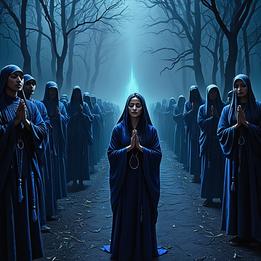
Chant
A repetitive vocal pattern, often rhythmic or melodic, used for ritual, prayer, meditation, or protest. It connects individuals to tradition, community, or the divine.
Chant Dream Meaning
A repetitive vocal pattern, often rhythmic or melodic, used for ritual, prayer, meditation, or protest. It connects individuals to tradition, community, or the divine.
Interpretive Themes
Collective Unison
highRepresents a desire for belonging and shared purpose.
Rhythmic Trance
highSuggests a need for release or transcendence.
Invocation & Manifestation
mediumIndicates a focus on intention and will.
Ancestral Connection
mediumPoints to a search for roots or guidance.
Protest & Assertion
lowMay reflect inner conflict or a need to be heard.
Cultural Lenses
Jungian Perspective
View Context →Represents a connection to the collective unconscious, archetypal patterns, and the process of individuation. The chant's rhythm may symbolize the pulsation of psychic energy or a ritual to integrate shadow aspects.
Freudian Perspective
View Context →May symbolize repressed desires or childhood experiences surfacing through rhythmic, oral fixation. Could relate to pre-verbal urges, parental commands internalized, or a sublimation of libidinal energy into structured sound.
Gestalt Perspective
View Context →The chant is an expression of the whole self in the here-and-now. Each part of the chant (sound, rhythm, breath) represents a different aspect of the dreamer's current experience needing integration and awareness.
Cognitive Perspective
View Context →Likely reflects mental rehearsal, rumination, or an attempt to organize chaotic thoughts into a predictable, rhythmic pattern. May be the brain's way of processing emotions or consolidating memories during sleep.
Evolutionary Perspective
View Context →Rooted in primal bonding and coordination behaviors for survival. Chanting in dreams may tap into ancient neural pathways for group cohesion, territorial marking, ritualized preparation for conflict, or mating displays.
South Asian Perspective
View Context →Deeply tied to Vedic mantras, bhajans, and Sufi qawwali. Represents Nada Brahma (sound as God), a tool for spiritual purification (sadhana), aligning individual vibration with cosmic order, and devotional ecstasy.
East Asian Perspective
View Context →In Buddhist contexts (e.g., sutra chanting), it cultivates mindfulness, transfers merit, and pacifies spirits. In Shinto, rhythmic Kagura chants invoke kami. In modern times, it persists in temples and protest movements.
Middle Eastern Perspective
View Context →Central to the Islamic call to prayer (Adhan), Quranic recitation (Tajwid), and Sufi Dhikr ceremonies. The chant is sacred sound that disciplines the soul, expresses submission to God, and induces mystical states.
African Perspective
View Context →Integral to rites of passage, storytelling (griots), healing ceremonies, and communication with ancestors. The chant is a living archive, a conduit for spiritual energy (ase/nyama), and a means of community binding.
Indigenous North American Perspective
View Context →Used in healing songs, powwows, and vision quests. The chant connects to the land, animal spirits, and ancestors. It is a prayer for balance, a narrative of creation, and a vehicle for entering altered states.
Modern Western Perspective
View Context →Manifests in protest chants (e.g., civil rights), sports anthems, mindfulness mantras, and musical genres from Gregorian chant to rap. It signifies group identity, political will, self-help, and aesthetic appreciation of ancient forms.
Global/Universal Perspective
View Context →A cross-cultural human practice for transcending the ordinary. Universally, chanting serves to mark ritual time, build community solidarity, alter consciousness, transmit oral tradition, and bridge the human and spiritual realms.
Want a deeper analysis?
Get a personalized interpretation of your entire dream including this symbol.
Interpret My DreamCommon Appearances & Contexts
| Context | Emotion | Interpretation |
|---|---|---|
| Context Alone in darkness | Emotion Fearful | Interpretation Seeking protection or light. |
| Context Leading a crowd | Emotion Empowered | Interpretation Embracing personal influence. |
| Context In a vast temple | Emotion Awe | Interpretation Connecting to the sacred. |
| Context During a protest | Emotion Defiant | Interpretation Asserting beliefs strongly. |
| Context Learning from elder | Emotion Reverent | Interpretation Receiving ancestral wisdom. |
| Context Chant goes unheard | Emotion Frustrated | Interpretation Feeling ignored or powerless. |
| Context Chant becomes song | Emotion Joyful | Interpretation Expression transforming into art. |
| Context Chant breaks rhythm | Emotion Anxious | Interpretation Disruption of inner harmony. |
| Context In a sports stadium | Emotion Exhilarated | Interpretation Tribal belonging and competition. |
| Context Whispering a chant | Emotion Secretive | Interpretation Holding private power or prayer. |
| Context Chant heals someone | Emotion Compassionate | Interpretation Using voice for restoration. |
| Context Forgetting the words | Emotion Panicked | Interpretation Loss of tradition or identity. |
Interpret Your Full Dream
Beyond this symbol, every dream carries a unique story. Share your dream for a personalized AI-powered interpretation.