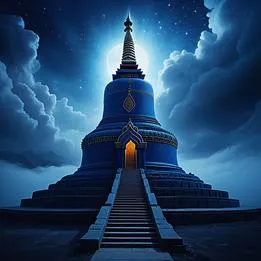
Buddhist Stupa Dream Meaning
A Buddhist stupa represents a physical manifestation of spiritual enlightenment and a pathway to achieving Nirvana.
Common Appearances & Contexts
| Context | Emotion | Interpretation |
|---|---|---|
| Walking around a stupa | Peace | This may signify a desire for inner peace or resolution of current life challenges. |
| Meditating in a stupa | Elation | Indicates a deep connection with spirituality and a longing for enlightenment. |
| Building a stupa | Achievement | Reflects a personal investment in one’s spiritual or creative pursuits. |
| Encountering a stupa in nature | Wonder | Represents the merging of inner peace with the beauty of nature. |
| Receiving a prayer wheel at a stupa | Hope | Symbolizes the offering of prayers or intentions for yourself or others. |
| Witnessing a stupa collapse | Fear | Could indicate anxieties about losing faith or the fragility of belief systems. |
| Decorating a stupa | Joy | Symbolizes participation in community and culture, reinforcing personal identity. |
| Stumbling upon a hidden stupa | Surprise | Might signify discovering hidden aspects of oneself or the quest for deeper truths. |
| Traveling to a famous stupa | Anticipation | Represents a journey towards knowledge and self-awareness. |
| Standing in front of a stupa under a full moon | Reflection | May represent a period of contemplation and inner clarity. |
Interpretive Themes
Spiritual Journey
high ConfidenceStupas mark important sites of spiritual significance, guiding seekers on their quest.
Sacred Spaces
high ConfidenceStupas serve as tangible connections to the divine and collective memory.
Symbol of Unity
medium ConfidenceStupas often embody principles that unite diverse communities.
Cultural Heritage
medium ConfidenceStupas are historical landmarks that tell the stories of Buddhist cultures.
Transformation
high ConfidenceVisiting a stupa is often associated with personal transformation and awakening.
Cultural Lenses
Buddhist Perspective
Full Hub →Stupas were originally mounds to enshrine relics of the Buddha and his disciples.
Emotional function: Induces feelings of peace and connection to higher ideals.
Eastern Asian Perspective
Full Hub →Stupas evolved into pagodas and became symbols of good fortune.
Emotional function: Inspires serenity and hope.
Asian Cultures Perspective
Full Hub →Stupas are integral to temple complexes and often house Buddha statues.
Emotional function: Facilitates communal harmony and celebration.
Cultural Narratives Perspective
Full Hub →Stupas are referenced in various cultural texts and stories as symbols of wisdom.
Emotional function: Encourages introspection and growth.
Hindu Perspective
Full Hub →Though primarily Buddhist, some stupas are associated with Hindu deities.
Emotional function: Bridges spiritual practices across traditions.
What is Your Dream Archetype?
Beyond this symbol, your soul carries a distinct pattern. Take the 2-minute quiz to discover your archetypal personality.