Zmey Gorynych Myth Meaning & Symbolism
A three-headed dragon of chaos demands tribute, until a hero, often Ivan, must confront it to restore cosmic and personal order.
The Tale of Zmey Gorynych
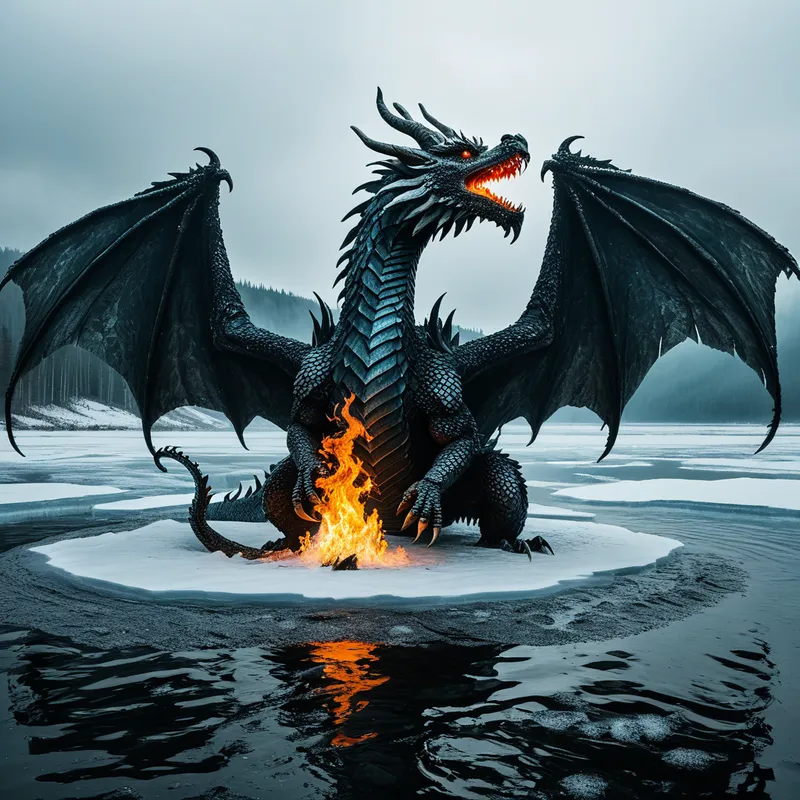
Listen, and hear the tale that the old pines whisper when the wind comes from the north. In a time when the world was younger and magic clung to the earth like morning mist, there was a kingdom shadowed by a great terror. From the Gorynych Mountain, or from the depths of the Smorodina River, it came: the Zmey Gorynych. Its body was a fortress of scales, black as a starless midnight and hard as forged iron. Three heads it bore, each a crown of malice—one breathed licking tongues of fire that could char a forest to ash, the second spewed a venomous green fog that wilted life itself, and the third exhaled a freezing gale that turned hope to ice.
The beast’s shadow fell upon the villages, and its demand was a cruel toll. Not gold or grain, but the fairest maiden of the land, offered up in tribute to sate its endless hunger. Grief became the season’s harvest. The people’s songs turned to dirges, their hearth-fires burned low with dread. The king, his heart a hollow drum of despair, saw his own daughter, the radiant Vasilisa the Wise, chosen by fate’s cruel lot.
But in every age, when the darkness grows too thick, a light is kindled. He came not with an army, but alone. He might be called Ivan Tsarevich, or simply Ivan, the farmer’s youngest son. His weapon was not just a sword of fine steel, but a heart stitched with courage and a mind sharpened by the counsel of magical helpers—a wise Grey Wolf, or a Baba Yaga who gave him a quest in exchange for her aid.
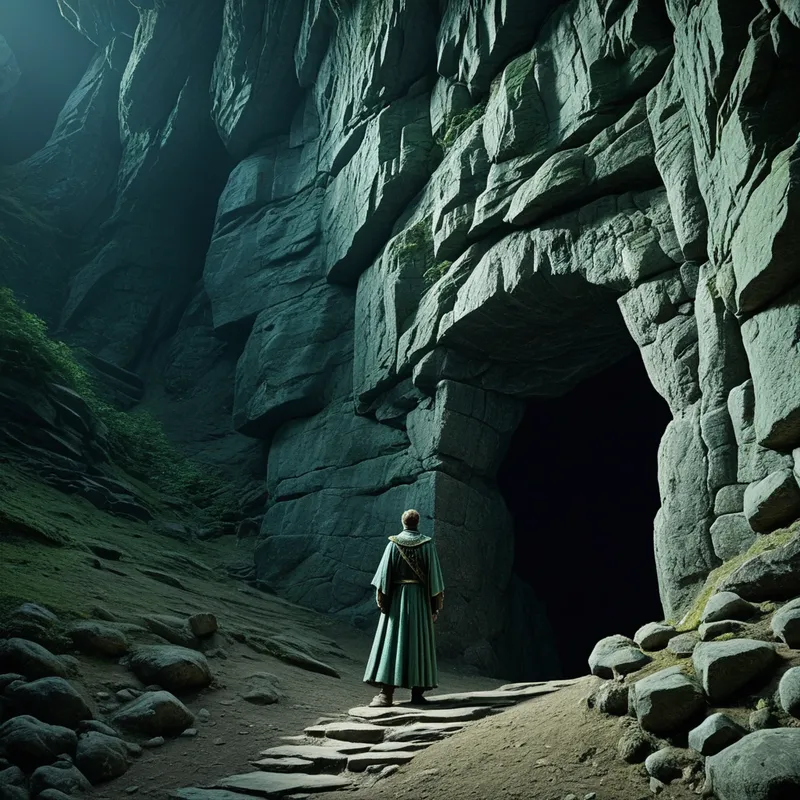
His journey was the world’s wound. He crossed the fiery river, navigated forests where the trees grasped at him, and climbed the treacherous mountain where the dragon made its lair—a cave stinking of sulfur and old bones, glittering with stolen gold and the silent tears of captive princesses. The battle was not a single clash, but a terrible dance. As Ivan struck off one thrashing head, two more would grow in its place, a hydra of despair. The earth shook with their struggle; the sky wept lightning.
The secret, whispered by the ancient ones, was not merely brute force, but timing, cunning, and a touch of the otherworldly. To slay the Zmey truly, all three heads must fall at once, or its life-force—a hidden egg or a vital spark—must be found and destroyed. With a final, mighty blow, or by crushing the dragon’s heart hidden far away, the hero prevailed. The monstrous form shuddered, collapsed, and melted into the earth from whence it came. The captives were freed, the tribute ended, and the land, breathing a sigh as deep as time, began to heal. Ivan returned not just with a bride, but with a kingdom restored to wholeness, the balance between chaos and order painfully, heroically, re-forged.
Cultural Origins & Context
The myth of Zmey Gorynych is not a single story, but a deep, resonant pattern woven into the fabric of East Slavic, particularly Russian, Ukrainian, and Belarusian, folklore. It belongs to the rich oral tradition of the skazka (wonder-tale), passed down through generations by village storytellers during the long winter nights. These tales were not mere entertainment; they were a communal psychic toolkit, a way to explain the terrifying caprices of nature—wildfires, plagues, invasions—and to model the values of courage, resilience, and communal sacrifice.
The Zmey is a quintessential “alien” invader myth. Scholars often link its rise in prominence to the period of the Mongol-Tatar invasions (the Tatar Yoke), where the relentless, fire-breathing, tribute-demanding dragon became a potent symbol for a very real, oppressive foreign power. The hero who defeats it embodies the spirit of resistance and the longed-for national liberation. Furthermore, the myth taps into even older, pre-Christian strata of Slavic cosmology. The Zmey can be seen as a chthonic, chaotic force opposed to the celestial order of gods like [Perun](/myths/perun “Myth from Slavic culture.”/). Its demand for maidens may echo ancient, terrifying rituals of appeasement to unpredictable river or mountain spirits. The tale thus functions as a cultural palimpsest, where historical trauma is processed through an archetypal, mythological lens, providing a narrative container for collective fear and the hope for deliverance.
Symbolic Architecture
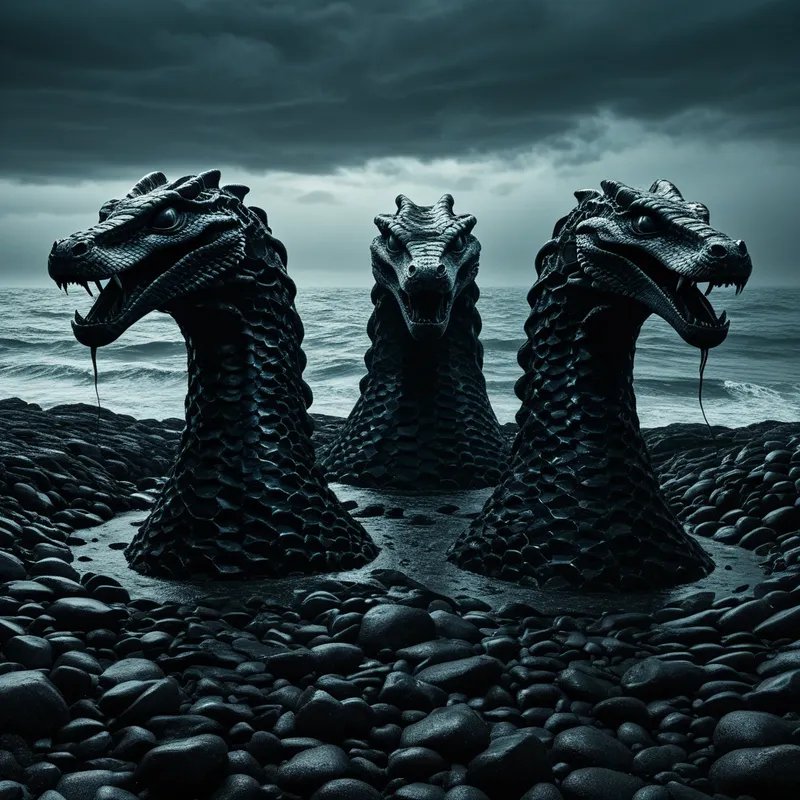
At its core, the myth of Zmey Gorynych is a masterful depiction of a monolithic, tripartite [obstacle](/symbols/obstacle “Symbol: Obstacles in dreams often represent challenges or hindrances in waking life that intercept personal progress and growth. They can symbolize fears, doubts, or external pressures.”/). The three heads are rarely identical; they often represent a trinity of overwhelming challenges.
The dragon is not merely an external monster, but the concretized form of a paralyzing complex—a three-fold threat that attacks the body, corrupts the spirit, and freezes the will.
The fire-breathing head symbolizes consuming, annihilating rage and [passion](/symbols/passion “Symbol: Intense emotional or physical desire, often linked to love, creativity, or purpose. Represents life force and deep engagement.”/)—the kind that burns bridges and leaves only ash. The poisonous head represents insidious, corrupting influence—doubt, cynicism, or a venomous ideology that slowly kills hope and [connection](/symbols/connection “Symbol: Connection symbolizes relationships, communication, and bonds among individuals.”/). The frost-breathing head is the force of stagnation, [despair](/symbols/despair “Symbol: A profound emotional state of hopelessness and loss, often signaling a need for transformation or surrender to deeper truths.”/), and emotional frigidity that locks [life](/symbols/life “Symbol: The symbol of ‘Life’ represents a journey of growth, interconnectedness, and existential meaning, encompassing both the joys and challenges that define human experience.”/) in perpetual [winter](/symbols/winter “Symbol: Winter symbolizes a time of reflection, introspection, and dormancy, often representing challenges or a period of transformation.”/). Together, they form a perfect [system](/symbols/system “Symbol: A system represents structure, organization, and interrelated components functioning together, often reflecting personal or social order.”/) of oppression, demanding the ultimate tribute: the sacrifice of one’s future (the maiden as potential, as new [life](/symbols/life “Symbol: The symbol of ‘Life’ represents a journey of growth, interconnectedness, and existential meaning, encompassing both the joys and challenges that define human experience.”/), as the [soul](/symbols/soul “Symbol: The soul represents the essence of a person, encompassing their spirit, identity, and connection to the universe.”/)‘s vitality).
The [hero’s journey](/symbols/heros-journey “Symbol: A universal narrative pattern representing personal transformation through trials, discovery, and return with wisdom.”/)—aided by magical helpers—models the necessity of seeking resources beyond the ego. The Baba Yaga represents the feared but necessary wisdom of the unconscious, the wild, instinctual [knowledge](/symbols/knowledge “Symbol: Knowledge symbolizes learning, understanding, and wisdom, embodying the acquisition of information and enlightenment.”/) required to navigate a [crisis](/symbols/crisis “Symbol: A crisis symbolizes turmoil, urgent challenges, and the need for immediate resolution or change.”/). The battle itself, where heads regrow, illustrates the futility of addressing only one [aspect](/symbols/aspect “Symbol: A distinct feature, quality, or perspective of something, often representing a partial view of a larger whole.”/) of a deep-seated [problem](/symbols/problem “Symbol: Dreams featuring a ‘problem’ often symbolize internal conflicts or challenging situations that require resolution and self-reflection.”/); a partial victory often leads to a more formidable resurgence. True victory requires a simultaneous, integrated strike or finding the “hidden egg”—the vulnerable, nascent core of the complex from which it draws its power.
The Dreamer’s Resonance
When the pattern of Zmey Gorynych stirs in the modern dreamer’s psyche, it signals a profound confrontation with what Carl Jung termed the Shadow—but a Shadow that has coalesced into a seemingly insurmountable, multi-fronted crisis. This is not a dream of a simple snake, but of a systemic dragon.
The dreamer may feel the “tribute” being extracted: a draining job, a toxic relationship, or a consuming addiction that demands their vitality, their “maiden” essence of joy and creativity. The somatic experience can be one of literal suffocation (the poison), burning anxiety (the fire), or a cold, numb paralysis (the frost). The dream is mapping a state of siege. The appearance of the dragon often coincides with life periods where three major areas—perhaps work, family, and health—simultaneously demand impossible sacrifices, creating a feeling of being stalked by a monolithic disaster. The dream is the psyche’s dramatic, exaggerated portrayal of this felt reality, insisting that the situation can no longer be appeased with periodic tributes. It demands a hero’s response.
Alchemical Translation
The alchemical journey of Individuation is mirrored perfectly in the myth. The initial state is one of nigredo—the blackening, the kingdom in despair, the ego dominated by the dragon-complex. The call to adventure is the first stirring of the Self, refusing further sacrifice.
The dragon’s hoard in the cave is the treasure of the psyche guarded by the Shadow—the captive talents, energies, and potentials we have disowned and which the complex now controls.
The journey to the mountain is the conscious descent into the unconscious (solutio—crossing the river, coagulatio—navigating the solid forest). Consulting Baba Yaga or the Wolf is engaging with the archetypal wisdom of the anima/animus or the trickster, accepting guidance that does not come from the rational ego. The battle is the fiery separatio and calcinatio—the brutal, painful work of differentiating oneself from the complex, of “cutting off heads,” of enduring the heat of confrontation.
The critical alchemical stage is the coniunctio, the sacred marriage. This is symbolized not only by Ivan wedding the freed princess but by the hero integrating the threefold nature of the dragon itself. He does not become the dragon, but he must understand and master the energies it represented: to wield fire (passionate action) without being consumed, to discern poison (critical thought) without being corrupted, and to endure frost (solitude, patience) without freezing. The final slaying is the rubedo, the reddening, the achievement of the philosopher’s stone—a psyche that has reclaimed its stolen vitality, integrated its shadow, and restored order from within. The returned hero rules a kingdom that is, in truth, his own fully realized Self.
Associated Symbols
Explore related symbols from the CaleaDream lexicon:
- Dragon — The monolithic, tripartite embodiment of a consuming complex or systemic oppression that demands sacrificial tribute from the individual or community.
- Hero — The archetypal force of the conscious ego, called to undertake a perilous journey into the unknown to confront and integrate a overwhelming shadow.
- Fire — Represents the annihilating, transformative, and purifying aspect of the dragon’s power and the ordeal the hero must pass through.
- Mountain — The daunting, elevated locus of the ultimate confrontation; symbolizing the high-stakes challenge, isolation, and the ascent towards a decisive clash.
- Cave — The deep, hidden repository of the dragon’s hoard and captive treasures, symbolizing the unconscious where repressed potentials and shadow contents are stored.
- Journey — The essential process of leaving the known world (the besieged kingdom) to acquire the wisdom, allies, and strength needed to face the core conflict.
- Sacrifice — The devastating tribute of vitality (the maiden) demanded by the unchecked complex, and later, the heroic sacrifice of safety and innocence required to end it.
- Forest — The liminal, mysterious realm of the journey where magical aid is often found, representing the instinctual, untamed psyche outside conscious control.
- Bridge — The perilous crossing from the ordinary world into the realm of myth and challenge, often guarded and symbolizing a point of no return.
- Heart — The hidden, vulnerable core of the dragon (sometimes an external egg or spark), the destruction of which brings true resolution, symbolizing the emotional root of a complex.
- Shadow — The psychological equivalent of the Zmey itself; the totality of the unconscious, repressed personal and collective contents that appear monstrous and threatening.
- Rebirth — The restoration of the kingdom and the freeing of captives after the dragon’s fall, symbolizing the renewal of psychic life and potential after a major integration.