Zipacna the Mountain Maker Myth Meaning & Symbolism
A myth of cosmic arrogance and cunning defeat, where a crocodilian earth demon's pride in creating mountains is undone by divine trickery and fate.
The Tale of Zipacna the Mountain Maker
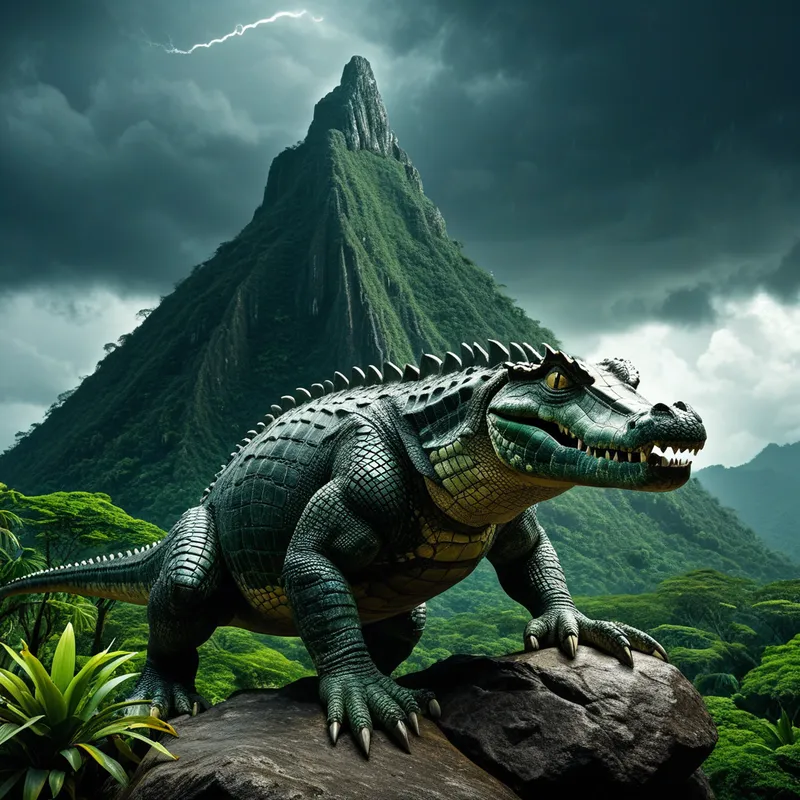
In the time of dawning, when the world was still soft and the gods were testing their creations, the earth itself could boast its own terrible children. From the deep, wet clay and the heat of the first volcanoes was born Zipacna. He was Pride of the Earth, a creature of immense shoulders and a hide like living stone. His boast echoed through the valleys: “I am the maker of mountains! I am the one who heaves the great ranges from the flatness of the world!”
And so he was. By day, he would wander the land, and where he saw fit, he would dig his claws into the soil, brace his back, and with a groan that shook the heavens, lift a new mountain into the sky. He took his rest in the cool mud of riverbanks, satisfied with his solitary, monumental work.
But the Hero Twins, those clever, destined youths, heard his boast. They saw not a creator, but a threat—a being of unchecked power and swelling arrogance that upset the balance. They devised a plan not of direct confrontation, but of cunning entrapment.
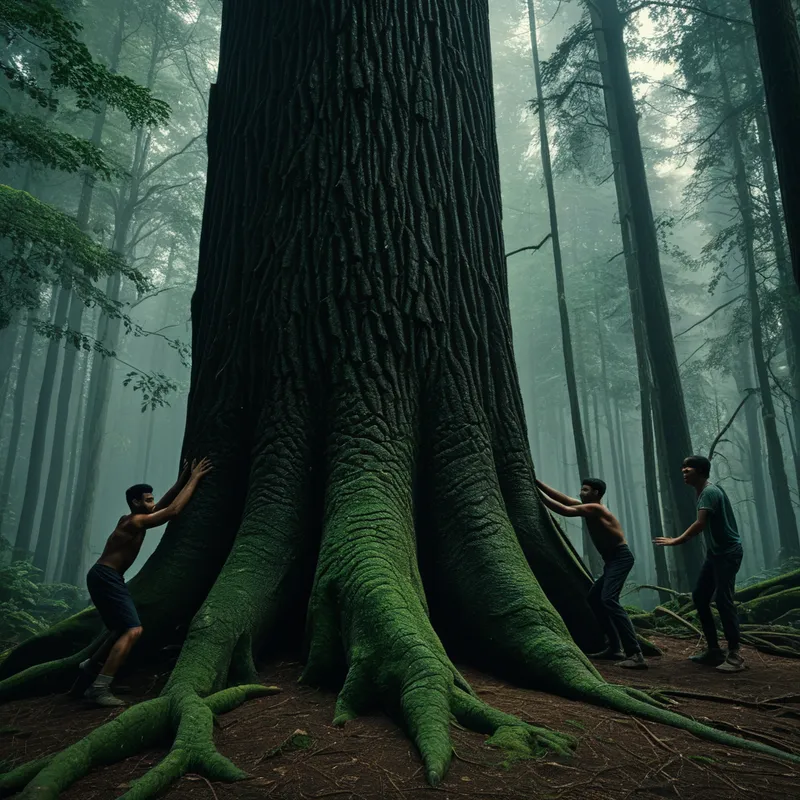
They found Zipacna by a river, as he lounged after raising a new peak. “Mighty Zipacna,” they called, their voices honeyed with false admiration. “We four hundred youths are building a great house. We have felled the mightiest tree for its central pillar, but our strength fails us. Could one of your power help us carry it?”
Zipacna, preening at their praise, agreed. He watched as the four hundred strained and failed to lift the massive trunk. With a dismissive chuckle, he walked to the tree, hoisted it onto his shoulder alone, and carried it effortlessly to the building site. The youths, feigning awe and gratitude, asked him to descend into the deep pit they had dug for the pillar, to position it just so. Suspicion flickered in Zipacna’s ancient eyes, but his pride drowned it out. He descended.
It was a trap. As he stood at the bottom, the four hundred began to hurl the immense trunk down upon him, and then a torrent of earth and stone, seeking to bury him alive and claim they had slain the mighty mountain-maker. But Zipacna was of the earth itself. He did not die. In the darkness, he carved out a small cavity for himself, and there he waited, listening to the triumphant shouts and celebratory drinking of the youths above who believed him dead.
Days later, when the revelry had reached its peak and the four hundred lay in a drunken stupor atop the mound that was his tomb, Zipacna acted. With a final, seismic heave, he collapsed the earth from below. The great house, the mound, and all four hundred youths plunged into the pit, and the earth swallowed them whole. The river was diverted to cover the site, forming a deep pool. Zipacna emerged, his vengeance complete, and returned to his mountain-making.
But the Hero Twins were not finished. They understood his nature now—his pride in his strength and his creations. They found him again, this time on the shore of a lake, boasting of the two great mountains he had just finished, Hunahpu and Xucaneb. “Truly, you are the greatest of the earth’s children,” they said. “We have heard of a mountain greater than any you have made, a mountain of irresistible flesh—a giant crab dwelling in a watery cavern. Surely even you could not lift such a living mountain?”
Stung by the challenge to his supreme identity, Zipacna scoffed. “Show me this crab-mountain, and I will crush it and bring it to you.” The twins led him to a cave by the waterside and pointed within. Driven by the need to prove his title as the ultimate lifter of weights, the maker of all things mountainous, Zipacna crawled into the dark cavern to find this legendary beast.
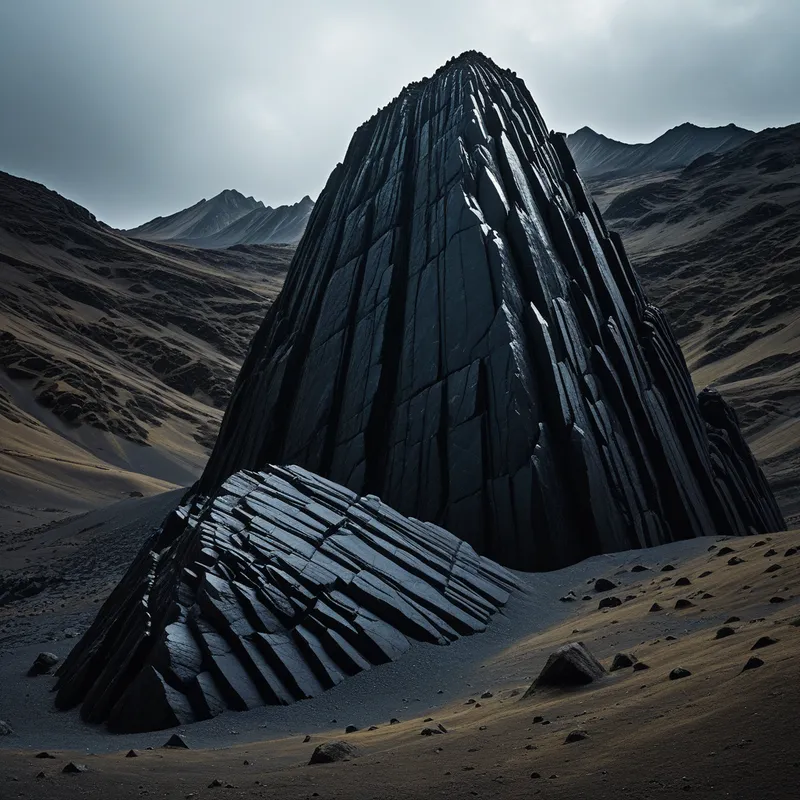
It was his final boast. The cavern was not a home to a crab, but a tomb prepared by the twins. As Zipacna entered fully, searching for his rival, the twins caused the entire mountain above the cavern to collapse upon him. The great maker of mountains was, at last, pinned and bound by the very substance of his pride. There, in the eternal darkness, he was transformed, his power contained, becoming one with the stone. The arrogant force of the earth was subdued, not by greater strength, but by the cunning that understood and turned his own nature against him.
Cultural Origins & Context
This myth is preserved in the Popol Vuh, the sacred narrative of the K’iche’ Maya. It was not merely a story but a foundational cosmology, recited by trained keepers of tradition to explain the ordering of the world. The tale of Zipacna sits within a sequence detailing the exploits of the Hero Twins, who systematically defeat the arrogant, disorderly beings of the previous world before the dawn of humanity.
Zipacna, along with his father Vucub Caquix and his brother Cabracan, represents the chaotic, pretentious forces of a prior creation that must be cleared away to establish a stable world fit for humans. The myth served a societal function of reinforcing order over chaos, intelligence over brute force, and communal destiny (embodied by the Twins) over individual, monstrous arrogance. It was a narrative tool for teaching about the dangers of hubris and the cleverness required to establish and maintain cosmic and social balance.
Symbolic Architecture
Zipacna is the [archetype](/symbols/archetype “Symbol: A universal, primordial pattern or prototype in the collective unconscious that shapes human experience, behavior, and creative expression.”/) of the primal creative force untethered from [consciousness](/symbols/consciousness “Symbol: Consciousness represents the state of awareness and perception, encompassing thoughts, feelings, and experiences.”/). He is raw [earth](/symbols/earth “Symbol: The symbol of Earth often represents grounding, stability, and the physical realm, embodying a connection to nature and the innate support it provides.”/)-power, the [capacity](/symbols/capacity “Symbol: A measure of one’s potential, limits, or ability to contain, process, or achieve something, often reflecting self-assessment or external demands.”/) to build and shape [reality](/symbols/reality “Symbol: Reality signifies the state of existence and perception, often reflecting one’s understanding of truth and life experiences.”/)—here, literally to raise mountains. His is not the ordered creation of a craftsman god, but the instinctual, boastful [eruption](/symbols/eruption “Symbol: A sudden, violent release of pent-up energy or emotion from beneath the surface, often representing transformation or crisis.”/) of potential. He represents a foundational, often disruptive, [aspect](/symbols/aspect “Symbol: A distinct feature, quality, or perspective of something, often representing a partial view of a larger whole.”/) of the psyche: the sheer will to manifest, to leave a [mark](/symbols/mark “Symbol: A ‘mark’ often symbolizes identity, achievement, or a defining characteristic in dreams.”/), to be recognized as a “maker.”
The mountain is not just a thing he builds; it is the solidified monument of his ego. To challenge his ability to lift is to threaten the very core of his identity.
The four hundred youths symbolize the collective, the nascent [social order](/symbols/social-order “Symbol: Dreams of social order reflect subconscious processing of hierarchy, belonging, and one’s place within collective structures.”/), or the multitude of conscious efforts that are futile against such a primal force. Their attempt to crush him with the [tree](/symbols/tree “Symbol: In dreams, the tree often symbolizes growth, stability, and the interconnectedness of life.”/)—the very thing he effortlessly carried—shows the [folly](/symbols/folly “Symbol: Folly represents whimsical, often impractical architecture that challenges traditional norms, symbolizing human folly and pride.”/) of trying to defeat a deep instinct with the tools of its own [strength](/symbols/strength “Symbol: ‘Strength’ symbolizes resilience, courage, and the ability to overcome challenges.”/). Zipacna’s survival and vengeance illustrate how repressed or attacked primal forces can erupt catastrophically, swallowing the conscious ego (the reveling youths) whole.
The true defeat comes only when the Twins use metis (cunning intelligence). They do not fight his strength; they seduce his pride. The crab is the perfect lure—another “[mountain](/symbols/mountain “Symbol: Mountains often symbolize challenges, aspirations, and the journey toward self-discovery and enlightenment.”/)” of flesh, a rival [creator](/symbols/creator “Symbol: A figure representing ultimate origin, divine power, or profound authorship. Often embodies the source of existence, innovation, or personal destiny.”/). By appealing to the very archetype he is enslaved to (“the Mountain Maker”), they guide him into a trap of his own making. His creative power becomes his [prison](/symbols/prison “Symbol: Prison in dreams typically represents feelings of restriction, confinement, or a lack of freedom in one’s life or mind.”/).
The Dreamer’s Resonance
When this myth stirs in the modern dreamscape, it often signals a confrontation with what we might call the Zipacna complex: an inflated, arrogant, and isolated creative or destructive power within. To dream of moving mountains with ease, or of being an unstoppable earth-shaker, can point to a burgeoning but unintegrated creative drive, one that is all potency but no direction, seeking only to prove itself.
Conversely, to dream of being trapped in a cave under a mountain, or of a monstrous, reptilian force lurking just beneath a tranquil landscape, speaks to the feeling of being crushed by one’s own unrecognized or unexpressed potential. The somatic experience is one of immense pressure, density, and weight—a feeling of being both powerful and imprisoned. The dream may be initiating a process of recognizing this brute force within, not to glorify or fear it, but to outwit its simplistic, boastful narrative. It asks: What “mountain” is your ego trying to build to prove its worth? And what clever, twin-like consciousness is needed to contain and transform that raw energy?
Alchemical Translation
The individuation process modeled here is the transmutation of blind creative arrogance into conscious, contained creative power. Zipacna represents the prima materia of the psyche—the raw, chaotic, and potent stuff of the unconscious that must be worked upon.
The first stage is the confrontation. The ego (the four hundred youths) naively tries to bury this force, only to be swallowed by it. This is the failure of repression. The second, alchemical stage is the circumvention and fixation performed by the Twins (the transcendent function, the reconciling symbol). They acknowledge the force’s nature (“You are the Mountain Maker”) and use that very identity to lead it to its own transformation.
The cave of the crab is the alchemical vas hermeticum, the sealed vessel where the transformation occurs. The collapsing mountain is the fixatio, the binding of the volatile spirit into a stable form.
Zipacna is not destroyed; he is pinned, bound, and transformed within the mountain. Psychologically, this is the integration of a titanic complex. The individual learns to contain that immense creative/destructive energy, not to let it roam freely and boastfully shape their outer world in chaotic monuments to the ego, but to have it become a foundational, structural part of the inner landscape. The power to “make mountains” is internalized. One no longer needs to boast of building peaks; one becomes the stable mountain, with all that potent earth-force now serving as its grounded, unshakable base. The rebel force is subdued to create inner order, enabling true creation to begin.
Associated Symbols
Explore related symbols from the CaleaDream lexicon:
- Mountain — The central symbol of Zipacna’s identity and his creations, representing both monumental achievement and the ultimate weight of ego that can become a tomb.
- Earth — Zipacna’s elemental nature and source of power, symbolizing the raw, unconscious, instinctual ground of being from which all form emerges.
- Cave — The place of entrapment and transformation, representing the introverted, containing space of the unconscious where primal forces are confronted and altered.
- Trickster — The archetype embodied by the Hero Twins, whose cunning intelligence is required to outwit and integrate brute, arrogant strength.
- Pride — The fatal flaw and driving force of Zipacna, symbolizing the inflation that occurs when a potent psychic force is identified with, rather than related to.
- Stone — The substance of Zipacna’s hide and his final prison, representing fixity, permanence, and the process of hardening potential into tangible reality.
- Hero — The archetype of the Twins, representing the conscious ego’s journey to confront and order chaotic unconscious elements for a greater purpose.
- Shadow — Zipacna as the powerful, arrogant, and destructive aspect of the personality that must be acknowledged and integrated rather than vanquished.
- Chaos — The state represented by Zipacna’s unchecked mountain-making, a creative but disordered force that must be bounded to allow for stable world-building.
- Thunder — The sonic equivalent of Zipacna’s earth-shaking power, a symbol of terrifying, awe-inspiring force that emerges from conflict in the heavens and the earth.
- Rebirth — Implied in Zipacna’s transformation; his binding is not an end, but a change of state, making his power available in a new, structured form for the world that follows.