Zhuge Liang Myth Meaning & Symbolism
The story of a scholar-hermit who became a master strategist, embodying the union of wisdom, foresight, and the tragic burden of destiny.
The Tale of Zhuge Liang
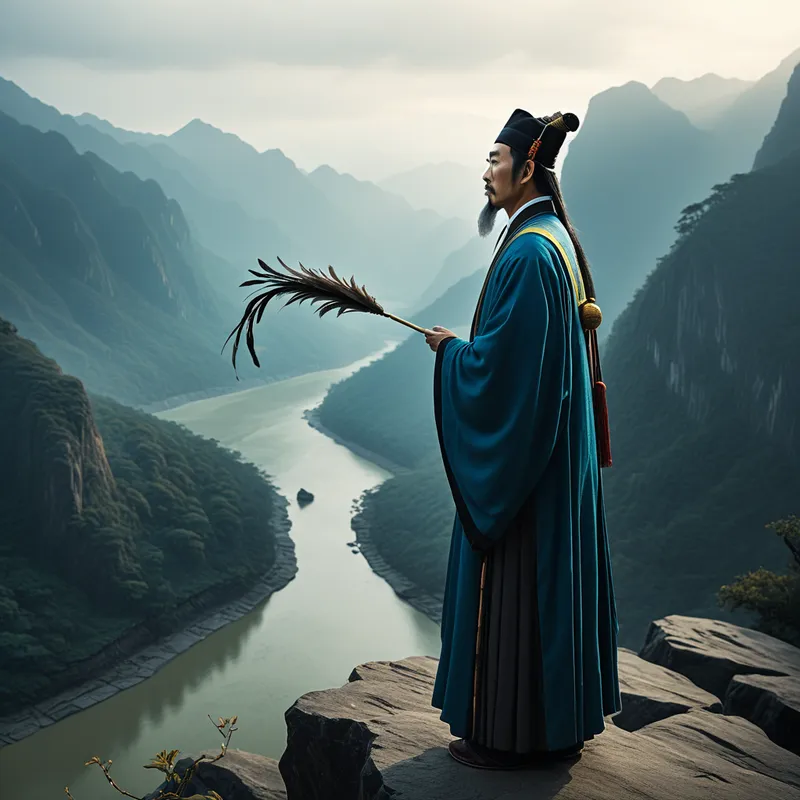
The land was broken, a tripartite heart torn by ambition. The Han dynasty’s crimson flame guttered, and from the chaos, three kingdoms rose like dragons from the mud. In this age of iron and fire, a name was whispered, not yet a roar but a sigh in [the bamboo](/myths/the-bamboo “Myth from Taoist culture.”/) groves: Kongming. He was the Sleeping Dragon of Longzhong.
He dwelled not in a palace, but in a thatched hut, surrounded by books and the sound of wind in the pines. His world was one of contemplation, of observing the patterns of heaven and earth in the flight of birds and the flow of rivers. His peace was shattered by three visits. A lord, Liu Bei, whose virtue was his only army, came seeking [the dragon](/myths/the-dragon “Myth from Chinese culture.”/)’s wisdom. Twice he was turned away, the scholar feigning sleep. On the third visit, with snow thick on the ground and patience worn to its core, the dragon awoke.
In a humble room smelling of ink and old paper, Kongming unrolled a map not of parchment, but of destiny. His voice was calm, a stream cutting through the noise of war. He spoke of the Three Kingdoms as a balance of forces, of securing a homeland, of alliances woven like silk and broken like rotten thread. He saw the future in the Eight Trigrams, a strategy born not of brute force, but of cosmic alignment. Liu Bei wept, for he had found not a general, but a polestar.
Thus began the legend. The Sleeping Dragon took flight. He conjured arrows from mist-laden boats, his silence more terrifying than any war drum. He arrayed stones on a riverbank that became an impenetrable maze, the Bagua Stone Array, confounding armies with pure geometry. He fanned flames that burned the ambitions of the mighty Cao Cao at the Battle of Red Cliffs, turning the very wind into a weapon. He was the mind behind the throne, the weaver of fate whose threads were soldiers, spies, and seasons.
Yet, for all his foresight, he could not outrun the exhaustion of destiny. In the windswept plains of the Wuzhang Plateau, he felt his life-force ebbing, his star dimming. Knowing his end was near, he performed one final rite. He lit the seven stars of the Northern Dipper within his tent, a desperate prayer to borrow time from the heavens themselves. The ritual failed; a soldier’s stumbled step extinguished the central flame. The dragon’s light went out. He died not in glorious battle, but on a campaign bed, his grand design for a reunited empire left unfinished, his final gaze fixed on a homeland he could not save. The great mind, which had moved armies like pieces on a board, was finally stilled by the immutable weight of heaven’s will.
Cultural Origins & Context
The figure of Zhuge Liang is a unique alchemy of history and myth, rooted in the tumultuous Three Kingdoms period. Historically, he was a brilliant chancellor and military strategist for the state of Shu Han. However, his transformation into a near-mythic sage began with his own writings, which displayed a formidable intellect, and was cemented centuries later in the 14th-century historical novel, Romance of the Three Kingdoms by Luo Guanzhong.
This novel, blending history, folklore, and drama, elevated Zhuge Liang to the status of a cultural superhero—the ultimate literati ideal. He became the embodiment of loyal service, strategic genius, and near-occult wisdom. The myth was passed down through storytelling, opera, and later film and television, serving a crucial societal function. In a culture that deeply values scholarship, planning, and virtuous conduct, Zhuge Liang became the archetypal model. He represented the power of the mind over the sword, of preparation over impulse, and of unwavering loyalty to a righteous cause, even in the face of inevitable failure. He is the tragic hero who fulfills his duty to the utmost, making his story a poignant lesson in integrity, sacrifice, and the acceptance of cosmic limits.
Symbolic Architecture
Zhuge Liang is not merely a clever tactician; he is a symbolic complex representing the [human](/symbols/human “Symbol: The symbol of a human represents individuality, complexity of emotions, and social relationships.”/) aspiration to comprehend and navigate the grand [patterns of existence](/symbols/patterns-of-existence “Symbol: Patterns of existence signify the interconnected and cyclical nature of life, symbolizing how experiences and events are recurrent and interrelated.”/). His myth is a [drama](/symbols/drama “Symbol: Drama signifies narratives, emotional expression, and the exploration of human experiences.”/) of [consciousness](/symbols/consciousness “Symbol: Consciousness represents the state of awareness and perception, encompassing thoughts, feelings, and experiences.”/) itself.
He is the intellect attempting to impose order on the chaos of the world, to see the hidden threads in the tapestry of events before they are woven.
His thatched cottage represents the [temenos](/myths/temenos “Myth from Greek culture.”/), the sacred [space](/symbols/space “Symbol: Dreaming of ‘Space’ often symbolizes the vastness of potential, personal freedom, or feelings of isolation and exploration in one’s life.”/) of introspection where [the self](/myths/the-self “Myth from Jungian culture.”/) withdraws from [the world](/myths/the-world “Myth from Tarot culture.”/)’s [noise](/symbols/noise “Symbol: Noise in dreams signifies distraction, confusion, and the need for clarity amidst chaos.”/) to commune with deeper principles. His [feather fan](/symbols/feather-fan “Symbol: A spiritual tool for purification, communication with higher realms, and gentle transformation, often associated with divine breath and subtle energy movement.”/) is not a tool for cooling, but a [symbol](/symbols/symbol “Symbol: A symbol can represent an idea, concept, or belief, serving as a powerful tool for communication and understanding.”/) of composed, detached control—the calm center of the storm. His strategies, like the borrowed arrows or the [Stone](/symbols/stone “Symbol: In dreams, a stone often symbolizes strength, stability, and permanence, but it may also represent emotional burdens or obstacles that need to be acknowledged and processed.”/) Sentinel [Maze](/symbols/maze “Symbol: A maze represents confusion, complexity, or a search for truth, often reflecting life’s challenges or inner turmoil.”/), symbolize [the principle](/symbols/the-principle “Symbol: A fundamental truth, law, or doctrine that serves as a foundation for a system of belief, behavior, or reasoning, often representing moral or ethical standards.”/) of [wu wei](/myths/wu-wei “Myth from Taoist culture.”/)—effortless [action](/symbols/action “Symbol: Action in dreams represents the drive for agency, motivation, and the ability to take control of situations in waking life.”/)—achieving monumental ends through understanding and leveraging natural forces and human [psychology](/symbols/psychology “Symbol: Psychology in dreams often represents the exploration of the self, the subconscious mind, and emotional conflicts.”/), rather than through direct, costly confrontation.
Psychologically, he represents the transcendent function, the faculty that mediates between the conscious ego and the unconscious, finding creative, unforeseen solutions to impossible problems. His ultimate failure, however, introduces the critical [shadow](/symbols/shadow “Symbol: The ‘shadow’ embodies the unconscious, repressed aspects of the self and often represents fears or hidden emotions.”/) of this [archetype](/symbols/archetype “Symbol: A universal, primordial pattern or prototype in the collective unconscious that shapes human experience, behavior, and creative expression.”/): the hubris of the mind. His attempt to extend his [life](/symbols/life “Symbol: The symbol of ‘Life’ represents a journey of growth, interconnectedness, and existential meaning, encompassing both the joys and challenges that define human experience.”/) by manipulating the stars is [the ego](/myths/the-ego “Myth from Jungian culture.”/)’s final, desperate rebellion against the Self’s broader, inscrutable [destiny](/symbols/destiny “Symbol: A predetermined course of events or ultimate purpose, often linked to spiritual forces or cosmic order, representing life’s inherent direction.”/). It is the tragedy of the sage who understands everything except the necessity of his own end.
The Dreamer’s Resonance
When the pattern of Zhuge Liang stirs in the modern dreamer’s [psyche](/myths/psyche “Myth from Greek culture.”/), it often manifests in scenarios of immense responsibility and intricate problem-solving. You may dream of being in a vast, empty control room facing a wall of monitors showing chaotic scenes, tasked with finding the one lever that will bring order. Or you may dream of preparing for a crucial meeting or exam, but your notes are written in an ancient, beautiful, yet incomprehensible script.
These dreams point to a psychological process where the conscious mind is being called to a higher level of strategic engagement with life’s complexities. The somatic feeling is often one of tense focus in the forehead and eyes, a “burning the midnight oil” sensation, coupled with a deep fatigue in the bones—the burden of foresight. It signifies a time when the dreamer is navigating a “campaign” in their waking life—a career move, a complex family dynamic, a creative project—that requires not just effort, but genius-level planning, patience, and perhaps a degree of benevolent cunning. [The shadow](/myths/the-shadow “Myth from Jungian culture.”/) appears in dreams of calculations that fail, of maps that lead nowhere, speaking to anxieties about over-intellectualization, analysis paralysis, or the fear that one’s best-laid plans will be undone by a single, unforeseen event.

Alchemical Translation
The individuation journey modeled by Zhuge Liang’s myth is the alchemy of the mind into an instrument of wisdom, and ultimately, its sacred surrender. The process begins in the [nigredo](/myths/nigredo “Myth from Alchemical culture.”/), the blackening: the chaotic, “warring states” period of the psyche, where conflicting desires, duties, and impulses tear the self apart. The call comes from the Liu Bei within—the principle of virtuous purpose—drawing the latent, sleeping wisdom (Kongming) out of its hermitage.
The albedo, the whitening, is the stage of purification and strategy. Here, the ego consciously engages in “grand planning.” It studies its own history, maps its complexes (the rival kingdoms within), and formulates a life strategy based on self-knowledge rather than reaction. It learns to use its feather fan—the observing consciousness—to cool heated emotions and direct energy wisely.
The ultimate transmutation is not victory, but the integration of failure. The sage’s power is perfected in the moment he acknowledges a will greater than his own brilliant design.
The [rubedo](/myths/rubedo “Myth from Alchemical culture.”/), the reddening or culmination, is paradoxically found in his death on the Wuzhang Plateau. This is the final alchemical stage where the brilliant, strategic consciousness—having served its purpose—must willingly reintegrate into the larger, mysterious pattern of the Self. The failed ritual to extend his life is the ego’s last stand. Its failure is not a defeat, but a liberation. The true “union of opposites” achieved is between human intellect and cosmic destiny, between tireless effort and profound acceptance. For the modern individual, the myth teaches that the highest wisdom is to plan with all one’s heart and mind, to engage fully with life’s battles, but to hold the blueprint lightly, ready to bow to the transcendent pattern that ultimately guides the ship, even when it sails into the final, unfathomable mist.
Associated Symbols
Explore related symbols from the CaleaDream lexicon: