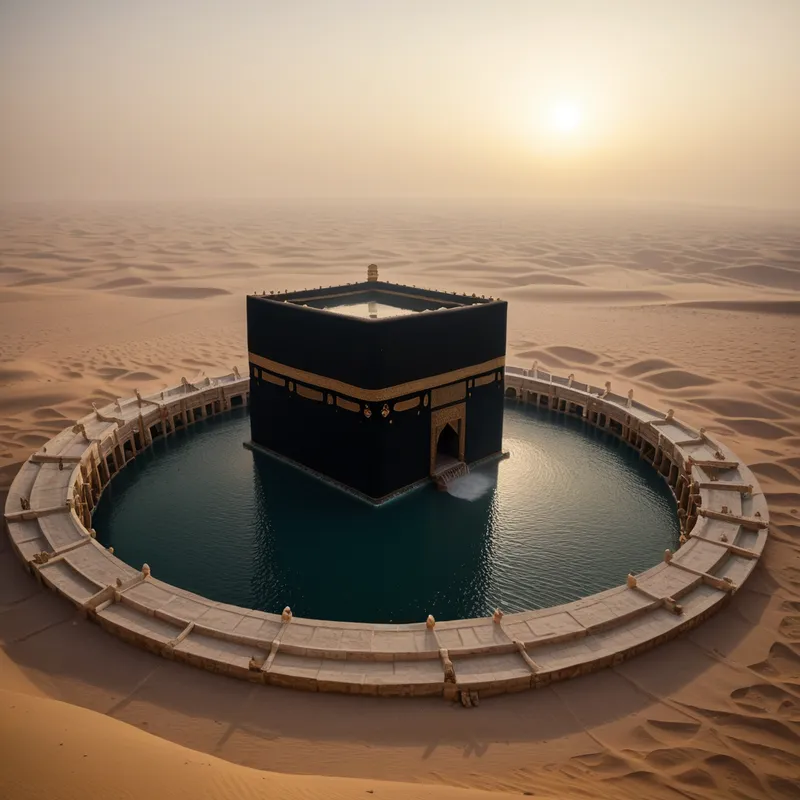
Zamzam Well Myth Meaning & Symbolism
A desperate mother's plea in the desert is answered by a miraculous spring, creating a sacred well of survival and divine grace.
The Tale of Zamzam Well
Hear now a tale born of sand and sun, of a cry that split the silence of [the void](/myths/the-void “Myth from Buddhist culture.”/) and called forth life from the heart of stone.
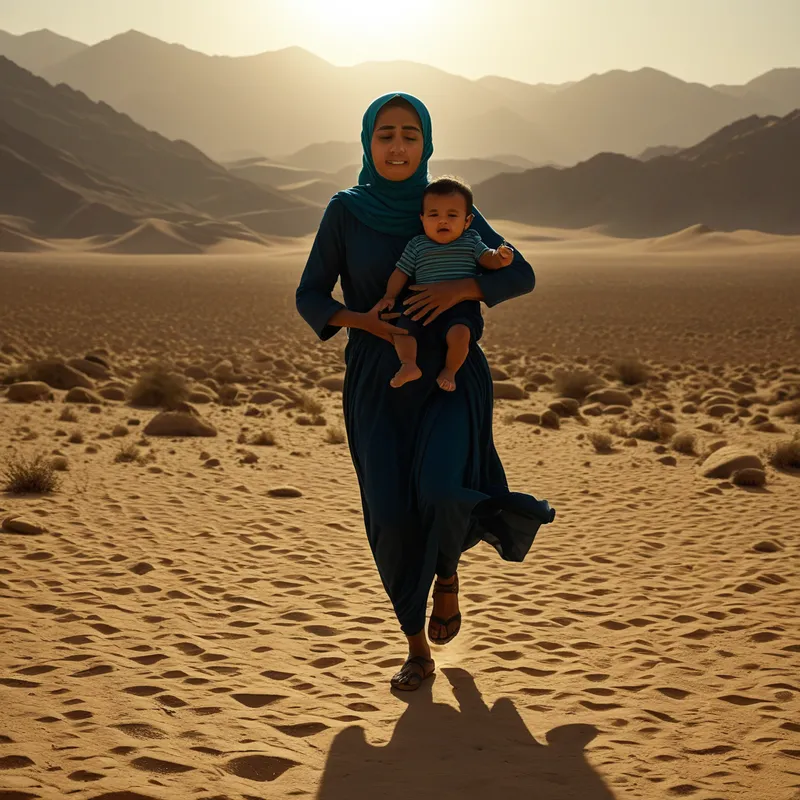
In the time when [the world](/myths/the-world “Myth from Tarot culture.”/) was younger and [the desert](/myths/the-desert “Myth from Biblical culture.”/) held its breath, there walked a woman named Hajar. She was not alone. In her arms, she carried her only son, Isma’il, a babe whose thirst was a silent plea against the relentless heat. They had been left in a barren valley, a place of cracked earth and whispering winds, by the command of God and the heavy heart of the prophet Ibrahim. His footsteps faded into the mirage, leaving behind only a skin of [water](/myths/water “Myth from Chinese culture.”/) and a pouch of dates.
The sun was a hammer on an anvil of sky. The water dwindled, drop by precious drop, until the skin was light and dry as a fallen leaf. The dates were gone. Hajar’s milk failed. Isma’il’s cries grew weak, fading into thin, desperate whimpers. The love in her heart was a vast ocean, but it could not wet his lips. Desperation, cold and sharp, coiled in her belly. She could not watch him die.
She laid him gently on the scorched earth and climbed the nearest rise, a mound called Al-Safa. She scanned the blinding emptiness. Nothing. No caravan, no ripple of green, no sign of mercy. She descended into the valley’s furnace and climbed the opposite hill, Al-Marwah. Again, nothing. Seven times she ran between those two hills, her feet burning, her breath ragged, her soul a single, focused prayer: Water. Life. For my son.
On the seventh run, as she stood upon Al-Marwah, a sound pierced the stillness. Not a cry, but a scrape. A gurgle. She turned, her heart a wild bird in her chest. There, at Isma’il’s feet, where he had kicked [the earth](/myths/the-earth “Myth from Hindu culture.”/) in his anguish, the sand was dark. A spring was bubbling forth, clear and cool, welling up from the deep, unseen veins of the world. She rushed to it, cupped her hands, and brought the water to her child’s lips. She drank herself, and as the water touched her, she knew it was not merely water. It was a reply. She cried out, “Zam! Zam!” – “Stop! Stop!” – as she tried to contain the blessed flow, to build a well around this miracle.
The well of Zamzam was born. Where there was only death, there now flowed life. Where there was despair, there now stood a sign for all who would come after.
Cultural Origins & Context
This is not merely a story of survival; it is the foundational narrative of a sacred geography. The myth originates from the pre-Islamic and early Islamic oral traditions of the Arabian Peninsula, specifically tied to the holy city of Mecca. It was passed down through generations, not by professional bards, but within the sacred lineage of the Quraysh and the keepers of the [Kaaba](/myths/kaaba “Myth from Abrahamic culture.”/).
Its primary societal function was etiological—it explained the origin of the Zamzam Well, the most vital source of water in an otherwise inhospitable valley, and the reason for Mecca’s existence as a settlement and later a sanctuary. Furthermore, it established the ritual of Sa’i</ab�r>, the commemoration of Hajar’s desperate search, which is now an integral pillar of the Hajj and Umrah pilgrimages. The myth served to sanctify the landscape, turning hills and a well into chapters of a divine drama, and to model the virtues of unwavering trust in God (Tawakkul) and relentless, active striving (Jihad of [the self](/myths/the-self “Myth from Jungian culture.”/)).
Symbolic Architecture
At its core, the myth of Zamzam is an archetypal [drama](/symbols/drama “Symbol: Drama signifies narratives, emotional expression, and the exploration of human experiences.”/) of the barren feminine confronting absolute [scarcity](/symbols/scarcity “Symbol: A dream symbol representing lack, limitation, or insufficient resources, often reflecting fears of deprivation or unmet needs.”/). The desert represents the ariditas of the [soul](/symbols/soul “Symbol: The soul represents the essence of a person, encompassing their spirit, identity, and connection to the universe.”/), a state of profound spiritual and emotional [drought](/symbols/drought “Symbol: Drought signifies a period of emotional scarcity, lack of resources, or feelings of deprivation leading to anxiety or intense longing.”/). Hajar is not a passive [victim](/symbols/victim “Symbol: A person harmed by external forces, representing vulnerability, injustice, or sacrifice in dreams. Often symbolizes powerlessness or moral conflict.”/); she is the active principle of the Great [Mother](/symbols/mother “Symbol: The symbol of ‘Mother’ represents nurturing, protection, and the foundational aspect of one’s emotional being, often associated with comfort and unconditional love.”/) in her most fierce and desperate [aspect](/symbols/aspect “Symbol: A distinct feature, quality, or perspective of something, often representing a partial view of a larger whole.”/)—the [mother](/symbols/mother “Symbol: The symbol of ‘Mother’ represents nurturing, protection, and the foundational aspect of one’s emotional being, often associated with comfort and unconditional love.”/) fighting for the survival of the future, symbolized by Isma’il.
The miracle does not occur in the waiting, but in the striving. The water springs not where Hajar stands praying, but where the child, the symbol of vulnerable potential, interacts with the barren earth.
Her seven runs between Safa and Marwah symbolize the complete cycle of [effort](/symbols/effort “Symbol: Effort signifies the physical, mental, and emotional energy invested toward achieving goals and personal growth.”/), the totality of [human](/symbols/human “Symbol: The symbol of a human represents individuality, complexity of emotions, and social relationships.”/) [action](/symbols/action “Symbol: Action in dreams represents the drive for agency, motivation, and the ability to take control of situations in waking life.”/). It is only after exhausting all visible, rational [options](/symbols/options “Symbol: The presence of multiple potential paths or choices, representing freedom, uncertainty, and the burden or opportunity of decision-making.”/) that the invisible, irrational grace emerges. The well itself is a [symbol](/symbols/symbol “Symbol: A symbol can represent an idea, concept, or belief, serving as a powerful tool for communication and understanding.”/) of the fons mercurialis, the [fountain](/symbols/fountain “Symbol: A symbol of purification, renewal, and abundance, fountains evoke themes of life-giving water and wisdom flowing freely.”/) of living [water](/symbols/water “Symbol: Water symbolizes the subconscious mind, emotions, and the flow of life, representing both cleansing and creation.”/) that arises from the [unconscious depths](/symbols/unconscious-depths “Symbol: The hidden, primordial layers of the psyche containing repressed memories, instincts, archetypes, and collective wisdom beyond conscious awareness.”/) when [consciousness](/symbols/consciousness “Symbol: Consciousness represents the state of awareness and perception, encompassing thoughts, feelings, and experiences.”/) has reached its limit. It represents unexpected sustenance, grace that arrives not from the horizontal [plane](/symbols/plane “Symbol: Dreaming of a plane often symbolizes a desire for freedom, adventure, and new possibilities, as well as transitions in life.”/) of [human](/symbols/human “Symbol: The symbol of a human represents individuality, complexity of emotions, and social relationships.”/) [effort](/symbols/effort “Symbol: Effort signifies the physical, mental, and emotional energy invested toward achieving goals and personal growth.”/) alone, but from the vertical [axis](/symbols/axis “Symbol: A central line or principle around which things revolve, representing stability, orientation, and the fundamental structure of reality or consciousness.”/) of the divine.
The Dreamer’s Resonance
When this myth pattern surfaces in modern dreams, it speaks to a profound somatic and psychological crisis of nourishment. The dreamer may find themselves in a vast, empty landscape—a desert, a dried seabed, an abandoned city. There is a palpable sense of thirst, of a vital resource being utterly depleted. This could correlate with burnout, creative block, emotional exhaustion, or a feeling that one’s inner “well” of compassion, ideas, or energy has run dry.
The figure of the crying child in the dream is crucial. It often represents a vulnerable, nascent part of the self—a new project, a fragile emotion, a need for care that the dreamer has neglected. The desperate running (the Sa’i) in the dream is the [psyche](/myths/psyche “Myth from Greek culture.”/)’s enactment of the frantic search for an external solution. The dream is a somatic rehearsal of the tension between despair and hope. The moment the water springs forth in the dream often brings an immense feeling of relief, a literal emotional catharsis that can sometimes awaken the dreamer. It signals that the sustenance must come from a deeper, more authentic layer of the self, and that the current conscious striving, while necessary, is not the source.

Alchemical Translation
For the modern individual navigating the desert of modern life, the Zamzam myth models the alchemical process of [nigredo](/myths/nigredo “Myth from Alchemical culture.”/) transforming into albedo. The initial state is one of abandonment and aridity—the feeling of being left with one’s own limited resources in a psychological wasteland. The conscious ego (Hajar) is tasked with preserving the nascent Self (Isma’il).
The active, repeated running (Sa’i) is the indispensable work of the conscious mind—the analysis, the seeking of help, the attempts to solve the problem. This work is not wasted; it is the necessary agitation that prepares [the vessel](/myths/the-vessel “Myth from Alchemical culture.”/). But the miracle, the transmutation, occurs at the point of surrender, at the intersection of human effort and divine grace, or in psychological terms, at the point where [the ego](/myths/the-ego “Myth from Jungian culture.”/)’s striving meets the autonomous, life-giving activity of the Self.
Individuation is not about finding a pre-existing oasis on the map. It is about the wellspring erupting in the exact spot of your deepest, most desperate need, transforming the very ground of your being.
To integrate this myth is to understand that our deepest sustenance—creativity, love, meaning—does not come from endless horizontal consumption or striving, but from allowing a vertical connection to the depths of our own being. We must perform our Sa’i, our diligent work, but we must also learn to kneel at the place of our greatest vulnerability, for it is there, where [the child](/myths/the-child “Myth from Alchemy culture.”/) kicks the earth, that the living water waits to break through. We become, like the well, a sacred source where the divine and the human meet.
Associated Symbols
Explore related symbols from the CaleaDream lexicon: