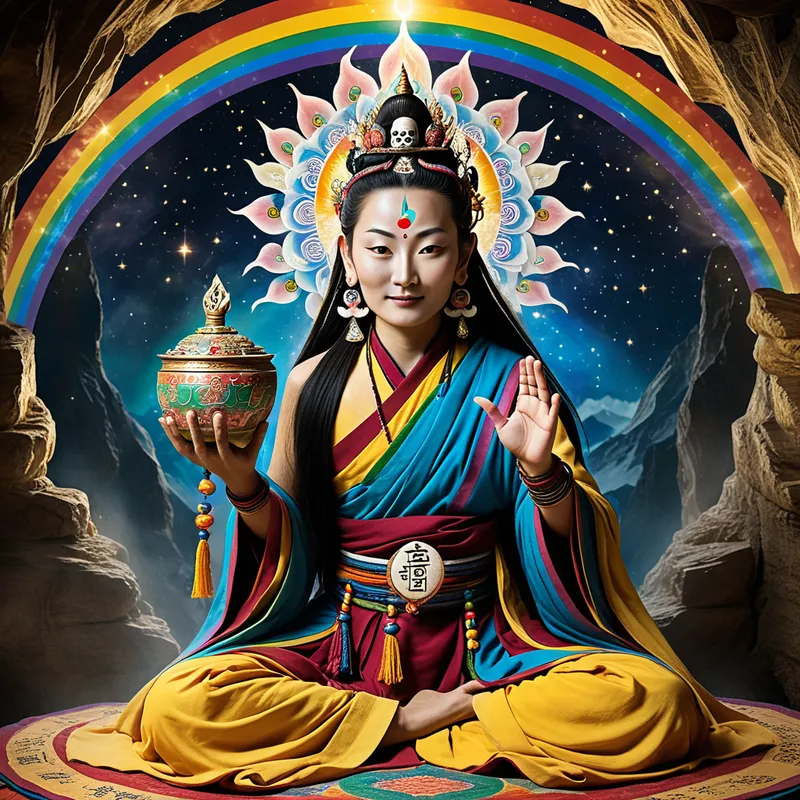
Yeshe Tsogyal Myth Meaning & Symbolism
The epic story of a princess who became the enlightened consort of Padmasambhava, embodying the alchemy of transforming worldly suffering into liberating wisdom.
The Tale of Yeshe Tsogyal
Listen. In the age when the snow lions still sang, in the land where the sky touches the earth, a daughter was born under auspicious signs. She was named Yeshe Tsogyal, and from her first breath, she carried the scent of lotus and the weight of a kingdom’s gaze. Her beauty was not of this earth; it was a mirror that reflected every man’s desire and every woman’s envy. They called her a princess, but she was a jewel locked in a gilded cage, a destiny written for her by the hands of kings and ministers.
Her youth was a tapestry of unwanted suitors and political gambits. She was given, not once, but twice, as a prize in the games of power—first to the King of Tibet, then to another. In the cold stone chambers of palace life, she felt the slow suffocation of a spirit meant for the open sky. The world saw a queen; she felt a prisoner. The turning point came not with a bang, but with a whisper—the whisper of a name that echoed through the high passes: Padmasambhava. He was the master from Oddiyana, a figure of impossible power and compassion, who walked with one foot in the human realm and one in the pure lands.
When she beheld him, the chains of her worldly life shattered. She prostrated herself, not before a man, but before the living embodiment of liberation. She begged him for teachings, for refuge, for the key to her own cage. Recognizing her as a dakini of supreme potential, Padmasambhava accepted her as his spiritual consort and foremost disciple. But the path was not of petals. To forge the diamond mind, one must first be broken.
Her trials were a descent into the very heart of samsara. She was cast out, persecuted, enslaved. She endured physical torment, starvation, and the deepest humiliations. In one harrowing ordeal, she was given as a servant to a hostile queen, who subjected her to ceaseless cruelty. Yet, in each moment of agony, Yeshe Tsogyal did not see an enemy, but a teacher. She did not feel hatred, but a boundless, fierce compassion. She transformed every blow into a mantra, every wound into a sacred mandala. Through the power of her practice, she turned poison into medicine, oppression into the fuel for her awakening.
Her journey culminated in years of solitary retreat in the wildest places—the caves of Maratika, the glaciers of Nepal. There, in absolute darkness and silence, she faced the final demons: not those outside, but the ghosts of attachment, aversion, and ignorance within. She mastered the inner yogas, achieved the rainbow body, and became a fully enlightened being, a Buddha in female form. She did not disappear into nirvana. She remained, becoming the guardian of the terma lineage, a fountain of wisdom for all future generations, the Mother of Tibetan Buddhism herself.

Cultural Origins & Context
The mytho-historical narrative of Yeshe Tsogyal emerges from the foundational era of Tibetan Buddhism in the 8th and 9th centuries. Unlike canonical sutras, her story is preserved in namtar, particularly her own Life and Liberation, which is itself considered a terma discovered centuries later. This mode of transmission is crucial. It frames her not merely as a historical figure, but as a timeless, archetypal force whose story is revealed when the world is ready for its wisdom.
The tale was told and retold by yogins in caves, by nuns in monasteries, and by storytellers around nomadic hearths. Its societal function was multifaceted: it established a powerful female lineage in a patriarchal religious structure, provided a model of devotion and perseverance for all practitioners, and encoded advanced tantric teachings within a compelling narrative. She became the paradigmatic disciple and the ultimate yogini, proving that enlightenment is not contingent on gender, social status, or an easy life, but on unwavering commitment to the path amidst the fires of worldly experience.
Symbolic Architecture
Yeshe Tsogyal is the psyche’s [journey](/symbols/journey “Symbol: A journey in dreams typically signifies adventure, growth, or a significant life transition.”/) from identified form to liberated essence. Her initial [life](/symbols/life “Symbol: The symbol of ‘Life’ represents a journey of growth, interconnectedness, and existential meaning, encompassing both the joys and challenges that define human experience.”/) as a beautiful [princess](/symbols/princess “Symbol: The symbol of a princess embodies themes of power, privilege, and feminine grace, often entailing a journey of self-discovery.”/) represents the ego’s entrapment in its own valued self-[image](/symbols/image “Symbol: An image represents perception, memories, and the visual narratives we create in our minds.”/)—admired, desired, yet utterly confined by the projections of others. Her [beauty](/symbols/beauty “Symbol: This symbol embodies aesthetics, harmony, and the appreciation of life’s finer qualities.”/) is not her flaw; her identification with it is the first [veil](/symbols/veil “Symbol: A veil typically symbolizes concealment, protection, and transformation, representing both mystery and femininity across cultures.”/).
The true alchemy begins not when we acquire something new, but when we consent to be shattered by the truth we have always sensed.
Her forced marriages symbolize the psyche’s bondage to collective expectations and familial complexes. Padmasambhava’s [arrival](/symbols/arrival “Symbol: The act of reaching a destination, marking the end of a journey and the beginning of a new phase or state.”/) represents the [eruption](/symbols/eruption “Symbol: A sudden, violent release of pent-up energy or emotion from beneath the surface, often representing transformation or crisis.”/) of the Self—the organizing, transcendent principle of the psyche—into the stagnant order of the conscious mind. He is the catalyst that makes the unbearable [situation](/symbols/situation “Symbol: The ‘situation’ symbolizes the junction between the subconscious and conscious realms, often reflecting the current challenges or dynamics in the dreamer’s waking life.”/) intolerable, forcing the [choice](/symbols/choice “Symbol: The concept of choice often embodies decision-making, freedom, and the multitude of paths available in life.”/) between slow [death](/symbols/death “Symbol: Symbolizes transformation, endings, and new beginnings; often associated with fear of the unknown.”/) and radical transformation.
Her horrific trials—enslavement, abuse, [exile](/symbols/exile “Symbol: Forced separation from one’s homeland or community, representing loss of belonging, punishment, or profound isolation.”/)—are the necessary nigredo, the blackening of the [alchemical process](/symbols/alchemical-process “Symbol: A symbolic transformation of base materials into spiritual gold, representing inner purification, integration, and the journey toward wholeness.”/). This is the descent into the [shadow](/symbols/shadow “Symbol: The ‘shadow’ embodies the unconscious, repressed aspects of the self and often represents fears or hidden emotions.”/). She does not bypass her karma; she enters into its darkest chambers and performs the ultimate act of psychic [integration](/symbols/integration “Symbol: The process of unifying disparate parts of the self or experience into a cohesive whole, often representing psychological wholeness or resolution of internal conflict.”/): she meets violence not with [counter](/symbols/counter “Symbol: A counter symbolizes boundaries, transitions, and the interplay between order and chaos, as well as a space for negotiation and interaction.”/)-violence, but with a [consciousness](/symbols/consciousness “Symbol: Consciousness represents the state of awareness and perception, encompassing thoughts, feelings, and experiences.”/) that transforms the experience itself. The external persecutors become mirrors of her own inner obstacles, and by mastering her [relationship](/symbols/relationship “Symbol: A representation of connections we have with others in our lives, often reflecting our emotional state.”/) to them, she masters herself.
The Dreamer’s Resonance
When the pattern of Yeshe Tsogyal stirs in the modern dreamer, it often manifests as a profound somatic and psychological ordeal. One may dream of being trapped in a gilded, luxurious prison; of being bartered or sold; of serving a cruel, capricious authority figure. The body may feel heavy, bound, or suffocated upon waking.
This is not a nightmare to be merely escaped. It is the psyche signaling a critical juncture in the process of individuation. The dreamer is being confronted with the “beautiful prison” of their current identity—a successful career that feels empty, a relationship that comforts but does not nourish the soul, a self-image that is admired but not authentic. The cruel figures in the dream often personify internalized critics, societal pressures, or familial mandates that the dreamer has passively served.
The Yeshe Tsogyal process in dreams asks the dreamer: What priceless aspect of your spirit are you trading for security? And are you ready to be dismantled, to become a servant of your own deepest truth, in order to become free?

Alchemical Translation
For the modern individual, Yeshe Tsogyal’s myth models the path of psychic transmutation through full engagement with life’s raw material. Our culture often promotes transcendence as an escape—rising above problems, positive thinking, avoiding “negativity.” Yeshe Tsogyal’s path is one of radical immanence.
The first step is Sacrificial Seeing: recognizing the cage within the castle. This is the painful, honest appraisal of where we are complicit in our own imprisonment for the sake of comfort, approval, or safety.
The second is Conscious Descent: agreeing to endure the breakdown. When life presents us with our own version of enslavement—a toxic job, a debilitating illness, a heartbreak—the alchemical approach is not to curse the fate, but to ask, “What within me must die here? What attachment is being burned away?” This is the fire that purifies the ore of the spirit.
The final, most profound step is Transmutive Practice: turning the base metal of suffering into the gold of wisdom. This is the active, daily work of reframing. It is using the anger from a betrayal to fuel boundaries. It is using the ache of grief to open the heart wider to compassion. It is using the humiliation of failure to cultivate genuine humility.
Enlightenment, in this frame, is not a distant heavenly state. It is the capacity to meet every moment, especially the shattered ones, with a consciousness that transforms it into a step on the path.
Yeshe Tsogyal becomes the Self in its fully realized, feminine aspect. She is the psyche that has digested all experience, even the most traumatic, and secreted out pure, luminous awareness. She is the proof that our deepest wounds, when fully inhabited with consciousness, become the very apertures through which the light of wisdom enters the world.
Associated Symbols
Explore related symbols from the CaleaDream lexicon:
- Mountain — The sacred, immutable ground of being and the arduous path of ascent that Yeshe Tsogyal climbs, representing the steadfast commitment required for spiritual awakening.
- Cave — The womb of transformation where she undertakes solitary retreat, symbolizing the necessary descent into the dark, introspective space of the unconscious for rebirth.
- Fire — The purifying element of her trials and her inner yogic heat (tummo), representing the transformative power that burns away illusion and refines the spirit.
- Water — Her name, “Primordial Wisdom Lake,” and the fluidity of her enlightened mind, symbolizing the receptive, mirror-like wisdom that reflects reality without distortion.
- Mirror — The core quality of her enlightened awareness, representing pristine cognition that reflects all phenomena perfectly without attachment or aversion.
- Lotus — The flower that blooms unstained from muddy water, symbolizing her enlightenment arising directly from the mire of worldly suffering and samsaric experience.
- Dragon — The fierce, primal energy of the dakini that she embodies, representing the untamed, powerful wisdom that guards the treasures of the deep psyche.
- Key — Her role as a custodian of the terma treasures, symbolizing the ability to unlock hidden wisdom within oneself and for future generations.
- Sacrifice — Her voluntary endurance of immense suffering for the sake of the Dharma, representing the necessary relinquishment of egoic comfort to achieve liberation.
- Rebirth — Her entire journey from princess to slave to enlightened Buddha, symbolizing the alchemical process of dying to one state of being to be born into a higher one.
- Light — The rainbow body luminosity she achieves, representing the ultimate transmutation of the physical and psychic elements into pure, radiant consciousness.
- Goddess — Her ultimate identity as the Great Bliss Queen, representing the fully actualized, sovereign feminine principle of enlightened wisdom and compassionate activity.