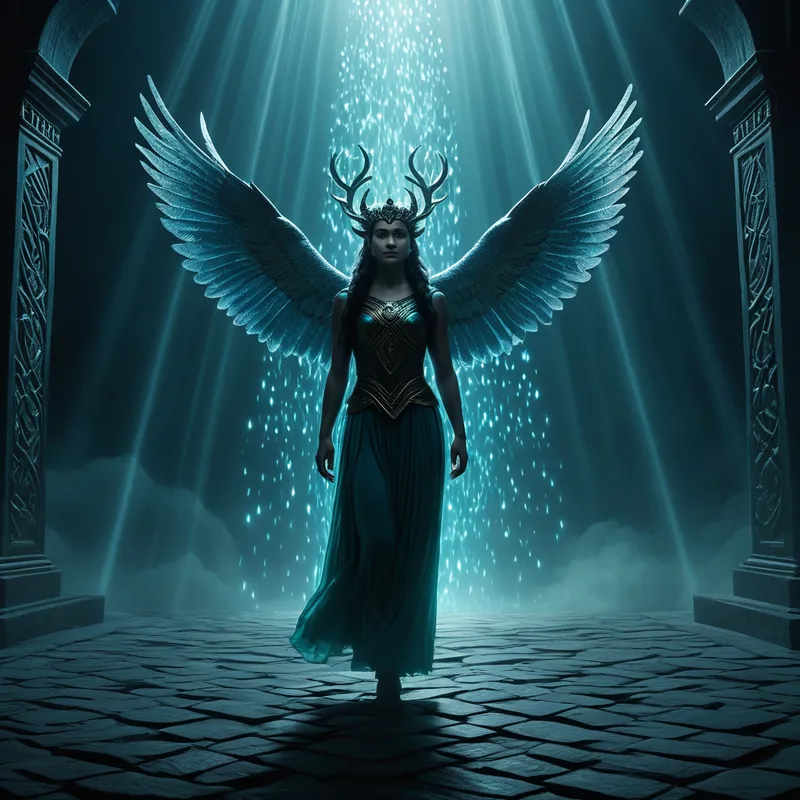
Yemoja's Great River
A Yoruba myth of Yemoja, goddess of rivers and motherhood, whose waters symbolize creation, protection, and the flow of life's mysteries.
The Tale of Yemoja’s Great River
In the beginning, there was the great expanse of [Olokun](/myths/olokun “Myth from Yoruba culture.”/), the deep, unknowable sea, a realm of boundless potential and silent depths. From this unity, consciousness stirred, and the Orisha came into being. Among them was [Yemoja](/myths/yemoja “Myth from Yoruba culture.”/), whose spirit was not yet bound to form. She was the yearning for nurture, the principle of containment, [the womb](/myths/the-womb “Myth from Various culture.”/)-space before the first breath.
The story tells that in those early days, Yemoja’s essence flowed as a great, celestial moisture, a nurturing mist that touched the edges of the nascent earth. But the solid world was parched and crying out. The first humans, shaped by the divine artisan [Obatala](/myths/obatala “Myth from Yoruba culture.”/), were fragile, their spirits thirsty for connection and their bodies in need of sustenance. Seeing this, Yemoja’s compassion, vast and deep as [the sea](/myths/the-sea “Myth from Greek culture.”/) from which she originated, swelled within her. She could not remain formless. With a sigh that became the first rain, she poured herself into [the earth](/myths/the-earth “Myth from Hindu culture.”/), carving a path of surrender through stone and soil. Her being became the first great river, Ódo Ògùn, a silver ribbon of life cutting through the green flesh of [the world](/myths/the-world “Myth from Tarot culture.”/).
This was no gentle act. It was a sacrifice of cosmic unity for earthly purpose. Where her waters flowed, the hard earth softened. Barren fields drank deeply and became fertile. Roots found purchase, and the first thick forests whispered along her banks. Villages sprang up where her curves offered protection, and the people learned to listen to her many voices: the chatter of the shallows was her laughter; the deep, humming pools were her lullabies; the roaring rush over rocks was her righteous anger when boundaries were disrespected.
Yemoja became Mother of All, Iyá Òkòtò. Her river was not just [water](/myths/water “Myth from Chinese culture.”/); it was a flowing womb. From her depths, she birthed not only the first fish but also many of the other Orisha, who emerged from her waters to take their roles in the world. Her most famous child is perhaps Ṣàngó, the god of thunder and [justice](/myths/justice “Myth from Tarot culture.”/), whose fiery spirit was tempered in her cool, deep currents. In this, her tale holds a profound mystery: she is the source of both the nourishing stream and the consuming lightning, the unity that contains and gives birth to potent opposites.
Her river holds the secrets of life and the passage to what lies beyond. It is said that the souls of the dead, particularly children, return to her watery embrace, where she comforts them in halls of coral and [pearl](/myths/pearl “Myth from Chinese culture.”/). Thus, her waters are a complete cycle: the amniotic fluid of birth, the sustaining milk of life, and the final, merciful embrace in [death](/myths/death “Myth from Tarot culture.”/). To stand by Yemoja’s Great River is to stand at [the threshold](/myths/the-threshold “Myth from Folklore culture.”/) of all beginnings and all endings, witnessed by a goddess whose love is as relentless and shaping as the current.
Cultural Origins & Context
Yemoja (also spelled Yemọja, Iemanjá) originates from the Yoruba religious and mythological traditions of what is now southwestern Nigeria and parts of Benin and Togo. Her worship traveled across the Atlantic with the diaspora, where she became syncretized and profoundly influential in Afro-American religions such as Candomblé (as Iemanjá), Santería/Lucumí (as Yemayá), and Umbanda.
In her West African homeland, she is specifically associated with the Ógùn River in Nigeria, a real, geographical artery that gives her myth a tangible, earthly anchor. This connection underscores a fundamental Yoruba worldview: the divine is immanent, residing within the forces of nature. Yemoja is not a metaphor for a river; [the river](/myths/the-river “Myth from Buddhist culture.”/) is an aspect of Yemoja, a visible manifestation of her àṣẹ (divine authority and life-force).
Her primary domain is the river, but as the “Mother of All,” her influence extends to all waters and, by extension, to all life. She presides over fertility, childbirth, and the protection of women and children. This role is not one of passive gentility but of fierce, protective power. As the mother of many Orisha, she is the foundational matrix from which differentiation arises, making her central to the Yoruba understanding of creation as an ongoing, generative process. Her worship involves offerings of white flowers, perfumes, and melons placed upon the water, acts that honor her beauty, her nurturing nature, and her sovereignty over the boundary between the human world and the deep, ancestral waters.
Symbolic Architecture
Yemoja’s myth constructs a symbolic [architecture](/symbols/architecture “Symbol: Architecture in dreams often signifies structure, stability, and the framing of personal identity or life’s journey.”/) where [water](/symbols/water “Symbol: Water symbolizes the subconscious mind, emotions, and the flow of life, representing both cleansing and creation.”/) is the primary element of [consciousness](/symbols/consciousness “Symbol: Consciousness represents the state of awareness and perception, encompassing thoughts, feelings, and experiences.”/) itself—fluid, adaptive, [life](/symbols/life “Symbol: The symbol of ‘Life’ represents a journey of growth, interconnectedness, and existential meaning, encompassing both the joys and challenges that define human experience.”/)-giving, and capable of great destruction. Her Great [River](/symbols/river “Symbol: A river often symbolizes the flow of emotions, the passage of time, and life’s journey, reflecting transitions and movement in one’s life.”/) is the archetypal [conduit](/symbols/conduit “Symbol: A passage or channel that transfers energy, information, or substance from one place to another, often hidden or structural.”/), the medium through which [life](/symbols/life “Symbol: The symbol of ‘Life’ represents a journey of growth, interconnectedness, and existential meaning, encompassing both the joys and challenges that define human experience.”/), [spirit](/symbols/spirit “Symbol: Spirit symbolizes the essence of life, vitality, and the spiritual journey of the individual.”/), and [destiny](/symbols/destiny “Symbol: A predetermined course of events or ultimate purpose, often linked to spiritual forces or cosmic order, representing life’s inherent direction.”/) flow.
The riverbed is the structure of the psyche, carved by experience, but Yemoja’s water is the living consciousness that fills it, gives it purpose, and constantly reshapes it. She represents the dynamic, feminine principle that refuses stagnation.
Her motherhood transcends biological function to represent the very principle of container and [source](/symbols/source “Symbol: The origin point of something, often representing beginnings, nourishment, or the fundamental cause behind phenomena.”/). She is the [vessel](/symbols/vessel “Symbol: A container or structure that holds, transports, or protects something essential, representing the self, emotions, or life journey.”/) that holds, nourishes, and eventually releases life into its own form. This makes her a [goddess](/symbols/goddess “Symbol: The goddess symbolizes feminine power, divinity, and the nurturing aspects of life, embodying creation and wisdom.”/) of profound emotional [depth](/symbols/depth “Symbol: Represents profound layers of consciousness, hidden truths, or the unknown aspects of existence, often symbolizing introspection and existential exploration.”/); her waters are the wellspring of feeling, [intuition](/symbols/intuition “Symbol: The immediate, non-rational understanding of truth or insight, often described as a ‘gut feeling’ or inner knowing that bypasses conscious reasoning.”/), and the unconscious. To be “in Yemoja’s waters” is to be in a state of psychic fluidity, where rigid ego boundaries dissolve, and deeper, more ancient knowing can surface.
Furthermore, her dual [role](/symbols/role “Symbol: The concept of ‘role’ in dreams often reflects one’s identity or how individuals perceive their place within various social structures.”/) as life-giver and [receiver](/symbols/receiver “Symbol: The symbol of a ‘receiver’ typically signifies the act of receiving messages, connections, or energies from others.”/) of the dead paints a complete [picture](/symbols/picture “Symbol: A picture in a dream often symbolizes one’s perceptions, memories, or the desire to capture and preserve moments in time.”/) of the [caregiver](/symbols/caregiver “Symbol: A spiritual or mythical figure representing nurturing, protection, and unconditional support, often embodying divine or archetypal parental energy.”/) [archetype](/symbols/archetype “Symbol: A universal, primordial pattern or prototype in the collective unconscious that shapes human experience, behavior, and creative expression.”/). True care does not only foster growth but must also compassionately hold [loss](/symbols/loss “Symbol: Loss often symbolizes change, grief, and transformation in dreams, representing the emotional or psychological detachment from something or someone significant.”/), [grief](/symbols/grief “Symbol: A profound emotional response to loss, often manifesting as deep sorrow, yearning, and a sense of emptiness.”/), and [dissolution](/symbols/dissolution “Symbol: The process of breaking down, dispersing, or losing form, often representing transformation, release, or the end of a state of being.”/). Yemoja’s river accepts all, cleanses all, and carries all toward the great [ocean](/symbols/ocean “Symbol: The ocean symbolizes the vastness of the unconscious mind, representing deeper emotions, intuition, and the mysteries of life.”/) of Olokun, symbolizing the ultimate return to the undifferentiated source.
The Dreamer’s Resonance
For the individual [psyche](/myths/psyche “Myth from Greek culture.”/), Yemoja’s Great River flows as the inner current of emotional and creative life. To encounter her in dream or active imagination is to be called to attend to one’s own depths. She appears when the soul is parched, when the wells of compassion—for oneself or others—have run dry. She is the healing balm for emotional wounds, inviting the dreamer to immerse in self-nurture and release the tears that cleanse.
She also manifests when one stands at a life threshold: before a birth, a creative project, a major decision, or a period of mourning. Her presence signifies that one is held within a larger, nurturing process. The anxiety of change is reframed as the necessary current of a sacred river carrying you to your next destination. Resistance to her flow—symbolized by dams, polluted waters, or arid riverbanks in dreams—often points to emotional blockage, a refusal to feel, or a neglect of one’s intuitive, feminine side.
For those who identify with the caregiver archetype, Yemoja’s myth offers a crucial warning and empowerment. The caregiver’s shadow is the martyr, drained by giving without self-containment. Yemoja, as a self-sourced river, teaches that true nurturing power comes from an endless inner spring, not from a finite personal reservoir. She models boundaries (the riverbanks) that make the nurturing flow possible and powerful.

Alchemical Translation
The alchemical process mirrored in Yemoja’s tale is [solutio](/myths/solutio “Myth from Alchemical culture.”/)—dissolution into the primal waters. This is not destruction, but the necessary breaking down of rigid, outworn forms (the hardened earth) so that new life can be reconstituted. [The ego](/myths/the-ego “Myth from Jungian culture.”/), like a clod of dirt, must soften and yield to the transformative waters of the unconscious to become fertile ground.
The Great River performs the alchemical miracle of the aqua permanens, the permanent water: it is the agent of change that itself remains unchanged, the eternal feminine principle that gives form while remaining formless.
Her journey from the unified sea (Olokun) to the specific river is the divine individuation into matter. In psychological terms, it is the process by which diffuse potential (the oceanic unconscious) becomes a specific, flowing stream of conscious life and purpose. The reverse flow—the return of souls to her depths—is the enantiodromia, where life flows back into the source, carrying with it the experiences of its journey, to be integrated into the great, silent knowing of the deep.
To work with Yemoja is to engage in a psychic alchemy where tears become cleansing waters, intuition becomes a guiding current, and emotional depth becomes the very medium in which the lead of suffering is transmuted into the gold of wisdom.
Associated Symbols
Explore related symbols from the CaleaDream lexicon:
- River — The eternal flow of life, consciousness, and time, representing both a path to follow and [the force](/myths/the-force “Myth from Science Fiction culture.”/) that shapes the landscape of the soul.
- Mother — The archetypal source of life, nurture, and unconditional containment, from which all differentiation emerges and to which all returns for solace.
- Ocean — The primordial, undifferentiated unity and the vast unconscious, the source from which all individuated life like rivers is born.
- Womb — The sacred, creative container where potential is gestated and nourished before being ushered into manifest form.
- Circle — The symbol of wholeness, cycles, and eternity, reflecting the complete journey of life from source to manifestation and back to source.
- Door — A threshold between states of being, such as life and death, consciousness and the unconscious, or one phase of life and the next.
- Tears — The bodily waters of emotion, representing release, cleansing, and the liquid bridge between inner feeling and the outer world.
- Fish — The inhabitants of Yemoja’s depths, representing the fertile, often hidden, life of the unconscious and the souls of ancestors.
- Rebirth — The cyclical process of return and renewal, embodied by the river’s constant flow and its role in receiving and transforming the departed.
- Vessel — Any container that holds life-giving substance, symbolizing the feminine principle of receptive, nurturing containment.
- Moon — The celestial body governing tides and waters, reflecting the cyclical, intuitive, and reflective nature of the feminine divine.
- Rushing River — The dynamic, powerful, and sometimes overwhelming force of emotional or creative energy that cannot be dammed, only respected and navigated.