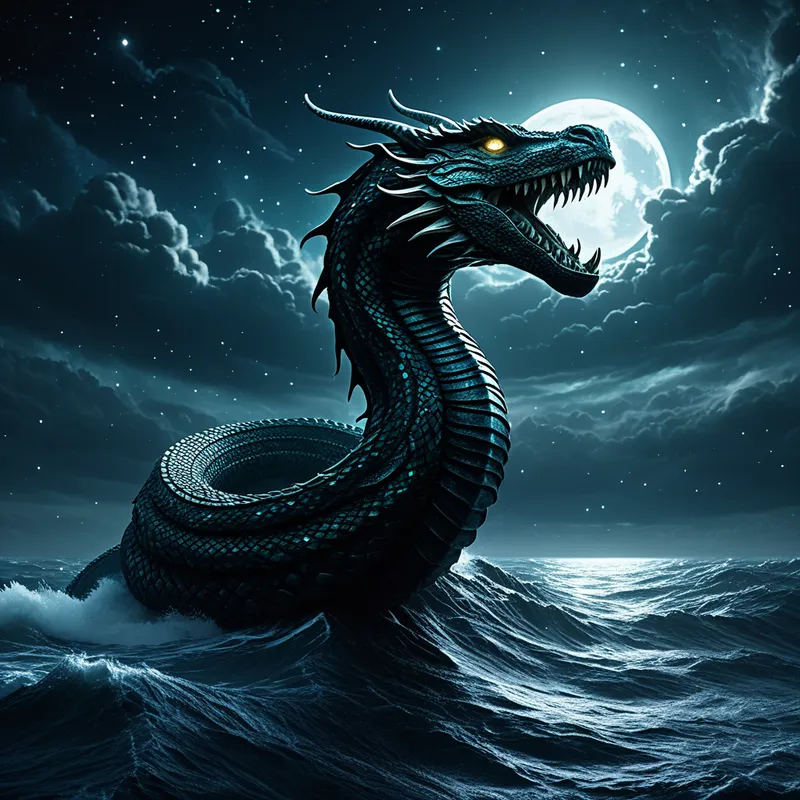
World Serpent/Jörmungandr Myth Meaning & Symbolism
The immense serpent cast into the sea by Odin, destined to encircle the world and rise at its end to battle Thor in the final twilight of the gods.
The Tale of World Serpent/Jörmungandr
Listen, and hear the tale of the great encircler, the doom that swims in the deep. In the time before time, when the Ginnungagap yawned and the first giants stirred, the All-Father, Odin, looked upon his children. Among them was Jörmungandr, a serpent of such monstrous and rapid growth that its coils threatened the very foundations of Midgard itself. It was a child of chaos, a living storm of scales and venom, its eyes holding the cold light of the abyss.
Fearing the unmaking of his new order, Odin acted. With a might born of dread, he seized the writhing beast and cast it from the high halls of Asgard
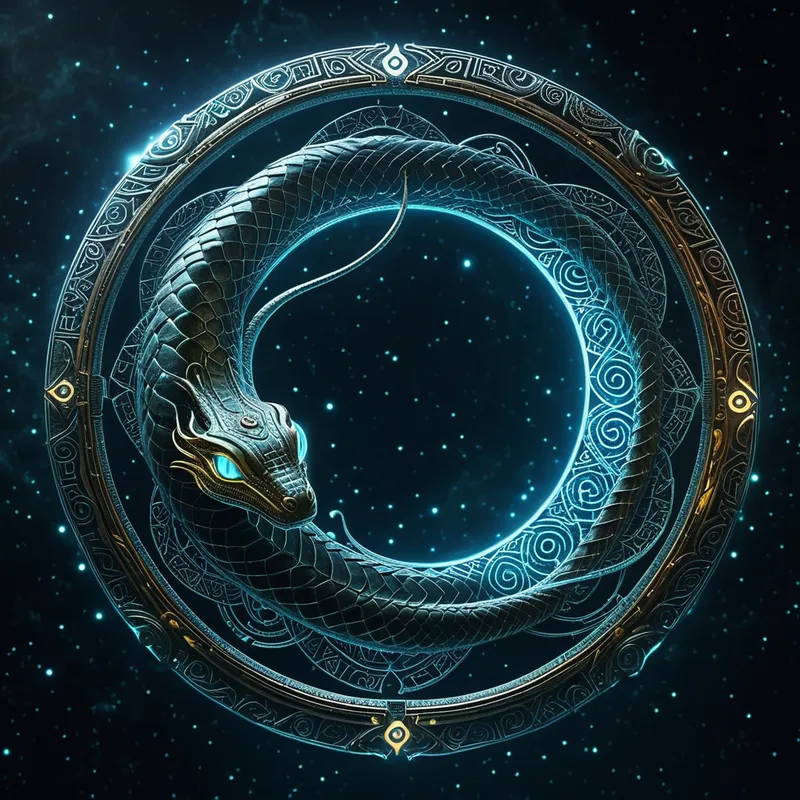
. Down, down it fell, through the windswept branches of Yggdrasil, past the realm of men, and into the vast, grey ocean that surrounds all lands. The sea boiled at its arrival. But the serpent did not drown. It grew. It grew to fit the expanse given to it, stretching its impossible length, tail seeking mouth, until it encircled the whole of the mortal world. There, in the sunless deeps, Jörmungandr bit its own tail, forming the Ouroboros, the living boundary between order and the outer chaos. Its rest was the world’s peace; its stirring, the world’s quake.
Yet, its fate was twined with that of the thunderer, Thor. Once, the god journeyed in disguise to the hall of the giant Útgarða-Loki. There, he was dared to lift a grey cat from the floor. Grinning, Thor thrust his hands beneath the beast, heaving with all his divine strength. He strained until his feet broke through the stone, his back arched like a drawn bow. Yet, he raised the cat only a single paw’s width. The giant laughed, for the cat was Jörmungandr itself, and Thor had made the encircling serpent tremble, causing the very oceans to slosh upon the shores.
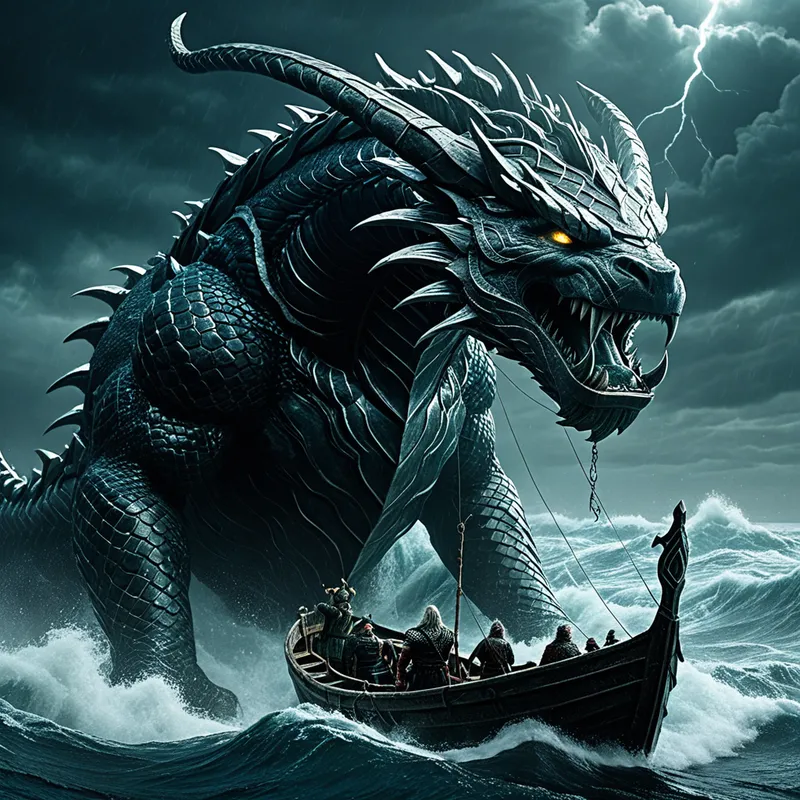
Their final meeting is woven into the tapestry of Ragnarök. When the stars fall and the sun grows black, the serpent will release its tail. The seas will heave and vomit forth the World Serpent, dripping poison and rage, to crawl upon the ravaged land. Thor, the protector, will answer the challenge. The air will crackle with his fury, the sky darken with his storm. They will meet on the final field, god and chaos made flesh. Thor’s hammer, Mjölnir, will find its mark, crushing the serpent’s skull. But as the great beast falls, it will exhale its last, a mist of venom that will engulf the thunder god. Victor and vanquished will fall together, their struggle the last, great breath of an age before the silence, and the waiting, begins again.
Cultural Origins & Context
This myth is a cornerstone of the Norse mythological corpus, primarily preserved in two 13th-century Icelandic texts: the Poetic Edda and the Prose Edda by Snorri Sturluson. These works systematized oral traditions that had circulated among Germanic peoples for centuries. The myth was not mere entertainment; it was a cosmological map and a theological framework. Skalds (poets) and storytellers would recite these tales in halls, using them to explain the natural world—earthquakes were the serpent’s stirring, sea storms its anger—and to reinforce a cultural worldview defined by cyclical conflict, inevitable fate (ørlög), and the heroic confrontation with chaos. The serpent’s containment by Odin mirrors the Norse understanding of civilization as a sacred enclosure (vé) carved from a hostile, giant-haunted wilderness.
Symbolic Architecture
Jörmungandr is the archetypal symbol of the contained chaos that defines reality. It is not evil, but a necessary, primordial force. By encircling Midgard, it does not threaten it from without, but defines it. The serpent is the boundary itself.
The Self is not a fortress against chaos, but the very circle that contains it. The serpent’s body is the horizon of our known world.
Psychologically, it represents the totality of the unconscious—immense, impersonal, and potentially annihilating if encountered directly without structure. Odin’s act of casting it into the sea is the ego’s necessary, initial act of repression or containment, creating a stable space (consciousness) in which to live. The serpent’s Ouroboric form symbolizes self-containment, eternity, and the cycle of life, death, and rebirth. Its venom represents the corrosive, transformative power of psychic truth, which can both poison and catalyze. The myth presents a universe where order (Asgard, consciousness) and chaos (the giants, the unconscious) are in a dynamic, tense, and ultimately inseparable relationship.
The Dreamer’s Resonance
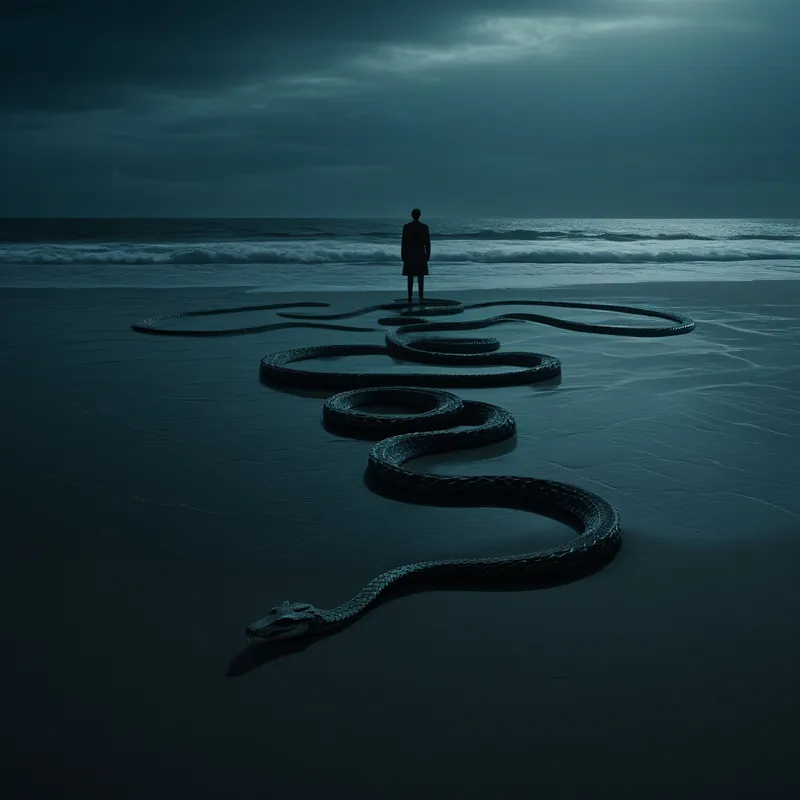
When the World Serpent surfaces in modern dreams, it rarely appears as a literal monster. It manifests as a feeling of being encircled, constrained, or bound by a situation with no beginning or end—a toxic job, a cyclical pattern of behavior, a pervasive anxiety that “the world is too much.” One may dream of vast, coiling shapes in deep water, of tidal waves, or of the ground itself undulating. Somatic sensations often accompany these dreams: a tightening in the chest or gut, a feeling of immense pressure, or nausea.
This is the psyche signaling that a contained, unconscious content has grown too large for its vessel and is demanding recognition. The dreamer is at the threshold where a long-repressed pattern, a “poison” from the past (a trauma, a complex), is threatening to break its bounds and flood into conscious life. The serpent in the dream is not attacking the dreamer; it is appearing to them. The psychological task is not to slay it, but to acknowledge its presence and immense scale—to understand what cyclical, self-perpetuating force has been holding one’s personal world in place, for both good and ill.
Alchemical Translation
The myth of Jörmungandr and Thor models the perilous, necessary stage of psychic transmutation where the conscious attitude (the heroic ego) must confront the full magnitude of the shadow it has helped to create. The individuation process requires us to “go fishing” for our personal Jörmungandr—to deliberately bait the hook and haul the terrifying, unconscious totality into the light of awareness, as Thor does on his fishing trip.
The goal is not victory, but the transformative encounter. The poison of the serpent and the lightning of the god must mix to create a new substance: conscious awareness of the whole self.
This confrontation at Ragnarök symbolizes the death of the old psychic structure. The ego (Thor) that identified solely as the heroic slayer of chaos must die, poisoned by the very truth it sought to master. Yet, from this mutual annihilation, the prophecies tell of a new, green world rising from the sea. Alchemically, this is the nigredo giving way to the albedo—the blackening of the old self leading to purification and renewal. For the modern individual, the myth teaches that wholeness is achieved not by forever banishing our inner chaos, but by recognizing it as the co-creator of our reality, the necessary circle that gives our world its form, and the source of the venom that, in measured doses, can catalyze our deepest transformation. We must learn to contain the serpent, and in the end, have the courage to meet it.
Associated Symbols
Explore related symbols from the CaleaDream lexicon: