Widow's Oil Jar Myth Meaning & Symbolism
A desperate widow, facing debt and ruin, finds her last jar of oil miraculously multiplied, transforming scarcity into overflowing abundance.
The Tale of the Widow's Oil Jar
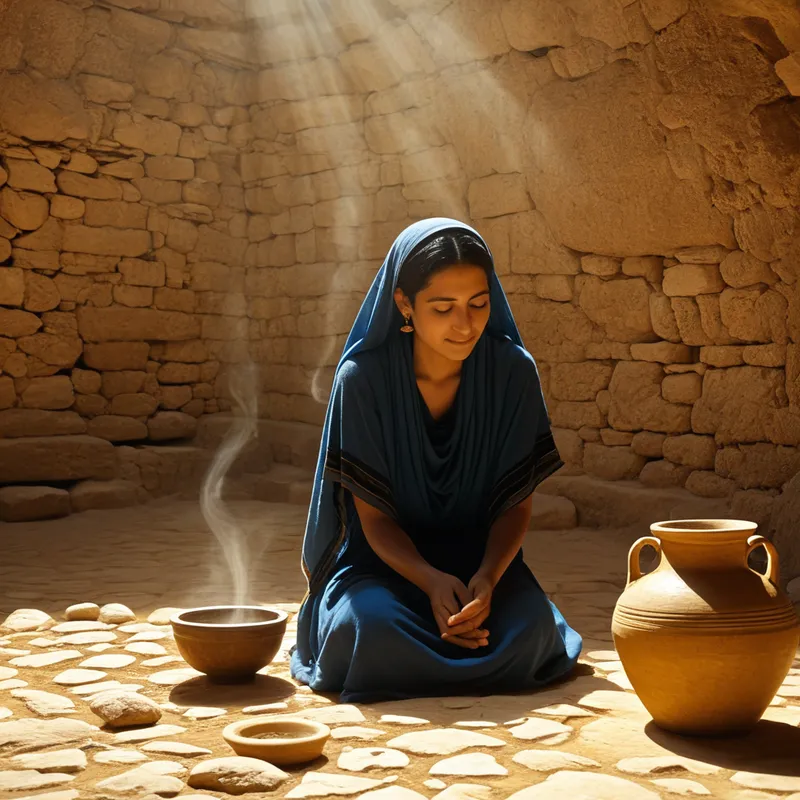
The sun was a merciless coin in a bleached sky, baking the dust of Zarephath into a fine, despairing powder. Within a house whose walls held only echoes of a lost laughter, a woman moved like a shadow. She was a widow, her name worn thin by grief, her world reduced to the trembling forms of her two sons and the hollow dread of a coming knock.
The creditor’s voice still rang in the silence, a cold, final decree. The debt, left by her husband, was a stone around their necks. “Your sons,” he had said, “will be taken. They will work off what you owe.” The law was a pitiless sun, and she stood directly beneath it, with no shade of a protector.
Her search was a ritual of ending. Fingers, calloused and familiar, traced the near-empty shelves. Her eyes, which had once held the light of a shared future, now scanned only for an end to the torment. They found it in a single, small jar. A little oil. Just enough, perhaps, for one last meal. A final act of care before the world broke in.
It was then that the stranger came. Not the creditor, but the prophet, Elijah, a man whose cloak seemed to hold the scent of wilderness and whose eyes held a quiet, terrifying fire. He asked her for water, and in her poverty, she moved to give it. Then he asked for bread.
Her breath caught. “As the LORD your God lives,” she whispered, the truth a bitter root on her tongue, “I have nothing baked, only a handful of meal in a bin, and a little oil in a jar. I am gathering two sticks, that I may go in and prepare it for myself and my son, that we may eat it, and die.”
The prophet’s voice was steady, a rock in her rushing river of fear. “Do not fear. Go and do as you have said; but first make me a little cake of it and bring it to me, and afterward make something for yourself and your son. For thus says the LORD, the God of Israel: ‘The jar of meal shall not be spent, and the jug of oil shall not be empty, until the day that the LORD sends rain upon the earth.’”
The air in the room changed. It was not a change one could see, but one the soul could feel—a subtle shift from the logic of scarcity to the terrifying possibility of a different arithmetic. Her hands, which moments before had moved toward an ending, now moved in a new faith. She took her last. She gave it away.
She mixed the meal. She poured the oil. The jar, which should have been emptied, felt strangely heavy. She baked the cake for the stranger. She returned to the jar. It was still there. The oil gleamed, a small, impossible sun in the clay darkness. She fed her son. The jar was still there.
A wild, fragile hope began to beat in her chest, a bird released from a cage. She called to her neighbors. “Bring vessels,” she said, her voice trembling with a new authority. “Empty vessels. Do not gather a few.”
They came, curious, bearing the hollow containers of their own lives. She took the jar, this humble, unremarkable vessel of her despair, and she began to pour. A stream of gold flowed into the first borrowed pot. Then the second. The third. The oil did not drip; it flowed. The jar was not drained; it was a source. Her sons rushed to bring more, their faces alight with a forgotten joy, as vessel after vessel was filled from the one that could not be emptied. The creditor’s shadow retreated before this rising tide of abundance. The last vessel was filled, and only then, as the prophet had spoken, did the oil stop.

Cultural Origins & Context
This story is preserved in the First Book of Kings (Chapter 17), a text that chronicles the turbulent history of the divided kingdoms of Israel and Judah. It emerges from a specific, desperate moment: a severe, multi-year drought, understood as divine judgment under the reign of the idolatrous King Ahab. The narrative functions on multiple cultural levels.
Firstly, it is a prophet legend, showcasing the authority and power of Elijah as a true messenger of Yahweh, in stark contrast to the prophets of the Canaanite god Baal. Secondly, and crucially, it is a story of social justice and covenant fidelity. Widows and orphans were the quintessential symbols of vulnerability in ancient Israelite society, protected by specific covenantal laws (e.g., Exodus 22:22-24). The widow’s plight—facing the loss of her sons to debt slavery—was a social horror. The miracle, therefore, is not a mere magic trick but a dramatic divine intervention to uphold justice and preserve a household, the fundamental unit of the society. It was a story told to remind the powerful of their duty and to assure the powerless of a God who sees and acts from within the confines of their despair.
Symbolic Architecture
At its heart, the myth is a profound map of a psychological and spiritual transition from a closed system to an open one.
The Widow represents the ego in a state of profound depletion. She has lost her animus (her husband), her social standing, and faces the loss of her future (her sons). She operates under the iron law of scarcity: there is only so much, and when it is gone, it is gone forever. Her last jar of oil is the final reservoir of her life-force, her last bit of psychic energy or hope.
The Prophet (Elijah) symbolizes the disruptive arrival of the Self, or an intuitive, guiding voice from the unconscious. His demand is outrageous to the ego’s logic: “Give me your last.” This is the critical, alchemical instruction. The transformation cannot begin by hoarding the last drop for oneself. It begins in an act of radical trust—giving the last of one’s resources to something beyond the ego’s immediate survival.
The miracle is not in the receiving, but in the courageous, counter-intuitive act of giving from a place of perceived emptiness.
The Jar of Oil is the symbol of the individual’s inner resource, the soul’s substance. Under the law of scarcity, it is finite and depleting. Under the law of faith and open-handedness, it is revealed to be connected to an infinite source. The act of pouring is essential. The oil does not multiply while the jar sits on the shelf. It multiplies in the act of outward flow, in the service of filling other vessels (other aspects of life, other people, other projects). The empty vessels brought by the neighbors represent the prepared spaces in one’s life—the debts to be paid, the relationships to be mended, the creative works to be filled. The miracle meets preparation.

The Dreamer's Resonance
When this myth stirs in the modern psyche, it often manifests in dreams of hidden resources or impossible plenty. A dreamer might find a secret room in their childhood home, filled with valuable heirlooms. They might turn on a faucet in a barren landscape to find it flowing with honey or gold. Conversely, the pre-miraculous anxiety appears as dreams of shrinking resources: a wallet that is always empty no matter what is put in it, a gas tank perpetually on E, or a meal that dwindles the more one eats.
Somatically, the process correlates with a profound shift from constriction to flow. The individual may experience a literal tightness in the chest (the hoarded breath, the held-in grief) that releases into deep, involuntary sighs or tears—the oil beginning to pour. Psychologically, it is the process of moving from a mindset of “I have nothing left to give” to the shocking discovery that the act of giving itself unlocks a previously inaccessible inner wellspring. The dream is an announcement from the Self: your perceived poverty is an illusion maintained by fear. Your true resource is bound not to what you hold, but to your willingness to release it.

Alchemical Translation
The journey of the widow is a perfect model for the individuation process when one feels utterly bankrupt. The alchemical prima materia—the base substance for transformation—is not gold, but despair itself. The feeling of being at the absolute end of one’s rope is the necessary starting point.
The first operation, calcinatio (burning), is experienced as the heat of the creditor’s threat, the burning shame of debt, the scorching reality of loss. It reduces the ego to its essential, brittle state.
The prophet’s demand initiates the solutio (dissolution). The ego’s last, rigid plan—“I will make a final meal and die”—is dissolved by an irrational command from a deeper authority. To obey is to let go of the final control, to allow the old, dying self to be dissolved in an act of faith.
The transmutation occurs at the precise point where the hand, trembling with the fear of death, chooses to pour out its last measure.
The miracle of multiplication is the coagulatio (coagulation)—the formation of the new substance. As the oil flows, a new psychic reality solidifies: I am not a closed system. My essence is not diminished by expenditure but is, in fact, synonymous with its expression. The endless filling of the vessels is the multiplicatio, the stage of amplification and manifestation, where the transformed inner reality fills all the empty spaces of one’s outer life—paying debts, nurturing relationships, sustaining creativity.
Finally, the oil stops only when the last vessel is full. This is the rubedo, the reddening, the culmination. The process is complete and self-regulating. The individual is no longer a widow defined by lack, but a caregiver and steward of an abundance that flows through her. She has become a vessel for the Self, a conduit for a resource that is both intimately hers and infinitely beyond her. The jar is never truly empty, for it has discovered its connection to the source.
Associated Symbols
Explore related symbols from the CaleaDream lexicon: