Wi wanyang wacipi Myth Meaning & Symbolism
A sacred Lakota ceremony where a visionary endures sacrifice to receive a dream for the people, restoring balance between the spiritual and physical worlds.
The Tale of Wi wanyang wacipi
Listen. There is a time when [the world](/myths/the-world “Myth from Tarot culture.”/) grows thin, when the buffalo hide of [the sky](/myths/the-sky “Myth from Persian culture.”/) seems stretched and the heartbeat of [the earth](/myths/the-earth “Myth from Hindu culture.”/) grows faint. The people are weary. The rains do not come; the herds are scattered. A shadow lies upon the camp, a silence that is not peace but a held breath. In such a time, a call goes out. It is not a sound, but a pull in the spirit, a thorn in the soul of one who dreams for the people.
This one, the wicasa wakan, enters the lodge of preparation. For days, they take neither food nor [water](/myths/water “Myth from Chinese culture.”/). The body becomes a hollow reed, the mind a clear pool reflecting only the great mystery, Wakan Tanka. They pray with each fading breath, offering their very substance, until the boundary between flesh and spirit is as delicate as dawn mist.
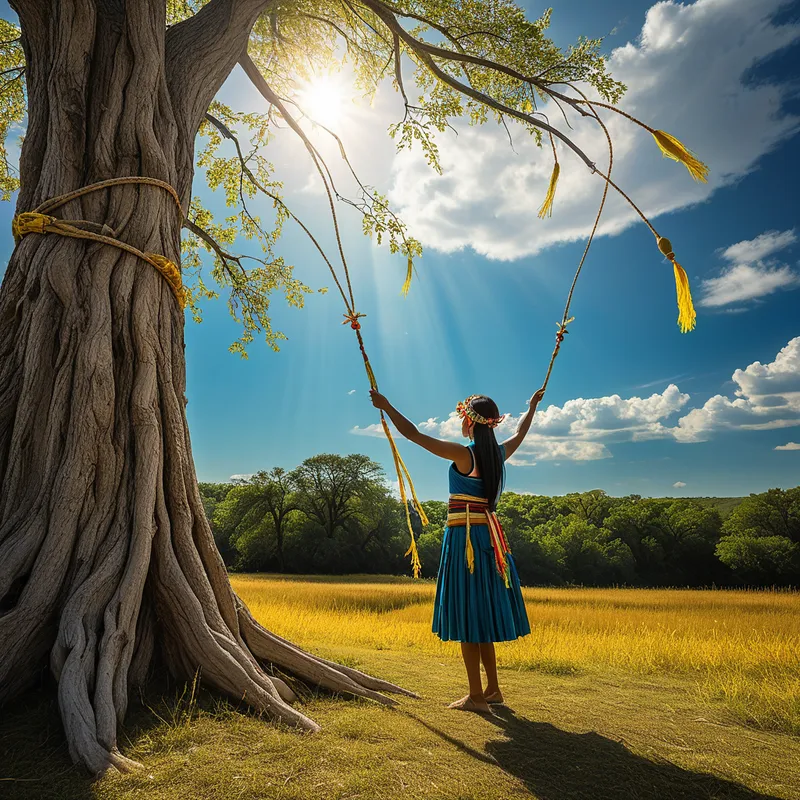
Then, the people gather. In the center of the great circle, they raise the can wakan, the sacred tree. It is not a mere post, but the very axis of the world, connecting [the star](/myths/the-star “Myth from Tarot culture.”/)-road above to the heart of Unci Maka below. To this tree, the dreamer is bound. Not with chains of captivity, but with thongs of raw hide, pierced through the skin of the chest or back. This is the anchoring.
[The drum](/myths/the-drum “Myth from West African / Diasporic culture.”/) begins. Its pulse is the heartbeat of the universe. The dreamer, their eyes fixed upon the blazing face of Wi, begins to dance. They do not dance for the sun, but with it. Each pull against the piercing, each step driven by [the drum](/myths/the-drum “Myth from West African / Diasporic culture.”/), is an offering of pain, a prayer made flesh. The world narrows to the searing light, the tearing flesh, the relentless throb of life pushing against the limit of endurance.
This is the gazing at the sun until the world dissolves. The physical eyes see only a blinding white fire, but the inner eye opens. In that moment of ultimate offering, when the individual will is surrendered completely, the vision comes. It may be a song never before heard, a map of where the buffalo walk, a cure for a sickness of the people, or a prophecy of a coming change. It is a dream for the world, gifted through the broken vessel of the one who dared to look into the heart of the sacred and not turn away.
The dance continues until the flesh gives way, until the piercing is torn free. In that final release, there is a great silence. The dreamer falls, and the people rush forward not to catch a broken body, but to receive a renewed world. The vision is now among them. The sacrifice has made the world whole again.
Cultural Origins & Context
Wi wanyang wacipi is not merely a story; it is the living, ceremonial heart of the annual cycle for the Lakota and many Plains Nations. The myth is the sacred template for the ceremony, and the ceremony is the enacted, communal embodiment of the myth. It was traditionally held in late spring or early summer, a time of renewal, aligning the people’s spiritual condition with the generative power of the season.
The knowledge of the ceremony and its profound meanings was held and protected by the wicasa wakan. It was passed down not as a simple narrative, but as a responsibility—a set of intricate rituals, songs, and prayers that had to be performed with exactitude to maintain the balance of the world. Its societal function was paramount: it was a communal act of world-renewal. Through the sacrifice of the individual dancer, the entire people participated in a cosmic realignment, ensuring health, abundance, and spiritual continuity. It was the ultimate expression of Mitakuye Oyasin, where one person’s ordeal healed the collective body.
Symbolic Architecture
At its core, Wi wanyang wacipi is a myth of mediated [vision](/symbols/vision “Symbol: Vision reflects perception, insight, and clarity — often signifying the ability to foresee or understand deeper truths.”/). The sun, Wi, represents the ultimate, unmediated [source](/symbols/source “Symbol: The origin point of something, often representing beginnings, nourishment, or the fundamental cause behind phenomena.”/) of [life](/symbols/life “Symbol: The symbol of ‘Life’ represents a journey of growth, interconnectedness, and existential meaning, encompassing both the joys and challenges that define human experience.”/), [truth](/symbols/truth “Symbol: Truth represents authenticity, honesty, and the quest for knowledge beyond mere appearances.”/), and spiritual power—a force so potent it can blind or destroy if approached directly. The [human](/symbols/human “Symbol: The symbol of a human represents individuality, complexity of emotions, and social relationships.”/) individual cannot bear this raw totality.
The sacrifice is not a payment to an angry god, but the necessary transformer that steps down the voltage of the divine so it can illuminate the human world.
The piercing and tethering to the can wakan symbolize this crucial mediation. The dancer is anchored to the World [Axis](/symbols/axis “Symbol: A central line or principle around which things revolve, representing stability, orientation, and the fundamental structure of reality or consciousness.”/), the connecting channel between [heaven](/symbols/heaven “Symbol: A symbolic journey toward ultimate fulfillment, spiritual transcendence, or connection with the divine, often representing life’s highest aspirations.”/) and [earth](/symbols/earth “Symbol: The symbol of Earth often represents grounding, stability, and the physical realm, embodying a connection to nature and the innate support it provides.”/). Their suffering is the [resistance](/symbols/resistance “Symbol: An object or tool representing opposition, struggle, or the act of pushing back against external forces or internal changes.”/) of [the ego](/myths/the-ego “Myth from Jungian culture.”/), the individual self, being stretched to its limit so that a transpersonal [reality](/symbols/reality “Symbol: Reality signifies the state of existence and perception, often reflecting one’s understanding of truth and life experiences.”/)—the vision for the people—can break through. The torn flesh represents the rending of the personal [veil](/symbols/veil “Symbol: A veil typically symbolizes concealment, protection, and transformation, representing both mystery and femininity across cultures.”/), creating an opening for the collective and the sacred to enter. The [tree](/symbols/tree “Symbol: In dreams, the tree often symbolizes growth, stability, and the interconnectedness of life.”/) is not just a [symbol](/symbols/symbol “Symbol: A symbol can represent an idea, concept, or belief, serving as a powerful tool for communication and understanding.”/) of life, but of supported life; it is the [structure](/symbols/structure “Symbol: Structure in dreams often symbolizes stability, organization, and the framework of one’s life, reflecting how one perceives their environment and personal life.”/) of tradition, [community](/symbols/community “Symbol: Community in dreams symbolizes connection, support, and the need for belonging.”/), and the natural world that makes the individual’s transformative ordeal possible and meaningful.
The Dreamer’s Resonance
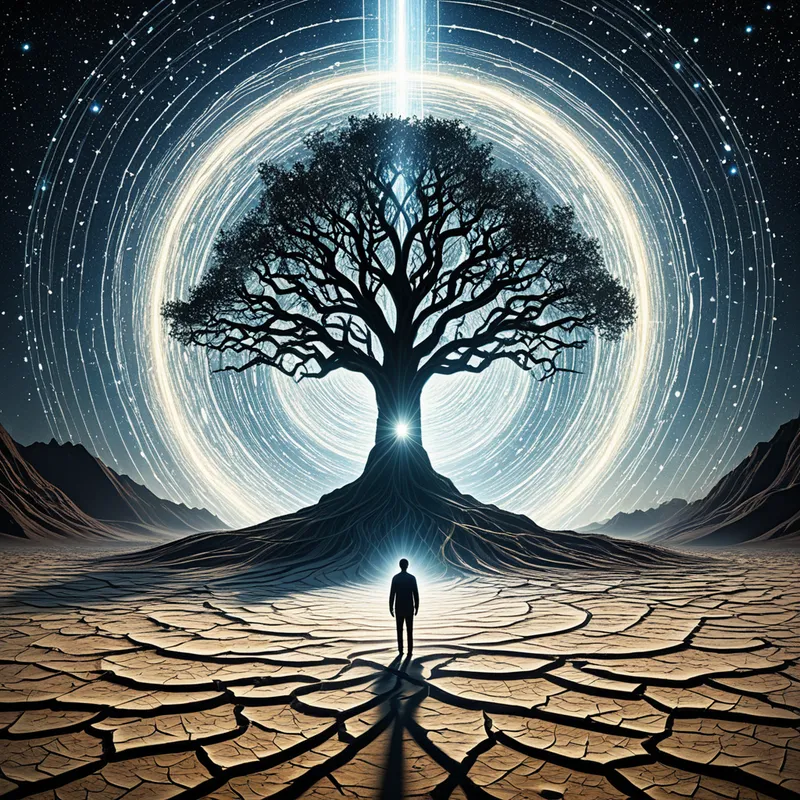
When this mythic pattern stirs in the modern dreamer, it often manifests as dreams of profound ordeal bound to a desperate need for clarity or purpose. One might dream of being tethered to a radiant but burning object—a tree of light, a pillar of fire, a brilliant machine—unable to look away. There is a somatic intensity: a feeling of being stretched, pierced, or parched. The dream ego is in a state of extreme exposure, often in a vast, empty landscape under a dominating sun or star.
Psychologically, this signals a critical juncture in the process of individuation. The dreamer is confronting a “sun-like” complex—a core, luminous truth about their life or [psyche](/myths/psyche “Myth from Greek culture.”/) that is currently too potent to integrate. It may be a calling, a trauma, or a destined path that feels annihilating to the current identity. The dream presents the ancient solution: you must be willing to be anchored (to your body, your therapy, your art, your community) and endure the searing process of holding that truth in full consciousness until your old self-conception “tears free,” allowing a new, guiding vision to emerge for your life.
Alchemical Translation
The alchemy of Wi wanyang wacipi models the transformation of leaden, suffering ego into the gold of transpersonal purpose. The modern individual’s “sun” is their own latent totality, [the Self](/myths/the-self “Myth from Jungian culture.”/), which can feel like an oppressive, burning demand for wholeness that shatters comfortable partial identities.
[The first stage](/myths/the-first-stage “Myth from Alchemical culture.”/) is the willingness to be pierced—to allow a truth, a grief, or a responsibility to hook into the very core of one’s being, to feel its painful pull. The second is the sacred anchoring: one must tether this ordeal to something greater than personal pain—to creative work, to service, to love, to a psychological framework like analysis. This is the can wakan, the supporting structure of meaning.
The dance itself is the conscious endurance—the daily, often agonizing work of integrating this truth, of “gazing at it” without spiritual bypass or denial, allowing it to dismantle the old self.
The final “tearing free” is not a violent destruction, but the inevitable release when the work is complete. The ego-identification with the suffering breaks, and what remains is not a scar, but a vision. The personal pain has been alchemized into a impersonal capacity: a clarity, a piece of art, a depth of compassion, or a direction that serves not just the individual, but their wider circle—their “people.” The myth teaches that the most profound renewal for the world begins with the courageous, anchored sacrifice of the one who is willing to dream for it.
Associated Symbols
Explore related symbols from the CaleaDream lexicon: