Mitakuye Oyasin Myth Meaning & Symbolism
A Lakota sacred phrase meaning 'all my relations,' expressing the fundamental kinship between all beings in the web of creation.
The Tale of Mitakuye Oyasin
Listen. The story does not begin with a word, but with a breath. It is the breath of Wakan Tanka moving over the face of Unci Maka, the Grandmother Earth, when she was dark and dreaming. In that breath was a sound, a vibration older than thunder, softer than a heartbeat. It was the first song, and its name was relation.
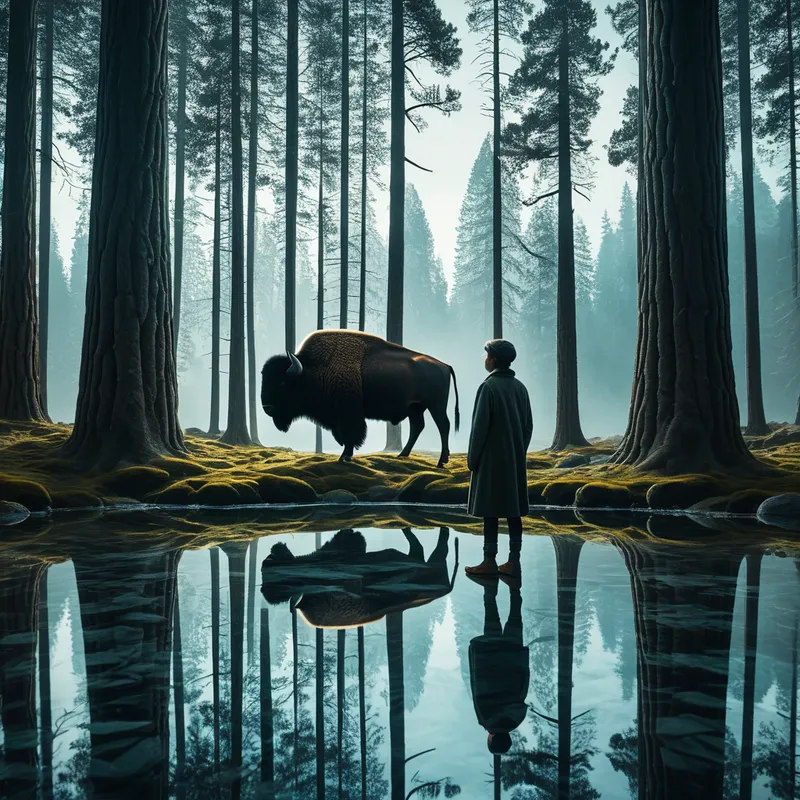
From this breath, the star nations were born, spinning out in a great, glittering sigh. From the warmth of Unci Maka’s body, the four-legged peoples emerged—the great, shaggy Tatanka with the storm in his brow, the swift deer with legs like whispering grass. The winged peoples followed, from the eagle who carries prayers to the sun, down to the humble grasshopper who knows the song of the soil. Then came the standing peoples, the trees with roots deep in memory and branches raised in perpetual ceremony. Finally, from the sacred red clay, the two-legged people were shaped, their hearts made to hear the first song that bound them all.
But for a time, the two-leggeds forgot the song. They saw the bison as only meat, the river as only water, the stone as only a tool. A great loneliness settled upon them, a hollow wind in the spirit. The world grew silent in response.
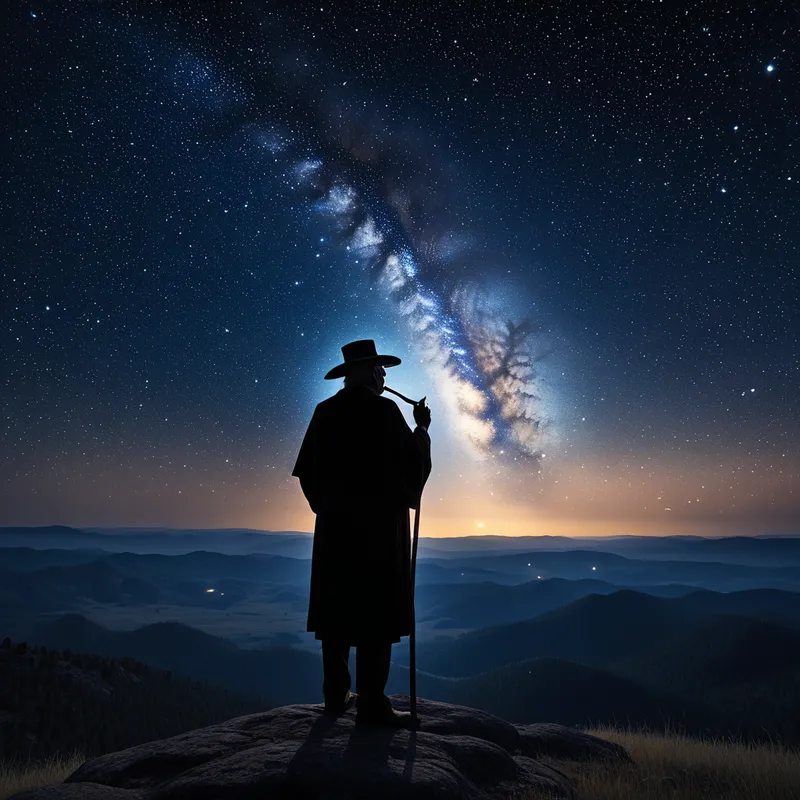
It was in this silence that a seeker, a man with ashes in his hair and a thirst that water could not quench, climbed Mato Paha, the Bear Butte. For four days and nights, he cried for a vision, his voice growing hoarse, his body trembling. On the fourth night, as the stars pressed close, he fell into a trance. He did not see a mighty spirit or a fearsome beast. Instead, he felt.
He felt the granite of the butte beneath him not as cold stone, but as the ancient bone of the Grandmother. He felt the wind not as an empty force, but as the shared breath of every living thing. He heard the call of an owl and knew it was the voice of the forest itself. He saw the stream glinting in the starlight and understood it was the vein of the land. In that moment, the hollow wind in him ceased. It was filled with a knowing so vast and tender it brought tears that washed the ashes from his face.
He descended at dawn. When his people saw him, they saw not a man, but a man who was also a mountain, a stream, a bison, an eagle. He opened his mouth, and the first song returned, not as a mighty chant, but as a simple, powerful phrase breathed into the center of the circle: Mitakuye Oyasin. All my relations. And with those words, the web of creation, which had grown dim, shimmered back into visibility, connecting every heart, every stone, every star. The loneliness was healed, not by finding one’s self, but by remembering one’s relations.
Cultural Origins & Context
Mitakuye Oyasin is not merely a myth in the sense of a distant narrative; it is the living, breathing theological and philosophical bedrock of Lakota cosmology. It is a sacred phrase spoken at the opening and closing of prayers, during the Chanunpa ceremony, and in moments of profound greeting or farewell. Its transmission was not confined to a single story but was woven into the fabric of daily life, ceremony, and oral teaching by elders, Wicasa Wakan, and storytellers.
Societally, its function was both cohesive and ethical. It established a constitutional law of existence: to be human is to be in a familial covenant with the entire cosmos. This created a framework for environmental ethics (how one hunts, uses resources), social ethics (how one treats the tribe and other tribes), and spiritual practice. One did not pray to the sky, but with it, as a relative. This worldview fostered a profound sense of belonging, responsibility, and humility, positioning humanity not as masters of creation, but as the "younger siblings" within a vast, intelligent family.
Symbolic Architecture
Psychologically, Mitakuye Oyasin represents the ultimate dissolution of the ego’s primary illusion: separateness. The seeker on the mountain embodies the individual psyche experiencing the crisis of alienation—the "hollow wind" of modernity’s disconnection. His vision is not an acquisition of power, but a surrendering to a pre-existing, fundamental truth.
The core symbol is the web or the circle without a center. It signifies a network of consciousness where identity is relational and fluid, defined not by isolation but by connection.
The Chanunpa itself is a physical manifestation of this symbol: the stone bowl (the Earth) and the wooden stem (all that grows upon it) are joined, and when smoked, the breath of the two-legged mingles with the breath of the plant world and rises to the sky world. It is an alchemical instrument of relation. Each being in the myth—stone, bison, stream, human—is an archetype of a different aspect of the Self, not a personal self, but the anima mundi, the world soul. To say "all my relations" is to acknowledge that one’s own psyche contains the bison’s strength, the river’s flow, and the stone’s endurance.
The Dreamer's Resonance
When this mythic pattern stirs in the modern dreamer, it often manifests as dreams of profound connection or its painful absence. One might dream of speaking the language of animals, of trees sharing secrets, or of one’s body transforming into landscape elements—roots growing from feet, hair becoming flowing water. These are somatic signals of the psyche yearning to remember its extended ecology.
Conversely, dreams of stark isolation—being in a soundproof bubble, shouting in a forest with no echo, or seeing loved ones as mannequins—highlight the "hollow wind," the psychological disconnection from the mythic web. The psyche is processing the trauma of fragmentation. The healing movement in such dreams is often subtle: a single leaf brushing the dreamer’s cheek, a shared glance with a creature, or the sudden, silent understanding of a rock’s age. These moments are the dream-ego’s first, tentative utterances of Mitakuye Oyasin, re-weaving the severed threads of relation in the unconscious.
Alchemical Translation
The individuation process modeled here is unique. It is not the hero’s journey of conquering and integrating a shadow to become a sovereign individual. It is the caregiver’s journey of realizing that the sovereign self is an illusion, and true wholeness is found in conscious, responsible participation in the communal body of life.
The seeker’s ascent is the inward focus of analysis, the withdrawal to confront the void. The vision on the mountain is the unio mystica, the mystical union, where the boundaries of the self dissolve into the greater pattern. But the critical alchemical stage is the return. He descends to speak the phrase to the circle.
The alchemical gold is not a perfected, isolated individual, but a relational consciousness. The transmutation is from "I think, therefore I am" to "I am related, therefore we are."
For the modern individual, this translates to a psychic shift from ego-centricity to eco-centricity. It means recognizing that healing one’s personal trauma is also healing a thread in the collective tapestry; that one’s depression or anxiety may not be solely personal, but a resonance with a wounded ecosystem or social field. The work is to perform the daily, mundane rituals of reconnection—with gratitude, with ethical consumption, with mindful presence—as a continuous ceremony. To utter "all my relations" is to perform a small, daily act of psychic alchemy, transmuting the lead of loneliness into the gold of belonging, not to a tribe of humans alone, but to the sacred, struggling, beautiful family of all that is.
Associated Symbols
Explore related symbols from the CaleaDream lexicon: