Wergild Myth Meaning & Symbolism
The sacred law of blood-price, where a life taken demands not vengeance, but a measured payment to restore cosmic and social balance.
The Tale of Wergild
Hear now, and listen well, by the smoke of the hearth-fire and the whisper of the Norns. This is not a tale of a god or a monster, but of the law that stands between men and the abyss.
In the days when the wind cut like a knife and the longhouse roof groaned under the snow’s weight, there lived two families. Their steadings were a day’s walk apart, divided by a forest where the grey wolves sang. From one hall came Bjorn, broad as an oak, with a laugh that shook the rafters. From the other came Kettil, quiet and sharp-eyed, a man whose thoughts ran deep as the fjord. Fate wove their threads at the Thing. A dispute over a prized bull, all rolling muscle and storm in its eyes. Words, hard as flint, were struck. A shove became a grapple. Steel, meant for the whetstone, flashed in the low sun.
And Bjorn fell.
The sound that followed was not a man’s cry, but the sound of the world cracking. The laughter of the Æsir stilled. The wind died. In that silence, only the drip of life-blood onto the frozen earth, and Kettil’s breath, ragged with the terrible knowing. He had not slain a stranger in battle. He had broken the Grith. He had made a corpse of his neighbor, and in doing so, summoned a darker corpse: the corpse of the feud. Bjorn’s kin, when they came, did not come with weapons first. They came with the cold fury of justice, their eyes holding the ghost of the man who was gone.
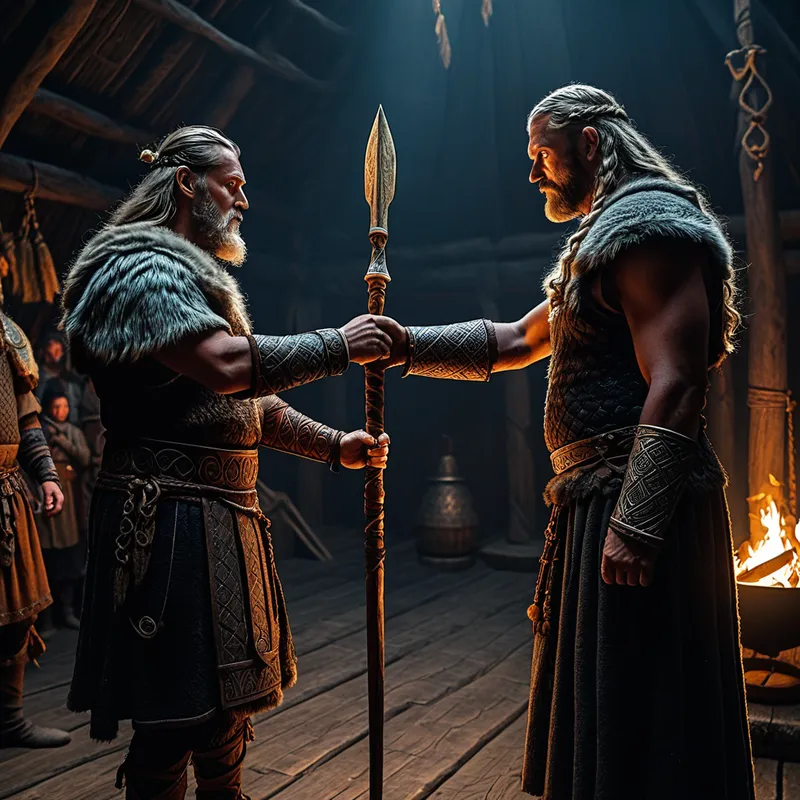
They stood before the law-rock at the next Thing. The accuser’s voice was a low thunder. The law-speaker, an old man with eyes like still water, recited the ancient reckonings. The value of a free man. The value of a farmer, a father, a pillar of his hall. Not in rage, but in grim poetry, he named the price: so many ounces of silver for the life lost, more for the skill of his hands, more for the laughter stolen from his hearth. It was a mountain of wealth. Enough to beggar Kettil’s line for generations.
Kettil stood, his face ash-grey. He nodded. Not in defeat, but in acceptance of the awful arithmetic of atonement. For a year and a day, he and his sons worked, traded, sold heirlooms, until the chest was full. Not with the heat of plunder, but with the cold weight of restitution. At the next gathering, under the watchful eyes of gods and men, the chest was laid open. The silver gleamed, dull and heavy. Bjorn’s eldest son, his own jaw set against a grief not yet cooled, stepped forward. He looked from the silver to Kettil, who met his gaze, bearing the full weight of the debt.
The young man reached not for a weapon, but for the chest. He took it. The law-speaker struck his staff upon the stone. “The debt is paid. The blood is washed clean. Let no man raise hand or word for this cause again, lest he bear the full outlawry.” And in that moment, the crack in the world sealed. Not with a victory, but with a balance. The feud was stillborn. The memory of Bjorn remained, but the ghost of his murder was laid to rest with silver and solemn law.
Cultural Origins & Context
Wergild, meaning “man-payment” or “blood-price,” was not merely a legal statute but the bedrock of a fragile social order. In the pre-Christian Germanic and Norse world, where central authority was weak and honor was the currency of survival, homicide created a catastrophic rupture. It obligated the victim’s kin to vengeance, initiating a potentially endless cycle of retaliatory violence that could consume entire families and communities.
The mythos of Wergild was woven into the Poetic Edda and the later Prose Edda, reflecting a worldview where even the gods were subject to compensatory law. Its telling was the work of the law-speaker (lögsögumaðr), a figure of immense prestige who memorized and recited the complex codes at the Thing. This was not dry legislation; it was a performative, sacred act. The recitation of a man’s worth—differentiated by social status, age, and skill—was an incantation that affirmed the inherent, measurable value of a human life within the cosmic order. It served a profound societal function: to transmute the raw, chaotic energy of grief and rage into a structured, communal process of resolution, thereby preserving the Grith, the essential peace of the community.
Symbolic Architecture
At its heart, Wergild is a myth of sacred economy. It replaces the economy of blood—an eye for an eye—with an economy of measured value. The life taken is not negated or avenged in kind; it is accounted for. The silver paid is not a replacement—a soul is beyond price—but a symbolic carrier of weight, effort, and social substance.
The scale does not ask who is right, but what is owed. It is the instrument that transforms a moral chaos into a mathematical problem, demanding not an equal death, but an equal weight.
Psychologically, the entity at the myth’s core is not a person, but the Principle of Balance. The killer, the bereaved family, and the community are all actors forced into relationship with this principle. The killer must internalize the full, concrete cost of his action, moving from denial to a burdensome, transformative acknowledgment. The bereaved must accept a material symbol for an immaterial loss, a painful but necessary sublimation of their justified wrath. The myth represents the ego’s terrifying confrontation with the consequences of its own shadow—its capacity for destruction—and the long, arduous labor required to reintegrate that shadow back into the social and psychic whole.

The Dreamer's Resonance
When this myth stirs in the modern unconscious, it rarely appears as a Viking Age tableau. Instead, one may dream of being presented with an incomprehensible bill or debt. Of desperately trying to gather strange coins that keep slipping through one’s fingers. Of standing before a stern, faceless council that demands “payment” for some unnamed, forgotten transgression. The somatic feeling is one of profound anxiety, guilt, and a burdensome weight on the chest.
This is the psyche’s signal of an unpaid Wergild. It indicates a place where the dreamer has, consciously or not, caused a rupture—in a relationship, to their own integrity, to an inner potential. They have “killed” something: a trust, an opportunity, a part of themselves. The unconscious law-speaker is now presenting the reckoning. The psychological process is one of confronting shadow material and the painful but necessary step of making amends, not to another necessarily, but to the self. It is the dream-ego being forced to account for its actions and undertake the labor of psychic restitution to restore inner balance.
Alchemical Translation
The alchemical journey modeled by Wergild is the transmutation of Poison (the feud, the unaddressed guilt) into Gold (restored order, integrated shadow). The initial state is Nigredo: the blackness of the murder, the despair of loss, the chaos of shattered bonds. The rising action—the pronouncement of the debt—is the Albedo: the application of the cold, clear light of consciousness and law upon the emotional morass. It separates the elements: here is the grief, there is the responsibility, this is the price.
The silver is the Mercurius, the elusive spirit that can bridge the irreconcilable. It is the substance of labor, of sacrifice, of tangible value that becomes the medium of exchange between the realm of crime and the realm of atonement.
The labor of gathering the payment is the Citrinitas, the yellowing or arduous inner work. It is the slow, often humiliating process of facing one’s capacity for harm, selling off old illusions (the heirlooms), and laboring to produce something of value from the ashes of one’s mistake. Finally, the acceptance of the payment by the aggrieved and the pronouncement of peace is the Rubedo, the reddening or culmination. It is not forgiveness in a sentimental sense, but a cosmic ratification. The debt is dissolved in the greater solvent of restored balance. The individual who completes this process does not return to innocence. They return to wholeness, carrying the solemn, hard-won knowledge of the weight of a life and the cost of its disturbance, now integrated as wisdom—the mark of the Sage.
Associated Symbols
Explore related symbols from the CaleaDream lexicon: