Wedding Cake Myth Meaning & Symbolism
A myth of a baker who, to save a village, bakes a cake that becomes the sacred, layered foundation of all future unions.
The Tale of Wedding Cake
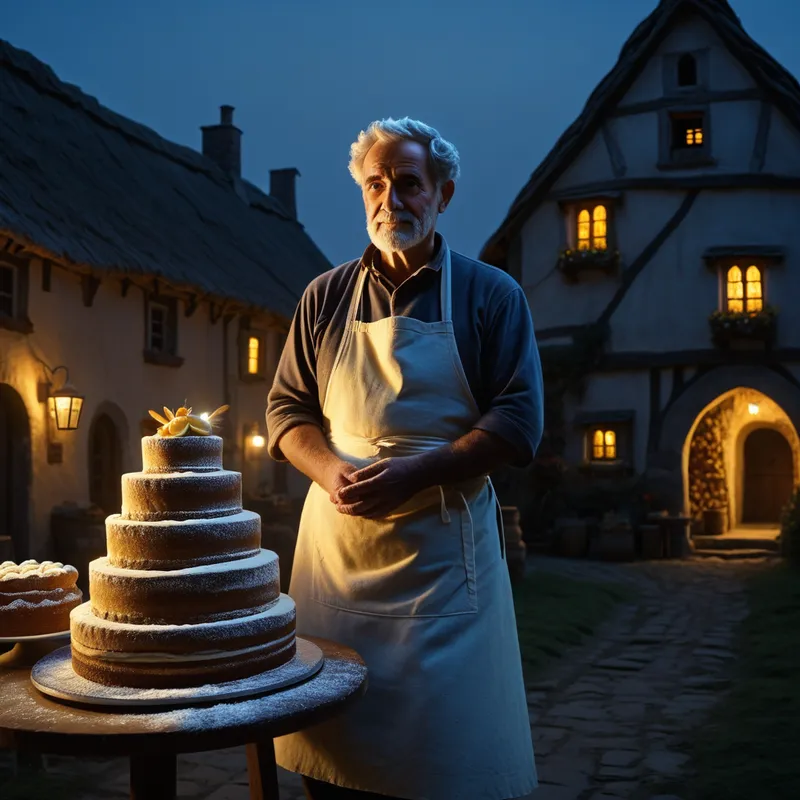
Listen, and I will tell you of the time when vows were not yet sweet, and unions were as brittle as winter branches. In a village nestled in a valley of whispering grain, there lived a baker named Althea. Her ovens were the soul of the community, and her hands could coax spirit from flour and [water](/myths/water “Myth from Chinese culture.”/). Yet, a shadow had fallen. A great chill of silence had settled between the people. Lovers quarreled, families fractured, and the communal fire burned low. The village was starving not for bread, but for connection.
The elders went to Althea, their faces etched with sorrow. “Our bonds are fraying,” they said. “We feel the approach of a permanent winter of the heart. You who give us daily sustenance, can you bake us a remedy?”
Althea stood before her cold hearth, feeling the weight of the request. She knew no ordinary loaf would suffice. That night, she dreamt of a structure—not of stone, but of sustenance. Tier upon tier, a tower of offering. She saw it crowned not with gold, but with the fleeting joy of ripe fruit. She awoke with a recipe written not on parchment, but on her spirit.
For days and nights, she worked. The first tier she made from the Elder Wheat, ground fine, kneaded with water from the sacred well. This was the foundation, the body of the community. The second tier she sweetened with the last of the season’s honey, a symbol of life’s fleeting joy, and bound with eggs from her own cherished hens, representing potential and nurture. The third and smallest tier she made from the purest, most costly white flour and sweet cream, a food for the spirit alone.
For the binding frost, she had no sugar. So, she wept into the bowl, and her tears, salted with compassion and sweetened with hope, crystallized into a gleaming, perfect icing. Finally, she placed upon the top a single, perfect berry from the first love-garden ever planted in the valley.
As she placed the final piece, a sigh seemed to move through the very air. The villagers gathered, drawn by a scent that was more than scent—it was a memory of belonging. They did not devour it. They beheld it. A young couple, on the verge of parting, stepped forward. They broke a piece from the bottom tier together, sharing its solid, earthy substance. A warmth returned to their eyes. They shared a piece from the sweet middle, and laughter bubbled between them. Finally, they shared a crumb from the top, the pure white layer, and in that moment, a silent vow passed between them, witnessed by all.
The great cake was not consumed that day, but slowly, ritually, shared over time. With each sharing, a bond was repaired, a new union was blessed. The cake itself never seemed to diminish, as if fed by the connections it fostered. Althea had baked not a dessert, but a vessel—a template for union. And so it was decreed that henceforth, no two souls would join their lives without first partaking of this layered promise, this sweet architecture of the heart, born from necessity, crafted from sacrifice, and sustained by shared participation.
Cultural Origins & Context
This myth finds its roots not in the courts of kings, but in the communal hearths of agrarian and early village societies across Europe. It is a charter myth, a narrative created to give profound meaning to a emerging social ritual. As weddings evolved from private economic agreements into public celebrations of community cohesion, the need for a central, symbolic act grew.
The story of Althea was likely passed down by matriarchs, midwives, and the keepers of [the hearth](/myths/the-hearth “Myth from Norse culture.”/)—the women who were the practical and spiritual chemists of the household. It was told during wedding preparations, not as a formal lecture, but as a whispered story while mixing batter or kneading dough. Its function was multifaceted: it sanctified the baker’s art, it encoded the ideals of a successful union (foundation, joy, purity), and most importantly, it transformed a display of wealth (a large, elaborate cake) into a sacred relic of communal sacrifice and blessing. The cake became a participatory icon, and the myth provided the liturgy for its consumption.
Symbolic Architecture
The myth’s power lies in its layered [symbolism](/symbols/symbolism “Symbol: The use of symbols to represent ideas or qualities, often conveying deeper meanings beyond literal interpretation. In dreams, it’s the language of the unconscious.”/), a literal and psychic [architecture](/symbols/architecture “Symbol: Architecture in dreams often signifies structure, stability, and the framing of personal identity or life’s journey.”/). Each tier is a [stratum](/symbols/stratum “Symbol: A distinct layer or level, often in rock or soil, representing depth, history, and hidden structures.”/) of [consciousness](/symbols/consciousness “Symbol: Consciousness represents the state of awareness and perception, encompassing thoughts, feelings, and experiences.”/) and [connection](/symbols/connection “Symbol: Connection symbolizes relationships, communication, and bonds among individuals.”/).
The bottom tier is the shared earth, the collective unconscious of family and tribe. It is what you are born into, the weight of history and the ground of being.
The middle, sweetened tier represents the personal Eros, the conscious enjoyment and affective bonds that make [life](/symbols/life “Symbol: The symbol of ‘Life’ represents a journey of growth, interconnectedness, and existential meaning, encompassing both the joys and challenges that define human experience.”/) pleasurable. The [honey](/symbols/honey “Symbol: A sweet, viscous substance produced by bees, symbolizing natural sweetness, reward, and nourishment.”/) is the attractant, the [sweetness](/symbols/sweetness “Symbol: Represents pleasure, reward, and positive experiences, often linked to emotional satisfaction and life’s enjoyable moments.”/) of romance and companionship. The eggs symbolize the fertile potential of the union—not merely for children, but for shared projects, dreams, and growth.
The top tier is the transcendent function, the symbolic Self. It is the rarely accessed, sacred space of the relationship that exists beyond utility and pleasure, pointing toward a spiritual unity.
Althea’s tears-as-icing are the crucial alchemical agent. They represent the necessary sacrifice—the [vulnerability](/symbols/vulnerability “Symbol: A state of emotional or physical exposure, often involving risk of harm, that reveals authentic self beneath protective layers.”/), the emotional labor, the bittersweet acknowledgment of individual sorrow that must be offered up to create something that binds and protects. The cake is not a fantasy of effortless [bliss](/symbols/bliss “Symbol: A state of profound happiness and spiritual contentment, often representing fulfillment of desires or alignment with one’s true self.”/); it is a [confession](/symbols/confession “Symbol: The act of revealing hidden truths, secrets, or wrongdoings, often to relieve guilt, seek forgiveness, or achieve psychological liberation.”/) that sweetness is built upon, and sealed with, the [salt](/symbols/salt “Symbol: Salt represents purification, preservation, and the essence of life. It is often tied to the balance of emotions and spiritual cleansing.”/) of [human](/symbols/human “Symbol: The symbol of a human represents individuality, complexity of emotions, and social relationships.”/) tears.
The Dreamer’s Resonance
When the symbol of the Wedding Cake arises in modern dreams, it rarely appears as a cheerful confection. The dreamer may encounter a cake that is grotesquely large and inedible, one that is crumbling, or one that they are forced to bake under immense pressure. These are somatic signals from the [psyche](/myths/psyche “Myth from Greek culture.”/) about the state of the dreamer’s “union” functions.
A crumbling cake often manifests when one feels the foundational agreements of a key relationship (with a partner, a family, or even with oneself) are eroding. The pressure to “bake” a perfect cake mirrors the modern anxiety around crafting an ideal life or partnership for social display, devoid of authentic emotional substance. Dreaming of eating the cake alone points to a deep hunger for connection that is being met with narcissistic self-consumption. The cake in dreams is the [mandala](/myths/mandala “Myth from Buddhist culture.”/) of relationship, and its condition is a direct report on the health of that psychic structure.
Alchemical Translation
Psychologically, the myth models the individuation process as it pertains to relatedness. Individuation is not a solitary journey; it is forged in [the crucible](/myths/the-crucible “Myth from Alchemical culture.”/) of the other. The “Wedding Cake” is the symbolic product of this forging.
The first alchemical stage ([nigredo](/myths/nigredo “Myth from Alchemical culture.”/)) is the village’s despair—the recognition of alienation and the cold hearth. This is the necessary dark night. Althea’s decision to act is the coniunctio, [the sacred marriage](/myths/the-sacred-marriage “Myth from Various culture.”/) of her skill (conscious mind) with the visionary dream (unconscious inspiration). The baking process is the albedo, the whitening: the meticulous, conscious labor of integrating different parts of [the self](/myths/the-self “Myth from Jungian culture.”/) (the foundational, the emotional, the spiritual) into a structured whole.
The sharing ritual is the rubedo, the reddening or culmination. The Self is not realized by hoarding it, but by offering it in communion. Wholeness is validated in relationship.
For the modern individual, the myth instructs that a mature psyche is a layered, structured entity. We must build our foundation on the solid grain of our inherited and earned truths. We must allow space for the sweet, joyful, and fertile pursuits. And we must aspire to that small, refined top layer—the transcendent values that give meaning to the whole structure. Crucially, none of it holds together without the binding agent of conscious, sacrificial feeling—our “tears.” To create a life of depth and connection, we must be willing to bake our sorrows into its very frosting, transforming them from agents of isolation into the glue of a sacred, shared edifice.
Associated Symbols
Explore related symbols from the CaleaDream lexicon: